 Care
Care
The Rabies Vaccine
Rabies is a fatal viral disease affecting both humans and other animals, including dogs. Although it's considered eradicated in numerous countries, it still causes thousands of deaths a year in some regions.
The most effective way to stop this disease, which, remember, has no cure, is by giving a vaccine. This can be given to dogs from three months of age onward and is mandatory in numerous territories.
What Is Rabies?
Rabies is a fatal disease caused by a virus of the rhabdovirus family. It's a zoonosis, meaning animals can transmit it to people. Transmission mainly occurs through the bite of an infected animal, since the virus is present in saliva. It affects the central nervous system, reaching the brain and inflaming it.
There are two forms of rabies, furious and paralytic. They cause symptoms such as aggression, muscle spasm, coughing, nausea, excessive salivation, behavioral changes, incoordination, and, finally, death. The incubation period is 2-8 weeks, although cases have been described ranging from a week to a year. Death occurs within 1-2 days.
It's a mandatory reportable disease. To control its spread, vaccination programs have been developed, especially for dogs, since they're the ones that most often transmit it to people. Cats and ferrets are also vaccinated, since the disease affects almost every warm-blooded animal. Vaccination has helped eradicate rabies from numerous countries.
The Rabies Vaccine
Vaccines are preparations containing the pathogen against which immunity is intended. But it isn't included as-is — instead, it's modified or inactivated, so it can never trigger the disease. In the case of rabies, the vaccine contains the inactivated virus.
This way, the immune system recognizes it and produces the antibodies needed to fight it. If the dog were to encounter the virus in its natural environment, its body would already have the defenses ready to attack it immediately. Otherwise, it would have no protection at all. The virus is fatal. Immunity is established 2-4 weeks after the vaccine is given.
But this isn't lifelong. That's why the dose needs to be repeated every 1-3 years. The first rabies vaccine was developed by Louis Pasteur in 1885, following a scientific method considered unacceptable today, since he applied the inactivated virus directly to a child bitten by a rabid dog. Nowadays, the virus is inactivated and purified in labs from cell cultures.

When to Give the Rabies Vaccine to a Dog?
The first dose of the rabies vaccine can be given at three months of age. But we can find ourselves facing two scenarios. In some territories, the rabies vaccine isn't mandatory. So, owners can decide not to give it. This option is supported by the view that the disease has been eradicated in that place.
On the other hand, there are places where the vaccine is mandatory, such as Spain. This means that if we don't give it, we're committing an administrative offense and will face a fine. Vets recommend vaccinating every dog. Occasionally, in some territories where the virus is supposedly no longer circulating, cases have still occurred.
The risk of infection persists in a world where people and animals can travel thousands of kilometers within hours. The law usually sets annual revaccination, although this could be done every three years, since there are vaccines that guarantee protection for that period. It's best to check the current legislation in your area to avoid committing an offense.
Why Vaccinating Against Canine Rabies Is Important
If a high percentage of the dog population is vaccinated against rabies, we manage to stop the virus from spreading, since it won't be able to be transmitted from a vaccinated dog to people or other animals. Dogs are considered the animal that most often transmits rabies to humans. Giving the vaccine protects both dogs and the human population.
Side Effects and Contraindications of the Rabies Vaccine
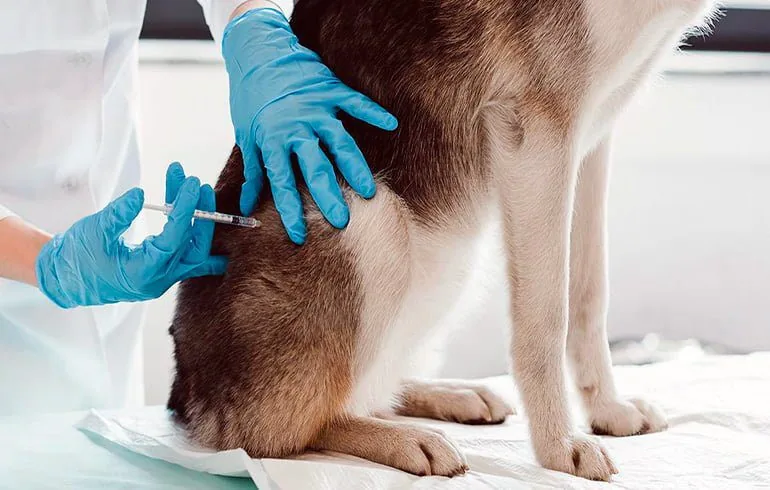
As with any other vaccine, it can't be given to a sick animal or one that is or has been following treatment with immunosuppressive drugs. Depending on the vaccine chosen, it might not be given to pregnant or nursing females. Vaccinating is a clinical act that only a vet can perform.
It's this professional who will examine the dog to determine whether it can be vaccinated or needs to wait. On the other hand, the rabies vaccine is safe and doesn't usually cause any adverse effect. In some cases, fever or general malaise can appear, which will resolve spontaneously within about 24 hours.
There can also be swelling at the injection site, which usually goes away on its own. In very rare cases, the vaccine will cause a severe allergic reaction requiring immediate veterinary attention. This is an emergency.
Bibliography Carlson and Giffin. 2002. Manual práctico de veterinaria canina. Madrid. Editorial el Drac.
IMPORTANT: This article is for informational purposes only and does not constitute veterinary, nutritional or behavioural advice. Every dog is different, and only your trusted vet can advise you on its specific needs.