 Care
Care
Torn Cruciate Ligament in Dogs - Surgery or Plasma?
If you suspect your dog may have a torn ligament, or it's already been confirmed and you're looking for information on the veterinary treatments available, you're in luck — we'll show you every option available.
Remember that when it comes to a torn cruciate ligament, surgery should always be the last resort, since it's the most invasive option and requires a longer recovery. It also doesn't always solve the problem.
What is a torn cruciate ligament?
Ligaments help joints function properly, keeping them stable. When a ligament tears or degenerates, our dog will experience pain and need treatment.
The cruciate ligament is the one that most often degenerates, tears, or ruptures, since it bears a heavy workload when the dog walks, runs, or jumps. These are found in the knees, which can develop arthritis.
The tear can be in the cranial or caudal ligament, with a cranial cruciate tear being the more common one. When it degenerates, tears, ruptures, or becomes inflamed, the knee stops working properly, causing a lot of pain.
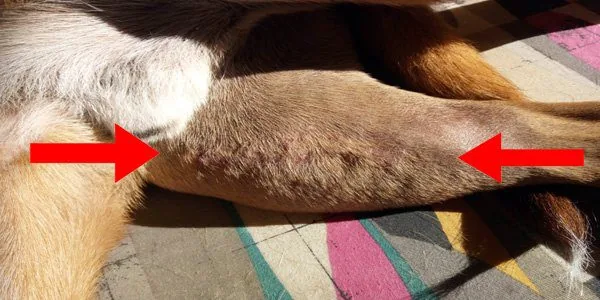 Size of the scar from cruciate ligament surgery (TTA)
How can the cruciate ligament tear?
Dogs over twenty kilos — that is, medium and large breeds — are the ones most likely to tear one of these ligaments, regardless of age.
Young dogs generally get a tear, hyperextension, or rupture from a bad step — perhaps landing wrong while running and playing, or catching a paw in a hole, causing trauma.
In other words, young dogs generally develop this problem from an accident. However, dogs over six years old usually get a torn cruciate ligament from wear and tear. It's more prevalent in females and neutered males, as well as in breeds such as Mastiffs, Labradors, and athletic breeds like Rottweilers, Boxers, among others.
Symptoms of a torn cruciate ligament
When it's a partial tear or early wear, it's hard to detect without medical tests. However, once the damage has already occurred, symptoms are very noticeable.
Our dog will start limping, occasionally or constantly. They'll avoid putting weight on the leg, holding it up (dangling), or only touching down with their toes, taking very short steps. Sometimes we'll also see swelling in the knee, with a lot of pain when touched or when trying to extend it.
- Limping, especially after resting, when muscles and tendons are "cold."
- Pain when putting weight on the leg.
- Possible swelling of the knee and surrounding area.
If we notice any of these symptoms, we should see a vet so they can run the necessary tests and give us a diagnosis.
Any details you can share with the vet are useful for guiding the diagnosis — pay special attention to when the limping started, whether it was after a sudden jump, whether it improves with rest, among other details that could be relevant.
A confirmed diagnosis is made through imaging (X-ray), along with the routine diagnostic tests the specialist will perform.
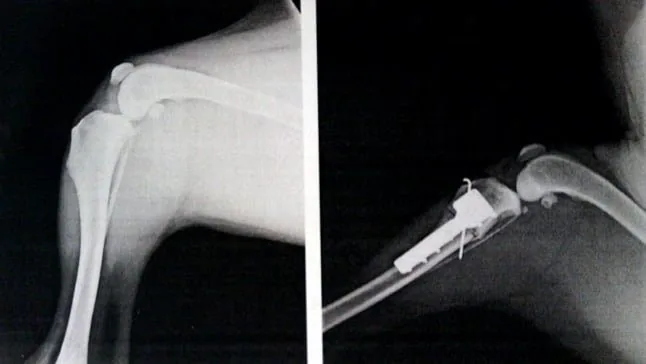
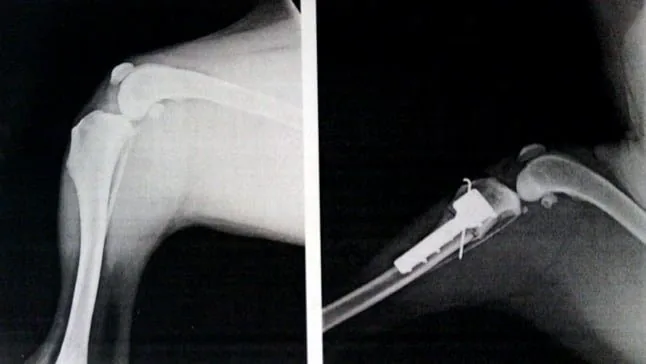 X-ray before and after surgery
Veterinary treatments
There are currently two types of treatment for a torn cruciate ligament: one is invasive, through surgery, and the other is regenerative, through injections.
It will always be the vet who, after reviewing the test results, recommends how to proceed. Every dog is different, so each one needs a fully personalized treatment.
Plasma injections
If the dog is very old, or has some other risk factor that rules out surgery, don't worry — vets have an alternative.
For these cases, the least invasive therapy is plasma injections, which will significantly help the ligament regenerate (growth factors). The plasma is drawn from the dog's own blood, to avoid any kind of rejection.
This treatment isn't always possible — it depends on the ligament's condition, so our vet may not recommend it in some cases. Injections need to be repeated every few years. Anti-inflammatories and chondroprotectants are also usually added to reduce pain and help rehabilitate the joint.
TTA surgery
Although it's not open-heart surgery, it's still a significant procedure. It involves advancing the tibial tuberosity — that is, removing a small piece of bone and using a plate so the bone heals correctly.
This relieves tension on the ligament, keeping it from being strained, and as a result reducing inflammation and pain in the dog. This technique offers fairly high success rates.
Sometimes surgery doesn't solve the problem, resulting in permanent limping. Complications such as a seroma or infection/rejection are also possible.
What's post-op care like?
With a few exceptions, recovery is usually done at home, since it takes a few months. During this time, our dog shouldn't run, jump, go up or down stairs, or make sudden/intense movements.
Depending on the type of tear, the specialist may recommend physical therapy — that is, certain passive movements that gradually get the joint moving, while also keeping in mind that it's important not to lose muscle mass in the thigh and lower leg (muscle atrophy).
The instructions from the vet who performed the surgery should always be followed, until the dog is medically cleared. In the meantime, they should rest and have a calm life, walking just enough to go to the bathroom, always on a leash during walks, kept short to prevent running.
It will be the vet who tells us when we can start taking longer walks, based on how the bone healing and overall recovery are progressing. Just be patient and help your dog recover.
Long-term prognosis
The prognosis varies and depends on how degenerated the joint is, your pet's age, and the type of treatment used (whether a surgical or conservative approach is chosen).
It's quite common for pets who've had a torn cruciate ligament in one knee to eventually develop the same problem in the other; so from this point on, care around jumping and sudden joint movements should be increased.
IMPORTANT: This article is for informational purposes only and does not constitute veterinary, nutritional or behavioural advice. Every dog is different, and only your trusted vet can advise you on its specific needs.