 Care
Care
Treatment for Canine Cystitis
Dogs can suffer from urinary tract problems. Urinating small amounts repeatedly is usually the first symptom, which, if left untreated, can lead to serious health problems.
If you want to learn more about this very common problem in dogs, we'll explain its symptoms and how to treat it.
What Is Cystitis?
Cystitis is a bacterial infection of the bladder. In both male and female dogs, it's usually preceded by an infection in the urethra that manages to travel up into the bladder.
There are also other factors that make a dog more prone to this infection, such as old age, diabetes, prolonged corticosteroid treatments, or, in males, prostatitis, meaning inflammation of the prostate.
Symptoms of Canine Cystitis
The main sign that will make us suspect our dog has cystitis is an increase in how often it needs to urinate. In addition, the dog feels discomfort each time it does so and passes very small amounts, sometimes just drops.
The appearance of the urine can also become cloudy, smell different than usual, or even show blood, which is known as hematuria. Some female dogs with cystitis will also have vaginal discharge. It's normal for animals to lick their genitals in an attempt to relieve the discomfort.

How Is Cystitis Diagnosed in a Dog?
If our dog urinates frequently and seems uncomfortable, cystitis is a likely diagnosis, but to confirm it, we need to collect a urine sample. For this we can use a plastic cup with a lid, sold at pharmacies, the same kind used in human medicine.
It's important to collect the sample with one of these containers, since this ensures it's completely clean. If we use any random jar or cup we happen to have at home, we run the risk of it already containing bacteria. This would contaminate the urine, and we wouldn't be able to tell whether the infection is coming from the dog or the environment.
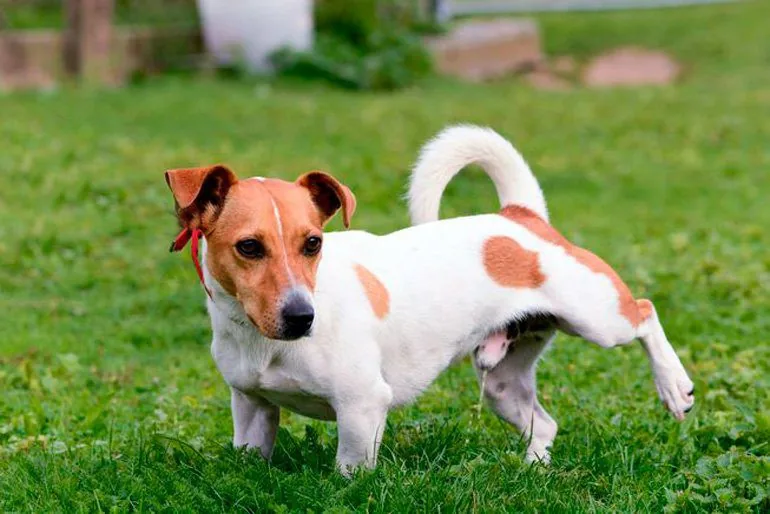
Collection is fairly easy in a male dog, since when he lifts his leg, there's enough space to slip the cup in and catch the stream of urine. In females, since they squat to urinate, it's harder to collect a sample.
In these cases, we can try to get them to urinate onto a nearly flat container, similar to a cat litter tray. We'd then pour it into the cup or collect it with a syringe. If we can't get the sample, the vet can take it directly from the bladder. This procedure is called cystocentesis.
If we collect the urine at home, we should get it to the clinic quickly for examination. If it's going to take a few hours, we need to keep it refrigerated in the fridge. If too much time passes or it's not stored properly, the sample won't be usable.

The Urine Strip and Culture
The vet can run a urine strip test. This test tells us whether bacteria or blood are present. A positive result along with matching symptoms points toward a diagnosis of cystitis, though it isn't the most specific test.
As we've already explained, if the sample gets contaminated, the result can be misleading. For an unambiguous diagnosis, the sample would need to be sent to a lab for a culture. This would tell us exactly which bacteria are behind the infection, if that's the case.

Treatment for Cystitis in Dogs
It's very important that, if we notice our dog urinating unusually often and seeming uncomfortable, we see a vet without wasting time. If a bladder infection isn't treated, the bacteria can travel up to the kidneys, affecting them as well. These infections can end up causing acute or chronic kidney failure.
To cure cystitis, the vet will prescribe an antibiotic. If we've had a urine culture done, we'll know exactly which one will be most effective against the bacteria causing our dog's infection.
Treatments usually last several weeks, and it's important to follow through to the end, even once the dog has stopped showing symptoms of infection. Once treatment is complete, we can test the urine again to make sure the infection has fully cleared.
We should know that infections can be recurrent. If our dog has finished treatment and shortly after shows cystitis symptoms again, we're going to need a more thorough veterinary work-up. For example, bladder stones can explain recurring cystitis.
If we haven't had a culture done up to this point, we'll need to request one with a second infection. The antibiotics the vet prescribes will be based on those results. Some dogs may develop chronic cystitis that requires long-term medication.
Cystitis and Urinary Stones
Stones, colloquially called "piedras" (rocks), are mineral formations that build up in the urinary tract due to various factors. The smallest ones can be passed like grit in the urine. Larger stones, on the other hand, won't be able to pass and can even cause complete or partial obstructions.
When a dog has cystitis, the clusters formed by bacteria provide a surface for minerals to precipitate onto, usually struvite. These stones end up causing discomfort while urinating and blood in the urine.
Getting rid of them involves treating the cystitis, if present, and giving the dog a specific diet to help dissolve these stones, which requires changing the pH of the urine — key to how they form. If the stones are causing an obstruction or can't be dissolved, surgery will be needed.
IMPORTANT: This article is for informational purposes only and does not constitute veterinary, nutritional or behavioural advice. Every dog is different, and only your trusted vet can advise you on its specific needs.