 Training
What Does It Mean When a Dog's Tail Is Raised Up?
A dog's tail is no mere aesthetic decoration. It plays a fundamental role in this species' visual communication. That's why amputating this crucial part of canine anatomy is being banned in more and more places.
By watching a dog's tail movements, we can gather a huge amount of information about their mood. Below we'll explain what our dog is trying to tell us when they keep their tail raised up. Shall we get started?
What a Dog's Tail Language Tells You
Dogs communicate through visual, auditory, scent-based and even tactile signals. They can't talk like us, but they make themselves understood if we pay a little attention to how they move or what kind of bark they give. Even so, we always need to bear the context in mind, since interpretation depends on it.
For example, it's normal for us to read a growling dog as a sign of threat. But if they growl while stretching their front legs and head onto the ground, raising their hindquarters, wagging their tail, opening their mouth and sticking out their tongue, the growl is just part of playful behaviour and has nothing to do with aggression.
Logically, using the tail as a communicative element also depends on their characteristics. So, there are breeds who anatomically always carry their tail up and curled over their back. It's physically impossible for them to lower it. Either way, in most dogs the tail takes up the following positions:
- Parallel with the body: aligned with the back. It can move horizontally left or right, or stay entirely still.
- Below the body line: the tail hangs and can sit over the back legs, between them, or even extend towards the genitals and abdomen. Wider, looser movements are typical of submissive dogs.
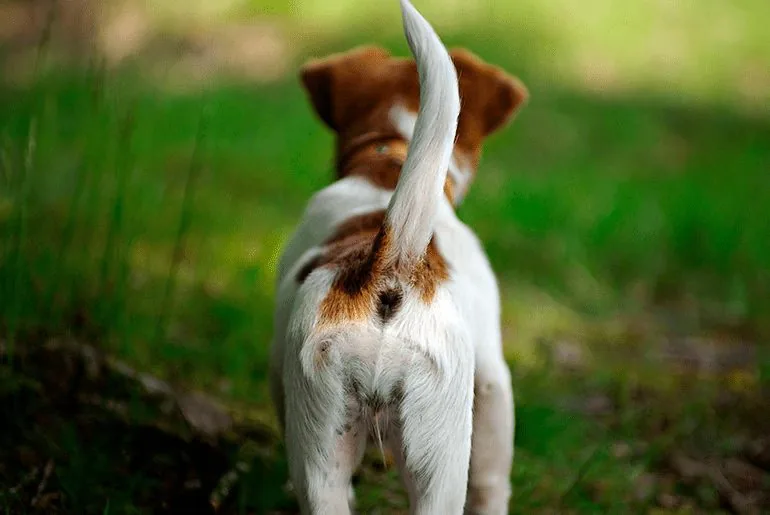
- Above the body line: the tail rises above the back and can be seen moving, sometimes in a circle, or entirely still, like an aerial. This posture is typical of confident dogs, and the movements will be rigid and short.

Dog Tail Movements
Besides the tail's position, to interpret what the dog is telling us we also need to watch its movement. Remember we also need to bear our dog's tail anatomy in mind, since it will affect their mobility. So, there are short tails, long ones, with or without fur, set high, medium or low.
There are also thin or thick ones, curled into a ring falling over the back and so on. Watch your dog's tail position when they're relaxed. That will be the "baseline position" for interpreting any movements that happen. Broadly speaking, stillness can point to either insecurity or danger.
For example, a terrified dog will have their tail hidden under their body and still. At the same time, an alert dog will normally have their tail entirely motionless. On another note, movement usually points to a good mood, such as when the dog wants to play, though it can also express hesitation about whether to approach or not.
Is a Dog Wagging Their Tail Happy?
It's a widely held belief that when our dog greets us with a happy tail wag, they're expressing how pleased they are to see us. Even so, sorry to disappoint you, this isn't true.
This movement, where the tail can be held more or less high, happens when the dog is torn between approaching or not. They want to move forward to greet us while also pulling back, since our size and how much they depend on us creates a certain fear in them. That's why one impulse ends up cancelling out the other, and the result is the tail movement.
The dog in this situation is experiencing an emotional conflict, and we need to bear the rest of their expression and the context in mind to know what they're trying to tell us. The higher the tail, the more tension. That's why, if an unfamiliar dog is wagging their tail, don't approach.
What a Raised-Up Dog Tail Means
Basically, when a dog carries their tail raised up, they're telling us one of two moods: alert or confidence. For example, it's not unusual for a confident dog to approach other dogs with their tail stretched up and moving side to side, like an aerial. There's an important detail here: dogs have anal glands.
These are responsible for producing a liquid with each individual dog's characteristic scent. Raising the tail displays that scent. By moving it, the glands get compressed. If a dog doesn't mind others sniffing them, it's because they feel confident in themselves. A dog with their tail low or tucked away shows the opposite: fear and insecurity. They're hiding the glands.
At the same time, a tail raised up can point to an alert state. In that case the whole body is rigid, tense, and the tail stays motionless. This is a common posture in some dogs when they detect unfamiliar smells or sounds. This position could be the start of an attack if, on top of it, the dog bares their teeth, their fur stands on end, or they growl.
Bibliography Morris, Desmond. 1988. Observe a su perro. Barcelona. Plaza & Janés.
IMPORTANT: This article is for informational purposes only and does not constitute veterinary, nutritional or behavioural advice. Every dog is different, and only your trusted vet can advise you on its specific needs.