 Care
Care
What Is a Pedigree Certificate in Dogs?
You've surely heard a friend talk about their dog's pedigree and how important it is, or your own dog might even have a pedigree certificate and you're not entirely sure what it's actually for or what it means.
Not every dog has a pedigree, and more importantly, not every dog can get one even if requested, even if they're purebred. A pedigree is a document issued by the Real Sociedad Canina Española (RSCE, the Royal Spanish Canine Society) that certifies a dog's genetic purity within its breed, provided it meets the required standards.
What Is a Pedigree?
A pedigree is an official certificate issued by the RSCE (Royal Spanish Canine Society) that certifies the purity of a dog's breed. It's like a kind of ID card showing the dog in question is purebred, descended from purebred dogs that also hold a pedigree.
For a dog to obtain a pedigree, it needs to meet a fairly strict set of requirements, and it must be the breeder/vet who requests the certificate from the RSCE:
- The individual's parents must hold a pedigree.
- They must belong to one of the breeds recognized by the RSCE.
- They must be healthy individuals, free of conditions that could be genetically transmitted.
- They must meet the color, height, and physical standards required for each breed.
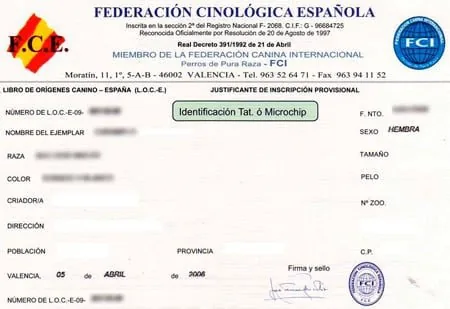
Unfortunately, many breeders, with the help of certain trusted vets, manipulate litters to obtain pedigree certificates for puppies that don't actually meet the requirements, in order to sell them at a higher price and profit. This is illegal and could cost them their license and a hefty fine, but sadly, it happens more often than any of us would like.
How Do You Get a Pedigree Certificate?
Normally, it's the breeder themselves who provides the pedigree certificate when you buy a purebred dog. That said, we can also request the pedigree certificate from the Royal Spanish Canine Society ourselves, providing the necessary documentation:
- Copy of the parents' pedigree
- Veterinary certificate confirming the litter comes from those pedigreed parents
- Veterinary health record
- Fees
If we buy a dog — which we obviously don't recommend, since we can adopt purebred or mixed dogs completely free from any of the thousands of shelters across Spain — we should also request the pedigree so we don't have to handle the paperwork ourselves.
Are Pedigree Dogs Better Than Non-Pedigree Dogs?
A pedigree certificate only certifies that dogs belong to a specific breed and that their family tree contains purebred individuals of that same breed. It's simply like a certificate confirming the breed hasn't been mixed with another over a certain number of generations.
Unfortunately, when a breed is kept pure, far more health problems arise than when a breed is crossed or mixed with different ones. This means pedigree dogs are much more prone to illness than non-pedigree dogs.
So it can be said with complete confidence that pedigree dogs aren't better than non-pedigree dogs, and are actually more prone to health issues. A pedigree is essentially a marketing tool breeders use simply to make more money selling puppies — it doesn't actually benefit the dog at all. It simply guarantees breed purity.

Can a Mixed-Breed Dog Get a Pedigree Certificate?
No, mixed-breed dogs can't obtain a pedigree certificate, since a pedigree indicates the genetic continuity of a specific breed — meaning the purity of that breed. Since mixed-breed dogs are crosses of different breeds, they can't hold a pedigree.
That said, no dog actually needs a pedigree certificate. A pedigree is something that only matters to us humans (some of us), since dogs are just as happy with or without one.
Don't obsess over finding a pedigree dog thinking it'll be better for being purebred — you'd be quite mistaken. Mixed-breed dogs have proven throughout history to be stronger, healthier, and even smarter than purebred dogs. Do you have a pedigree? Then don't demand one from your dog.
You can find more information at:
- Real Sociedad Canina Española (for dogs in Spain)
IMPORTANT: This article is for informational purposes only and does not constitute veterinary, nutritional or behavioural advice. Every dog is different, and only your trusted vet can advise you on its specific needs.