 Care
Care
When to Bathe a Puppy for the First Time?
Bathing a dog is one of those activities we know we'll have to do, more or less often, if we're planning to adopt one. So, since bathing will happen throughout its whole life, it's better to get it right from the start.
And to start off on the right foot, the first bath is essential so the dog keeps as positive a memory of it as possible, avoiding turning the experience into a trauma or an ordeal that makes future baths harder. Let's start with the puppy's bath.
The Puppy's First Bath
Why bathe your puppy is the first question you need to ask yourself. If your puppy has fleas, you don't need to solve that with a bath. Your vet can prescribe an anti-parasite product that frees it of these annoying visitors. If a specific part of its body has gotten dirty, you can clean just that without needing to bathe it whole.
For this we can turn to dog wipes, dry shampoo, or we'll just wash that area with lukewarm water and a specific shampoo. Either way, we'll dry it very well afterward. In conclusion, only if the dog is truly dirty, to the point where it's impossible to leave it that way, should we turn to the bathtub.
When to Bathe a Puppy?
There's no rush to wash a puppy, and it can even be dangerous to do so too soon. For example, if it's so small it still can't regulate its own body temperature, or if we don't dry it well. Ideally, put off the bath until it's grown enough, at around six months, except in cases of extreme dirtiness.
Up until 8 weeks of age, at the very least, the puppy needs to stay with its mother and siblings. During this period, she takes care of grooming. Afterward, vaccinations begin, which will go on for several weeks. While the initial vaccination series is underway, it's recommended not to bathe puppies, since their immune system isn't fully developed yet.
It could be done earlier with precautions, as long as it's essential and doesn't coincide with a vaccine. On the other hand, for it to accept the bath well, it would be a good idea to set the first wash around 12 weeks. During this period the puppy is open to different stimuli it's exposed to. If we do it right, we lay the groundwork so it won't be afraid of the bathtub.
How to Bathe a Puppy for the First Time
For the puppy's bath to be as pleasant an experience as possible, we need to set up a suitable environment and have on hand every product and accessory we'll need. These items are essential:
- Calm: choose a moment when you have time to give the wash your full attention. You can't rush it, since it might take you longer than you thought the first time.
- Temperature: the puppy can't get cold, so both the room temperature and the water temperature need to be warm.
- Puppy shampoo: no, baby shampoo or yours won't do, no matter how much it says "pH neutral" on the label. Buy one specifically formulated for dogs this age.
- Towel: one or more, depending on your puppy's size. The goal is to soak up as much water as possible.
- Hair dryer: it's very important the puppy doesn't get cold, which is why drying it completely is essential.
- Brush: while drying it with the hair dryer or once done, we can go over it with a brush suited to its coat's traits. This can also be done before the bath.
Tips for Bathing a Puppy
Once you have the time and have set up the environment and all the necessary supplies for the bath, you can start the process. There's not much science to it, but you do need to pay attention to a few details that can make the difference between the bath being a positive or negative experience for the puppy. We explain it step by step:
- Start the bath focused on making it a good experience for the puppy. It will shape its behavior for future washes.
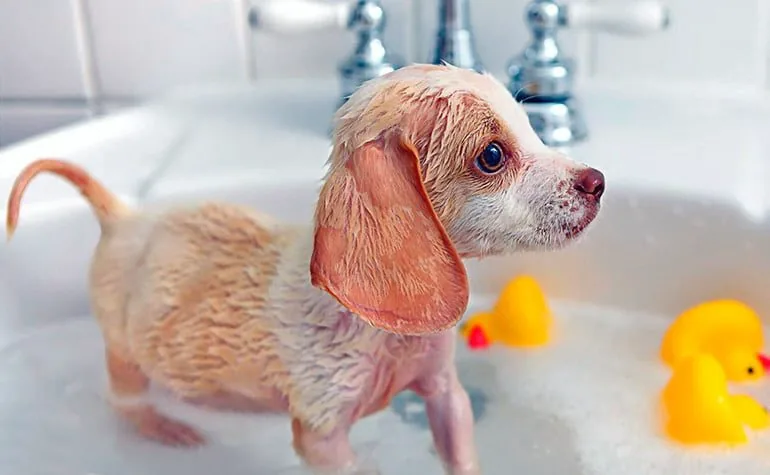
- Depending on its size, you can bathe it in the bathtub, the sink, or any other basin, but don't forget to put a non-slip mat or similar at the bottom so the puppy doesn't lose its balance. It could get scared and fall.
- You can use the showerhead or any container to pour water over it, little by little. Start with the legs and work your way up. Avoid the head. In that area it's better to run your wet hand over it so it doesn't get scared.
- If it lets you without any trouble, praise it and even give it a treat. If it tries to escape, don't scold it. Just try to keep it inside the bathtub and reward it when it's still or calm.
- It might turn out it likes the water and tries to play with the stream. Let it, but don't let it drink water that has soap in it.
- Once it's wet, apply the shampoo, lathering its whole body well. Afterward you just need to rinse it thoroughly and dry it, first with the towels, finishing with the hair dryer.
- The hair dryer should blow warm, not hot, air, and should be on the lowest setting to prevent scares. Start from the legs upward and avoid the face.
- Remember that the bath isn't just about hygiene — it's time spent together that helps strengthen our bond with the dog, gets it used to being handled, and, also very important, lets us do a full check by feel that can help detect lumps, parasites, injuries, etc.
Bibliography Ateuves no. 5. 2018. When should you start bathing a puppy? p. 41.
IMPORTANT: This article is for informational purposes only and does not constitute veterinary, nutritional or behavioural advice. Every dog is different, and only your trusted vet can advise you on its specific needs.