 Breeds
Whippet
The Whippet is the perfect paradox of the dog world: an athlete capable of reaching nearly 55 km/h in seconds, who, once home, turns into a quiet, comfort-loving companion. Born in the humble homes of industrial England, this medium-sized sighthound combines a Greyhound's elegance with exquisite sensitivity and a surprising love of the sofa. Discover everything that makes this dog of contrasts unique.
A Silhouette of Pure Speed
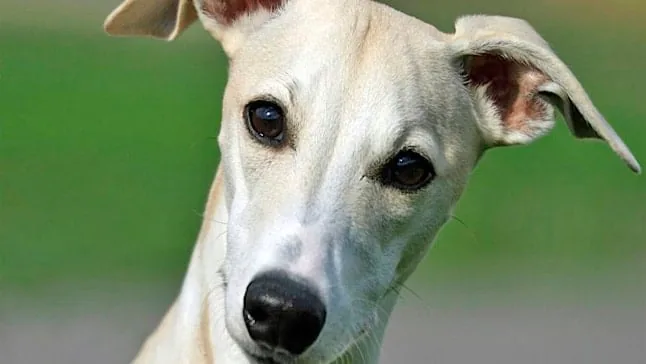
The Whippet fits the archetype of a light, streamlined sighthound, shaped by both natural and human selection for explosive sprinting. Under the official American Kennel Club (AKC) standard, males stand between 46 and 56 cm at the withers, while females fall between 43 and 53 cm. Weight ranges from 11 to 18 kg, always proportional to height, with lean muscle visible beneath the skin and no trace of excess fat.
Its coat is one of the easiest to maintain: short, fine hair lying close to the body, with no woolly undercoat. The color palette is exceptionally broad and unrestricted: white, black, blue, fawn, brindle, or any combination of these is accepted without penalty. The long, narrow head has small rose-shaped ears that fold back at rest, while the oval, dark eyes and the long, low-set tail round out a picture of flawless aerodynamics. Its life expectancy reaches 12 to 15 years, a notable lifespan for a dog of its size.
The Poor Man's Racehorse
The Whippet was born in northern England during the 19th century, in the cramped homes of miners and textile workers. The Industrial Revolution brought not just factories, but also the need for a fast dog for hunting hares and rabbits that took up little space and was cheap to keep. The solution was crossing English Greyhounds with local terriers, producing a compact, agile, hardy sighthound, perfect for the tight budgets of the working class.
Its roots reach back even further, to the sighthounds that accompanied Roman legions during the conquest of Britain, dogs that mixed with native varieties for centuries. By 1870, the Whippet was already the star of informal races where owners bet money on the outcome; its explosive acceleration over short distances earned it the nickname "the poor man's racehorse." The British Kennel Club officially recognized the breed in 1891, separating it from the Greyhound and directing its breeding toward both track performance and a temperament suited to domestic life.
Greyhound Speed, Sofa Temperament
Indoors, the Whippet defies every stereotype about high-energy dogs. It's quiet, calm, and surprisingly sleepy, capable of spending hours curled up on something soft without demanding constant attention. It's neither destructive nor barky, making it an ideal candidate for apartment living, as long as it gets its daily dose of outdoor exercise. Its sensitivity to tone of voice is legendary: a harsh scolding affects it deeply, far more than it would most other breeds.
With family it's affectionate and loyal, and gets along well with children who respect its space, though its thin skin and low body fat make it vulnerable to overly rough play. With other dogs it tends to be sociable and peaceful, especially if raised alongside them. Out on the street, though, an ancestral switch flips: its prey drive is absolute, and when it spots a small animal moving, it chases without listening to any calls. That's why off-leash freedom is only safe in fully fenced areas.
Secrets Only This Breed Holds
Few dogs can claim a gene directly linked to their athletic success. In the Whippet, a mutation in the myostatin gene — the same protein that regulates muscle growth in many species — produces heterozygous dogs with greater muscle mass and superior racing performance, as revealed by a scientific study from the National Human Genome Research Institute. This genetic quirk explains why some individuals stand out as natural sprinters without needing exhausting training.
Another oddity is its extreme duality: few dogs go from being the fastest animal in the house to the most motionless within minutes. Its historic nickname — "the poor man's racehorse" — also lives on in the breed's memory, a reminder that its speed wasn't born in palaces, but in mining-town yards. Its extremely thin skin and aversion to cold also set it apart, driving it to seek out blankets and warm corners with an almost human determination.
Care and Health for the Sprinter
The Whippet is generally healthy, but has quirks every owner should know about. Its low body fat percentage makes it especially sensitive to certain anesthetic drugs, so any veterinary procedure should use protocols adapted for sighthounds. Hereditary eye problems can also appear, and in predominantly white-coated dogs, a higher predisposition to congenital deafness. An annual check-up with specific tests is the best prevention.
As for exercise, it needs daily free runs in safe areas to satisfy its need for speed, but at home it's content with moderate walks and plenty of rest. Its short coat needs barely any maintenance — weekly brushing is enough — though the lack of undercoat leaves it vulnerable to cold, so a coat in winter is more a necessity than an indulgence. Diet needs precise control, since any excess weight strains its fragile bone and joint structure.
IMPORTANT: This article is for informational purposes only and does not constitute veterinary, nutritional or behavioural advice. Every dog is different, and only your trusted vet can advise you on its specific needs.