 Care
Care
Why Are Dogs Afraid of Firecrackers?
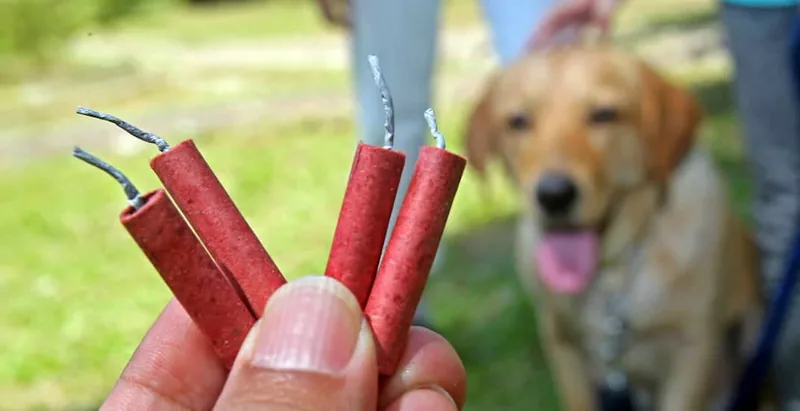
If you have a dog and have spent local festival season with it, you've surely seen how badly it reacts to firecrackers and fireworks. We can say the same about thunder during storms, and any deep, loud sounds in general. If you want to know why dogs are afraid of firecrackers, you're in the right place.
These sounds are behind a good portion of vet visits, since several studies confirm that between 53 and 74% of dogs show fleeing and anxious behavior when hearing firecrackers, rockets, fireworks, thunder, or gunshots. This is a defense mechanism rooted in and heightened by their sensory development.
What Causes the Fear of Firecrackers?
Several studies have tried to shed light on this question, since it's a widespread behavior among dogs. Ethologists agree this fear's origin is linked to their sensory development. It's worth remembering that hearing and smell are very finely tuned in these animals.
They can hear at distances four times greater than what humans reach. So, as you can imagine, the loud bang firecrackers make is picked up by dogs at an intensity far greater than ours. The smell of gunpowder is likewise picked up by their keen sense of smell, putting them on alert.
According to experts, this fear has ancestrally been present in dogs as a survival mechanism. Their instinct is to seek shelter or take refuge in a confined space. In some dogs, there's also a second way this fear develops, coming from their caretakers' overprotectiveness or past traumatic experiences.
Lack of Familiarity
Luckily for them, hearing firecrackers isn't a regular occurrence. Precisely this lack of familiarity is what puts them on alert and makes them nervous. This is one of the aspects their behavioral treatment focuses on, which we'll explore further below.
Overprotectiveness
It's natural that, seeing your pet distressed, you'd want to comfort it by petting it excessively, talking to it in a softer, more affectionate tone, and so on. All of this, instead of calming it down, leads it to trigger all its alarms. The message gets interpreted exactly opposite to what you intend.
We need to learn to accompany them rather than overprotect them. How do we do this? By distracting them, redirecting their attention through play, food, and/or background music. As we saw in the post "The Best Music for a Dog," sounds that mimic nature (waterfalls, waves, birds, and so on) help a lot in this regard.
So, if you find yourself in this situation, act as usual, as if that outside noise weren't happening. Close doors and windows, and lower the blinds. Your pet won't find reason to be alarmed if it sees you calm. Remember, you're its point of reference. If you're calm, your dog will be too.
Past Traumatic Experiences
Some furry friends show a certain auditory hypersensitivity, and if exposed repeatedly or abruptly to sounds very unpleasant for them, they'll associate them with anxiety and stress. So, next time they hear them, they won't be able to hold back and will run off, with all the risks that entails.
The Importance of Preventing Phobias
Although this is something innate they can't avoid, as caretakers, we should take certain precautions to prevent it from worsening and turning into a phobia. If the fear is out of control, the dog will suffer anxiety, a racing heart, and faster breathing. In the most extreme cases, cardiac arrest could occur.
Also, if the dog isn't used to this kind of loud sound and you're out on the street, it'll try to flee to find shelter if it's not leashed. During this escape, it could get hit by a car or cause an accident. So, this isn't a minor issue that should be underestimated, but don't panic. Below, we give you every key to managing it.
What Should Be Done? Is There a Treatment?
The best way to keep this fear in check is to expose the dog to this kind of sound in a controlled, gradual way. The younger, the better. You can try recording these sounds and playing them daily.
Start with a low volume and for no more than an hour. When anxiety appears, stay calm and only reward it once it's relaxed. By repeating this routine, it'll gradually get used to it and won't internalize the stress. This is what ethologists call systematic desensitization.
The second step is counterconditioning. In other words, getting what was initially perceived as a threat to become a pleasant experience instead. And how is this achieved? With patience and repetition. If you need help, it's best to see a specialized trainer or ethologist for guidance.
Drug Therapy
Especially in phobia cases, behavior modification treatment is usually supported by relaxing medications. In fact, this combination is the most effective approach for the most sensitive dogs, or those with deeply rooted fear. So-called calming pheromones are also useful, but not for every dog.
In short, dogs' fear of firecrackers stems from their survival instinct, and we should give it the attention it deserves. Did you know birds share this aversion to loud noises with dogs? We hope this has helped, and that you put these guidelines into practice to prevent your pet's firecracker phobia.
IMPORTANT: This article is for informational purposes only and does not constitute veterinary, nutritional or behavioural advice. Every dog is different, and only your trusted vet can advise you on its specific needs.