 Training
Why Does My Dog Give Me Little Nibbles?
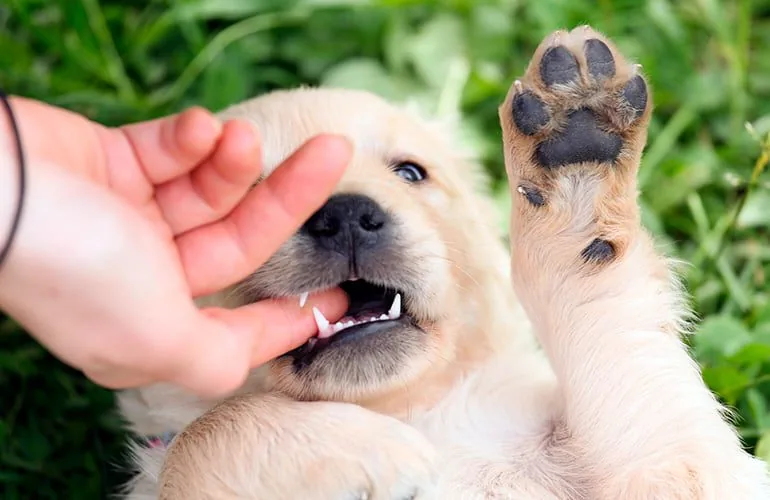
Dogs lick us, jump on us, cover us in slobber and fur and, some of them, also seem to enjoy giving us little nibbles. These nibbles happen in a playful or affectionate context.
If you're wondering why does my dog give me little nibbles, below we explain the reason behind this behaviour, which has nothing to do with a dog baring their teeth, growling and snapping.
The Reason Dogs Bite
Dogs lack hands to explore their surroundings the way we do. Instead, their mouth plays a fundamental role, alongside, of course, their highly developed sense of smell. We'll notice this especially in puppies, who are going through a very pronounced exploratory phase. The result is usually destruction.
They break toys, slippers, their own bed and, in general, any object within reach. It's their way of getting to know their surroundings, and also of entertaining themselves. And within this exploratory, playful drive, we're included too.
If we get the chance to watch a couple of dogs play, especially young ones, it's easy to see how they use their mouth to bite each other as part of the game. If one goes too far with a bite, the other will immediately complain, so they learn to control the strength of their jaws and use their mouth without hurting each other.
Dogs Play With Their Mouth
Going back to the play scene between several dogs, and focusing on how they use their mouth and, specifically, biting, it's easy to see that these little nibbles are used in this playful context to encourage the other dog to keep playing. So a dog may lunge to grab another with their mouth while taking on a body posture inviting play.
The dog usually rests their chest and front paws on the ground and raises their hindquarters while opening their mouth, barking happily, wagging their tail and jumping around. Dogs usually take on this attitude when they meet other dogs, but they may also want to play this way with us.
In this type of bite, there's not a hint of aggression. The dog's body language confirms this. It's a bite where they usually keep their mouth open, with no pressure, more like a hold they can release and take up again several times in a row.
Nibbles With a Closed Mouth
Besides the bite we've just described, there's another type of little nibble that isn't a sign of aggression either, which the dog does with their upper and lower incisors. This is the typical nibbling they do on their own body when they want to scratch themselves or catch a potential insect.
These tend to be small bites repeated quickly, like a tremor. They're little nibbles they can also give us in an affectionate context. Some dogs do them when their belly is being scratched, along with the involuntary movement of their back leg.
My Dog Bites Me While Playing
As long as it's clear the dog's bite has nothing to do with an aggressive reaction, it's not a worrying behaviour. If, on the other hand, they bare their teeth by lifting their lips, wrinkle their muzzle, growl, or snap at us whether or not they actually make contact, it's essential to see a professional specialising in canine behaviour or an ethologist.
Even so, in cases where we don't want our dog to bite us or hold us with their mouth, it matters to know how to react. First of all, you shouldn't scold them, shout at them, punish them, and far less use violence. As we've explained, the dog isn't doing it with any intention to harm — quite the opposite, they're showing a playful attitude towards us.
To curb it, we can stop the game immediately, without saying anything. This way we convey to them that this action ends the fun. We also have the option of stopping and offering them an alternative, such as a toy to distract their attention. As soon as they accept it, we'll reward them to reinforce and fix in their mind that we want them to repeat that game.
When Is the Bite a Cause for Concern?
Although the bite doesn't involve an aggression problem, it can be worrying if the dog uses their mouth excessively, especially if they don't control the strength of the bite and end up hurting us.
In these cases there could be a socialisation problem, for example, when the puppy was separated very early from their mother and littermates, before reaching 8-10 weeks old. It could also be a sign of excessive nervousness or stress.
As we've explained, you need to stop the game immediately or try to steer their attention towards the activity you want to encourage instead. These issues can be fixed, but just as with aggression, it may be necessary to contact a canine behaviour professional.
Bibliography Morris, Desmond. 1988. Observe a su perro. Barcelona. Plaza & Janés.
IMPORTANT: This article is for informational purposes only and does not constitute veterinary, nutritional or behavioural advice. Every dog is different, and only your trusted vet can advise you on its specific needs.