 Care
Care
Why Does My Dog Go Belly-Up?
If your dog ever plants itself in front of you belly-up, you might think it's taking on a submissive posture, and your usual reaction is to respond with a pet in that area.
But is that really what the belly-up position means? Below, we explain why a dog lies in this posture and what it can mean, whether it does so at home or outdoors.
Canine Body Language
Unfortunately for owners, dogs don't talk. That's why we need to learn to communicate with them through nonverbal communication. Dogs relate to each other largely through smell, but ours isn't sharp enough to communicate that way. So we're left with their body and the sounds they make.
It's important to have some knowledge of canine communication, since otherwise, we're likely to run into misunderstandings that, if frequent, can end up hurting our bond with our dog. Also, each sound or position can carry different meanings, interpreted based on context.
Pay attention to the posture in which the dog holds its ears, tail, mouth, its movements, whether its whole body is tense or relaxed, and so on. All of this together is how it expresses both its needs and feelings to us. It gives us information about it, but also lets us offer it an appropriate response.
Why Does My Dog Show Me Its Belly?
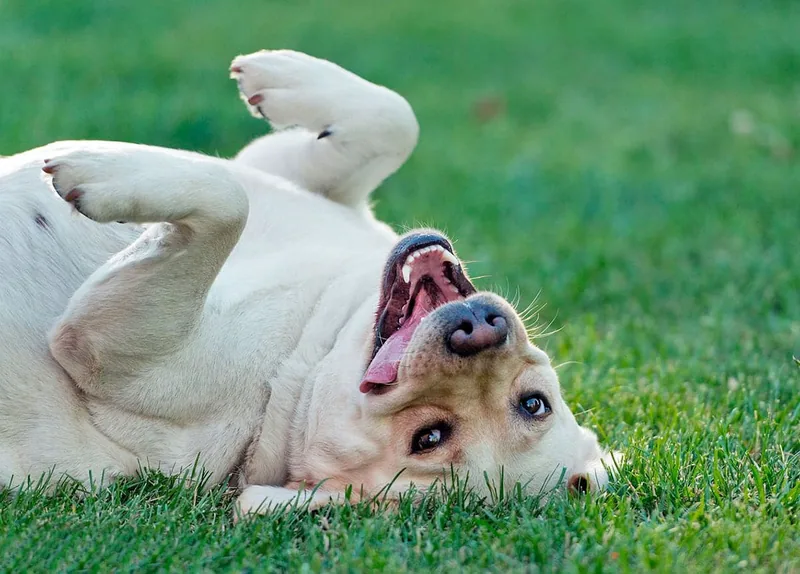
A belly-up dog will show us its whole abdominal and chest area, since it'll keep its front legs bent. It also usually leaves its neck exposed, since it often tilts its head back or to the side.
Sometimes the dog goes fully belly-up, while other times it stays half-turned, lifting a back leg to show its belly. Also, it can take this position when alone, in front of another dog, or with us. The situation gives us a clue to its meaning.
A Calm Dog Belly-Up
When our dog is lying down, whether resting or sleeping, we might find it belly-up, though this usually isn't a position it holds for long. This is a position that conveys extreme relaxation to us. We can tell because it's showing us especially vulnerable areas.
In the chest and abdomen lie all its vital organs, and in the neck we have important veins and arteries, plus the trachea. So, it needs to be genuinely relaxed to leave these areas exposed. This way, the second conclusion this posture lets us draw is that the dog is happy.
A dog resting belly-up expresses wellbeing and trust in its surroundings. A scared or stressed dog won't rest in this position. In other words, showing its belly tells us the dog trusts us and feels good in its home.
Showing the Belly Shows Canine Submission
But, setting aside resting, when a dog throws itself belly-up in front of a person or another dog, for many owners this is a sign of submission. For this reason, some even react with dislike, since they want their dog to be dominant. Others, on the other hand, interpret it as an adorable gesture of affection.
Either way, what's true is the dog is exposing vulnerable parts of its body to convey a message to us. We could translate it as "I'm not a threat" or "pet me." In these cases, calming signals may also appear, like sticking out the tongue, half-closing the eyes, or yawning.
The same dog can show both submissive and dominant postures in different situations. These are forms of communication that avoid conflict. If violence were involved, we'd be talking directly about aggression.
Puppy Communication
But what's the origin of a dog showing its belly to convey peace to us? We need to look at puppyhood to answer this question. When puppies are born, they're completely dependent on their mother. They crawl, have their eyes closed, and are devoted to eating, guided by smell, and to sleeping.
They can't even pee or poop on their own. To do so, they need their mother to stimulate them by licking their genital area. This action is made easier with the puppy belly-up. So, what was a biological function for the puppy turns into a communicative one to show it's as harmless as a baby.
The Role of Play
On the other hand, the belly-up position can also appear in play rituals in both puppies and adult dogs. During these sessions, every animal involved usually takes on different positions, which can be what we consider submissive, but also dominant ones.
Dogs alternate different roles and swap parts during these playful moments. It's part of healthy play and shows the bond between them strengthening, since it builds their trust. Nothing does this better than declaring yourself fully vulnerable in front of another. It's also a way to make sure the intent is purely playful.
IMPORTANT: This article is for informational purposes only and does not constitute veterinary, nutritional or behavioural advice. Every dog is different, and only your trusted vet can advise you on its specific needs.