 Training
Why Does My Dog Take My Spot?
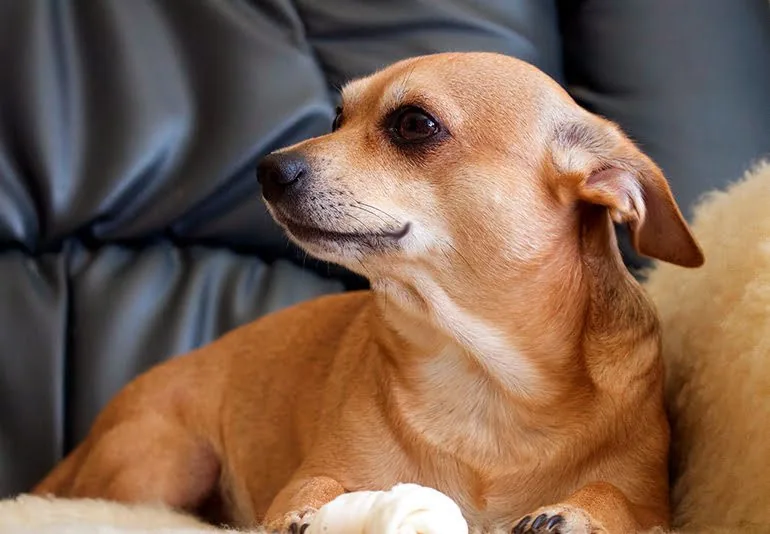
Has it happened to you that when you settle down for a while on your favourite sofa, your dog snuggles up until they manage to take your spot? Or perhaps you're sleeping and they wake you up because they're taking up the whole bed?
Below we explain why your dog is set on taking your spot and what you can do to fix it. The first thing to bear in mind is that it all starts because a dog is a social animal, built to live in company.
The Dog-Human Bond
We still have a lot to learn about the relationship between dogs and people. What's clear is that it's a long, very special bond between the two species. The most recent neurological studies have managed to establish that for dogs, we're part of their family.
Even so, they're clear that we're not dogs. Let's say that, in their brain, there's a compartment set aside for us, and another for their own kind. Although it seems hard to prove objectively, scientific discoveries are making it clear that dogs love us.
But they don't love us purely out of material self-interest. That is, regardless of whether we provide them with shelter and food, they feel affection towards us. They love us selflessly.
Having a Dog in Your Home
What does the relationship dogs have with us translate into when it comes to day-to-day life at home? First of all, as the social animals they are, they need company for their wellbeing. Thanks to the domestication process, we've become their reference point.
All the affection and needs dogs seek in interacting with other dogs are therefore directed towards their owners. Even more so than towards their own kind, as studies on the matter have shown. This means that, for example, if the dog feels fear or insecurity, they'll preferentially seek us out.
Hence it shouldn't surprise us in the slightest that they follow us around the whole house or that they're set on always being as close to us as possible. Even if that means ending up stealing our spot. We can consider it normal behaviour.
The Importance of Rest for Dogs
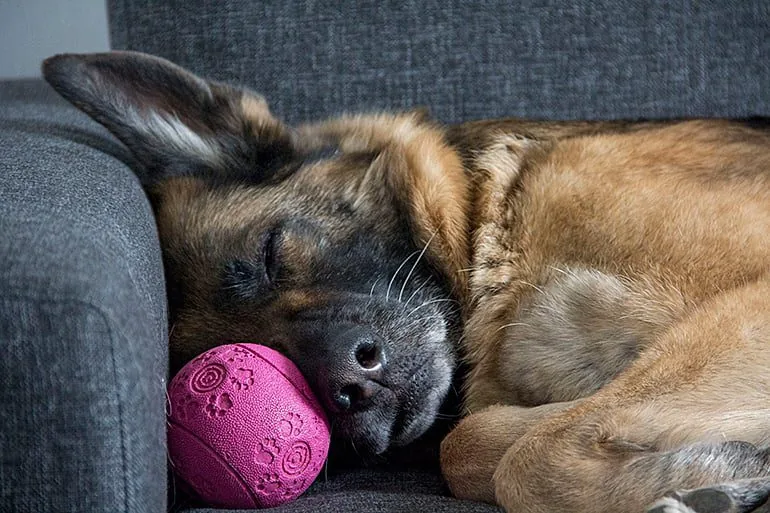
Domestication has meant dogs keep certain characteristics typical of the juvenile stage throughout their whole life. In other words, they're eternal puppies. For them, sleeping or resting next to their owner is the most normal thing in the world.
Even a dog who can't access the spot they consider preferable will try to lie down as close as possible to their owner. This has an explanation in wolf behaviour. Logically, while they're small they sleep together. Once they leave the den where they're born, they keep the habit of sleeping without losing sight of each other.
Only a wolf expelled from the pack is forced to move away. That's why our dog simply can't understand why we won't let them be in our spot. The rejection they feel can be softened if there are other dogs at home, since they can rest together, or if we let them rest close to us.
What to Do if Your Dog Takes Your Spot
What to do in this situation is a personal matter. That is, if it doesn't bother you that your dog sleeps on top of you or barely leaves you room on the sofa, that's fine. Even so, you can also choose to stop them from accessing these spots. Either way, the decision needs to be made together by everyone at home, and needs to be kept to consistently.
If it's decided they can't get on the sofa, but someone lets them anyway, the dog won't understand why sometimes yes and sometimes no. The result is they'll keep trying, and problems will arise. To teach them not to join us there, we'll always use the approach of rewarding them when they do it right, instead of scolding or punishing them.
Of course, even if we've decided to let them join us on the bed or the sofa, if to get our spot they growl at us or try to bite, we need to redirect this behaviour. Even if it's a small dog. Even so, corrections need to be made through praise, and never through verbal violence, let alone physical violence.
Excessive Dependence on the Dog
A balanced dog will seek our closeness, which can include lying down next to us, whether on the sofa, in bed, or generally anywhere they have us within reach. But they can also be left alone with no problem at all. Some dogs, on the other hand, will show great dependence.
This ends up turning into a psychological disorder known as separation anxiety. Affected dogs can show various behavioural problems. Specifically, separation anxiety is characterised by the dog not tolerating being left alone. In their owner's absence, they go crazy.
They bark, howl, whimper, destroy anything within reach, urinate and defecate inside the house and so on. Some general guidelines can be followed to fix it, but a specialist's involvement is usually needed. Look for an ethologist or canine behaviour expert, also if you have doubts about how to train your dog.
Bibliography Berns, Gregory. 2013. How Dogs Love Us. Melbourne. Scribe Publications. Morris, Desmond. 1988. Observe a su perro. Barcelona. Plaza & Janés.
IMPORTANT: This article is for informational purposes only and does not constitute veterinary, nutritional or behavioural advice. Every dog is different, and only your trusted vet can advise you on its specific needs.