 Breeds
Alaskan Malamute: Temperament, Care and Fun Facts
The Alaskan Malamute, bred to pull sleds in the Arctic, is a working dog that needs far more than physical exercise. This article breaks down his diet, the most common hereditary problems — such as a genetically caused loss of vision in bright light — and the keys to training an animal as intelligent as he is stubborn, helping you decide whether this sturdy, strong-willed breed is right for you.
Feeding the Alaskan Malamute
The Malamute comes from working in the snow, and his diet has to match that. This breed's metabolism is built for cold and physical exertion, which translates into a real need for quality protein and healthy fats. Any generic kibble usually doesn't cover it. The sensible move is to go for formulas specific to large, active breeds, or a BARF diet as long as a canine nutrition specialist is involved.
In adults, the usual portion runs between 400 and 700 grams of dry kibble, split into two meals. That wide range has an explanation: it all depends on how much the dog moves. A city Malamute doesn't burn the same as one doing mushing on weekends. Watch out for leaving food available all the time, because this breed has no brakes and will overeat if given the chance. Puppies follow a different schedule: three or four meals a day up to six months, then down to two.
Chondrodysplasia, the short-limb dwarfism that shows up in some individuals, is a Mendelian recessive trait. It comes from genetics, not diet, and specialist literature has confirmed this for decades: adding vitamin D, calcium and phosphorus to the diet does not correct this condition “Clinical and Pathologic Features of Chondrodysplasia (Dwarfism) in the Alaskan…” (1973). If a dog shows unusual bone development, the answer is at the vet's office.
Health and life expectancy
With the right care and no weight problems, an Alaskan Malamute can live between 10 and 14 years.
Cone degeneration is one of the health issues most present in the breed. It's hereditary, autosomal recessive, and has something peculiar about it: the dog sees normally in low light but becomes almost blind as soon as light levels rise. The cones in the retina simply stop working. There's no treatment, though affected dogs learn to get around without difficulty as long as their environment stays predictable “Canine CNGB3 mutations establish cone degeneration as orthologous to the human…” (2002).
There are two other disorders worth knowing about. NDRG1-linked polyneuropathy progresses gradually and shows up as laryngeal paresis, reduced postural reactions, weakened spinal reflexes and muscle wasting that worsens over time “A Gly98Val Mutation in the N-Myc Downstream Regulated Gene 1 (NDRG1)…” (2013). Separately, the NME5 gene can carry a frameshift variant that leads to primary ciliary dyskinesia, with repeated respiratory infections and fertility problems “NME5 frameshift variant in Alaskan Malamutes with primary ciliary dyskinesia” (2019). Given this genetic picture, testing breeding stock isn't optional, and any neurological or respiratory symptom that doesn't clear up should go straight to the vet.
Training and socialisation
The Alaskan Malamute is intelligent but strong-willed, which calls for consistent, patient training. He doesn't respond well to coercive methods; the key lies in positive reinforcement and setting a clear routine from puppyhood. Early socialisation is essential to avoid problems living with other dogs, since they can show dominance if not properly trained.
A common mistake is thinking the Malamute needs little mental stimulation. In reality, he needs at least two hours of exercise a day combined with scent games, obedience work and controlled pulling (such as dry-land mushing). Training should include basic control commands, especially "stay" and "come", reinforced with rewards and without repeating the command more than twice.
Socialisation with people and varied environments should start in the first weeks of life. Exposing him to different sounds, surfaces and situations lowers the risk of reactivity. Given his pack instinct, the owner needs to act as a calm, consistent leader, without resorting to physical punishment. If signs of aggression or excessive fear show up, the most effective step is consulting a dog trainer who specialises in Nordic breeds.
Origin and history
The name says it all: Alaskan Malamute comes from the Mahlemut, an Inuit people who lived around Kotzebue, in the far northwest of Alaska. For centuries they bred these dogs with endurance in mind, for pulling heavy loads across frozen ground. Speed mattered little. What mattered was arriving, however long it took, however hard the wind cut. Survival depended on it.
The gold rush of the late 19th century changed everything. Prospectors arrived in droves and needed sled dogs, any sled dogs, and the Malamute was crossed with other breeds until it nearly lost what defined it. Recovery came later, with breeders who took restoring the original type seriously. In 1935 the American Kennel Club recognised the breed, and during the Second World War the US military recruited it for load-hauling and rescue work. Once the conflict ended, the dog that had survived wars and gold rushes went on to find a place in people's homes.
Today he competes in long-distance sled races, though most Malamutes today live with families. That past of working in extreme conditions left him a cold tolerance and physical strength few breeds match. It also left him that independent streak which, if not handled well from the start, can make living together quite a challenge.
Physical characteristics
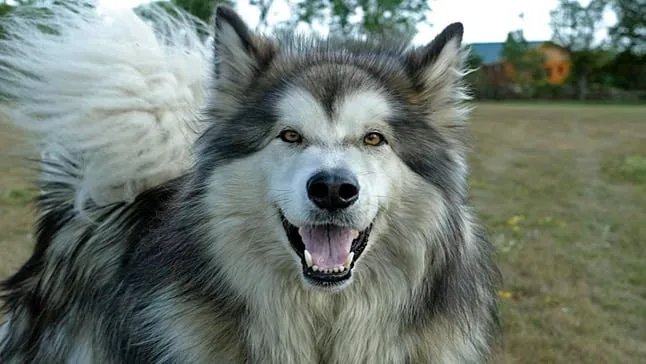
We're talking about a genuinely large dog. Males stand between 63 and 71 cm at the withers and weigh 38 to 45 kg; females run somewhat smaller, at 58 to 66 cm and 34 to 40 kg. All that size serves a purpose. The Malamute was selected to pull loaded sleds for hours, and the deep chest, heavy bones and strong limbs are the direct result of that job. The head is broad, the ears triangular, and the expression, though calm, always keeps a hint of alertness.
The confusion with the Siberian Husky is understandable. There's a full article on the differences with the Husky, but in short: the Malamute is bigger, heavier and more heavily built; the Husky is lighter, faster and carries a less dense coat. The Malamute's facial mask is usually white, while the Husky shows a much wider range of patterns. Temperament differs too — the Malamute leans toward independence and tends to be fairly reserved with strangers; the Husky is the type to run out and greet everyone without a second thought.
The coat has two layers. On the outside, coarse, weather-resistant guard hair; underneath, a very dense woolly undercoat that acts as thermal insulation. Below freezing it performs beautifully, but in summer or warm climates things get complicated — above 20°C the risk of heatstroke is real. The eyes are almond-shaped and brown, though lighter shades are also accepted. The tail curls over the back, a trait shared with the rest of the Nordic breeds.
Temperament and life with a Malamute
The Malamute's temperament is defined by intelligence, loyalty and a strong pack instinct. He's affectionate with his family but can be reserved or even dominant with dogs of the same sex. This isn't a breed for first-time owners, since he needs firm, consistent training. He responds very well to positive reinforcement, but also knows exactly when he can bend the rules if the owner is inconsistent.
At home, the Malamute is usually calm once he's burned off enough energy. He's not a dog that barks excessively, but he does produce characteristic howls. With children he's patient and protective, provided he's been properly socialised and his space is respected. It's not advisable to leave him alone for long hours, since he can develop separation anxiety.
His prey drive is moderate, but he can chase small animals if not trained. Living with cats is possible if he's raised around them from puppyhood. In short, the Malamute is a demanding companion who rewards you with deep loyalty, but he needs an active home with space and time to devote to him. He's not suited to small flats or sedentary lifestyles.
Care and grooming
The Malamute needs brushing 3–4 times a week, and daily during shedding season (spring and autumn), when he loses large amounts of undercoat. A pin brush and an undercoat rake are essential tools. Bathing can be spaced out every 2–3 months, since washing too often strips the natural oils from his skin. Drying him thoroughly is important, especially in cold climates.
Nails should be checked monthly, and ears inspected weekly to prevent infections. Dental hygiene is key: brushing with dog-specific toothpaste at least three times a week prevents tartar build-up. Given his dense coat, in summer you need to watch for signs of overheating (heavy panting, lethargy) and always provide fresh water and shade.
One thing worth keeping in mind is the heavy shed: during the two weeks of coat blow-out, it's a good idea to use a powerful vacuum and brush him outdoors. Shaving the coat in summer isn't advisable, since the double coat also acts as insulation against heat. Exercise should be avoided during the hottest hours, and if you live somewhere warm, it's best to schedule walks at dawn or dusk.
Common health conditions
The Malamute is a sturdy dog, but that doesn't protect him from everything. Hip and elbow dysplasia, cataracts, progressive retinal atrophy and hypothyroidism are the conditions that show up most often in the breed. Keeping him at his ideal weight, with regular exercise — consistent, not sporadic — and annual vet check-ups that include bloodwork and imaging as age calls for it, is the best way to stay ahead of problems.
Genetic tests exist that can identify carriers before deciding on a breeding pair. Serious breeders use them. If the dog develops a cough that won't clear up, has trouble swallowing, or tires sooner than normal, see the vet without overthinking it.
There are bite-force figures circulating online that nobody has been able to measure rigorously. There's no reliable scientific data on this, so it's best not to build anything on that basis. Watch out for this: any dog this size can cause harm if training falls short or if he's put in situations he can't handle. Supervising interactions with children and other animals, and working on training from puppyhood, isn't optional.
The Malamute needs real work. Hiking, canicross, activities with a clear purpose that let him get out what's inside him. Combined with constant positive reinforcement, that kind of daily management is what keeps these dogs on track and makes living with them manageable.
IMPORTANT: This article is for informational purposes only and does not constitute veterinary, nutritional or behavioural advice. Every dog is different, and only your trusted vet can advise you on its specific needs.