 Breeds
Albino Doberman: Characteristics and Essential Care
The albino Doberman has a cream coat and those blue-violet eyes that draw so much attention. Behind that image is a mutation in the SLC45A2 gene that disrupts melanin production. Diluted colours like blue or Isabella respond to a completely different gene, so things change.
SLC45A2: the mutation that switches off pigmentation in the Doberman
Beyond his looks, this dog carries serious health problems. His predisposition to dilated cardiomyopathy is high, with a significant prevalence in the breed. That's why deliberately breeding albino Dobermans is, plainly, an irresponsible practice.
The SLC45A2 gene has two independent variants implicated in oculocutaneous albinism in the Doberman and several small breeds. These are distinct mutations, each with its own origin, according to the study ‘A single base deletion in the SLC45A2 gene in a Bullmastiff…’ (2017).
This gene sits on canine chromosome 20 and plays a very specific role in colour metabolism. It codes for a membrane transport protein melanocytes need to function properly. Without it, melanin synthesis is disrupted. The pigment simply never gets produced.
When a Doberman inherits two defective copies of the gene, albinism shows up. With just one copy, the dog has completely normal colouring but can pass the mutation on to his offspring; he's a silent carrier. This was documented by ‘A Missense Mutation in SLC45A2 Is Associated with Albinism in Several…’ (2015), which confirmed homozygosity for a large deletion in the gene as the direct cause of oculocutaneous albinism in the breed.
The official classification of this condition is oculocutaneous albinism type 4, OCA4. Compared to OCA1 — which affects the TYR gene — here pigmentation isn't fully cancelled out. The mutation in SLC45A2 leaves minimal residual melanin synthesis, which translates into eyes with slightly more colour than in other types of albinism. Not much difference, really. Sensitivity remains extreme.
Physical characteristics of the albino Doberman
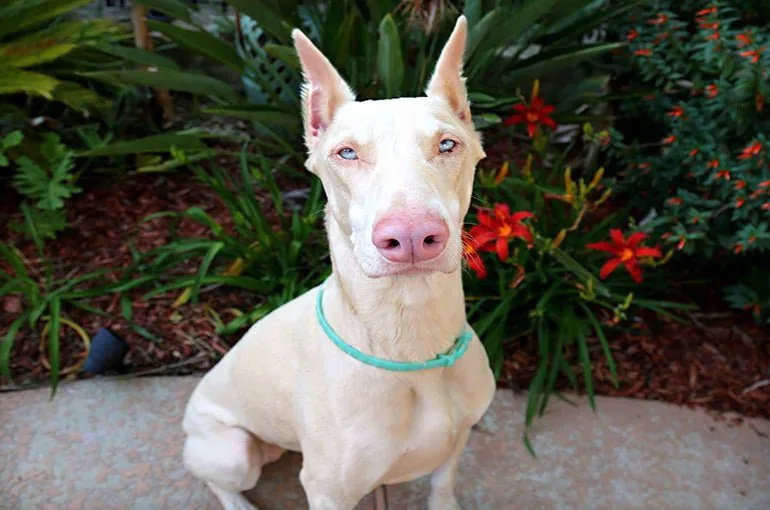
Seeing him in person is quite disorienting. The coat ranges from cream to ivory, leaning toward a very muted champagne, and that white never becomes pure white in any case. The nose, lips, pads and the area around the eyes show that same unpigmented pink defining these animals at a glance.
The eyes especially draw attention. The iris can be very pale blue, grey with a bluish tinge, or even that lavender tone many people don't expect to see in a dog. That striking transparency comes at a price. With no pigment in the iris or retina, light enters excessively and generates photophobia, and visual acuity is also reduced. The pink, thin skin shows through the short coat as if the animal had no filter against the sun, because in reality he doesn't: the melanin that would protect that whole surface simply doesn't exist.
The body, on the other hand, can keep the athletic build that sets Dobermans apart. Elegant bearing, defined musculature. But the genetics producing that striking phenotype carry a set of weaknesses going well beyond coat colour and end up affecting the animal as a whole.
Differences between the albino Doberman and the white Doberman from a dilution gene
Confusing an albino Doberman with a cream or whitish one from dilution is a common mistake. At first glance they can look fairly alike. But genetically they're completely different animals, and what that means for their health has nothing in common. Albinism stems from a mutation in the SLC45A2 gene. The Isabella colour — that pale beige sometimes labelled "white" — has a different origin. It's produced by a double dilution of black or brown, and the gene responsible is MLPH, the same one regulating dilution in many other breeds.
An Isabella has pigment. Little, but he has it. The nose shows in greyish or soft beige tones — never pink — and the eyes can be light amber or bluish, though with enough pigment density to hold up better than a true albino's. They can develop colour-dilution alopecia, which is the most common problem in these dogs. The albino's extreme photosensitivity, severe eye damage and that tendency to burn with any time in the sun are a completely different story.
Watch out for this, because the care needed isn't comparable. A dog with a dilution gene needs specific attention, sure, but nothing like what managing an albino involves. And as for breeding, the debates shouldn't be mixed up either. Producing Isabellas is frowned upon in some standards due to the skin problems it can bring, but it's a different practice — with a different ethical weight — from deliberately breeding albinos.
Specific health problems of the albino Doberman
The life of an albino Doberman is marked by a set of health challenges inherent to his genetic condition. The lack of melanin makes him exceptionally vulnerable to ultraviolet radiation, with a very high risk of severe sunburn and, long term, developing squamous cell carcinomas and other types of skin cancer. His eyes, lacking pigment protection, are prone to intense photophobia, nystagmus, strabismus and significantly reduced visual acuity.
Beyond these problems directly linked to albinism, they share all the breed's genetic predispositions, which in their case are worsened by an overall weaker constitution. Dilated cardiomyopathy in the Doberman has a significant prevalence, and screening is recommended starting from age 3 through monitoring ‘European Society of Veterinary Cardiology screening guidelines for dilated…’ (2017). This cardiac monitoring should be even stricter in albino individuals.
The combination of these factors results in reduced life expectancy and a quality of life requiring constant active management. At any sign of dermatological or eye problems, immediate vet assessment isn't just advisable, it's imperative.
Essential care to protect his skin and eyes
Managing an albino Doberman's lifestyle is the cornerstone of his wellbeing. Sun protection needs to be absolute. This means restricting walks to the first and last hours of the day, when UV radiation is minimal. Outdoors, even on cloudy days, using high-protection sunscreen for dogs (SPF 50+) applied to all pink-skinned areas, especially the nose, belly and inner ears, is essential.
Protective clothing, like breathable but tightly woven t-shirts or bodysuits, offers a crucial physical barrier against the sun. For the eyes, dog goggles certified to block UVA/UVB rays are an invaluable tool for preventing photo-induced damage and increasing his comfort in bright environments. Indoors, avoid placing his bed in direct-light areas.
Baths should be done with ultra-gentle, moisturising shampoos free of harsh perfumes so as not to further disrupt his delicate skin. Ongoing monitoring through palpation to detect lumps, scabs or new skin lesions should become a weekly routine, referring to the vet at the slightest doubt.
Official recognition, health certifications and responsible breeding
The Fédération Cynologique Internationale (FCI) doesn't include albinism among the valid Doberman Pinscher colours, and breed clubs with sound judgement, along with veterinary associations, take a unanimous stance: deliberately producing these dogs is irresponsible. It isn't a matter of taste or breed aesthetics.
Deliberately perpetuating the mutation in the SLC45A2 gene condemns many of these animals to living with serious health problems their whole life. A breeder who works properly knows this, and that's why they run the necessary genetic tests to identify carriers and exclude them from breeding. That's how responsible breeding works, no ifs or buts.
If someone offers you an albino Doberman with documentation "certifying" his colour as something valuable, that isn't the right path. Genuine transparency means explaining plainly what having one of these dogs involves, not selling how striking the individual looks.
These dogs can show up in litters where one of the parents carries the gene without the breeder knowing, and that does happen. What has no justification is consciously producing them to meet demand based on the exotic, while being fully aware of the consequences that brings the animal.
Every now and then albino Dobermans show up in shelters, often because their previous owners didn't properly gauge the level of dedication they need. Adopting one can be a genuinely compassionate gesture, but you need to go in with your eyes wide open: vet expenses will run well above average and the time they need is considerable.
Anyone who wants a Doberman and loves the breed has a much more sensible option available: a standard-coloured individual from a breeder who runs all the relevant health checks. The breed's character and qualities are still there intact, without funding practices that harm animals or mortgaging the dog's health from day one.
If you already live with an albino Doberman, sun protection and dermatological care are only part of the work. Cardiac monitoring is just as important: from age 3 onward it's worth doing annual heart check-ups, since the breed's predisposition to dilated cardiomyopathy reaches a prevalence of 58%.
IMPORTANT: This article is for informational purposes only and does not constitute veterinary, nutritional or behavioural advice. Every dog is different, and only your trusted vet can advise you on its specific needs.