 Breeds
American Bulldog: Complete Breed Guide
The American Bulldog is much more than a muscular body and a powerful jaw: depending on his breeding line — working or show — his exercise, diet and lifestyle needs change completely; you might also be interested in the French Bulldog. This article breaks down the essentials for truly understanding this breed, from his specific diet to the differences that determine whether he'll be a tireless athlete or a calm sofa companion.
How to feed an American Bulldog
Some breeds can eat anything and stay in shape. The American Bulldog isn't one of them. As a molosser, his metabolism makes good use of energy and quickly stores what's left over, and that stored fat ends up loading joints that aren't his strong point to begin with. Top-quality protein — meat, fish or egg among the first ingredients on the label — is what supports muscle mass and aids recovery after exercise. Good fats, like those in fish oil, look after the joints and skin, two problem areas in this breed. Complex carbohydrates, in moderate amounts, round out the energy supply without causing blood sugar spikes.
Meal timing matters as much as what's in the bowl. Adults eat twice a day. The American Bulldog's deep chest makes him vulnerable to gastric dilatation-volvulus, a serious veterinary emergency, and splitting the ration reduces that risk. With puppies things change quite a bit. Up to six months, three or four meals a day are recommended, and the calcium-phosphorus ratio needs close monitoring, because any imbalance at this stage can cause bone deformities with no fix later on. Anti-gulping bowls or snuffle mats work well to slow down eating, and besides curbing aerophagia they also give the dog something to focus on.
Beyond protein, fat and carbohydrates, there are compounds worth adding preventively. Glucosamine, chondroitin and omega-3 fatty acids help offset this breed's predisposition to hip and elbow dysplasia. There's no universal dose that works for everyone; the sensible approach is starting early, under veterinary guidance, because the long-term functional difference can be considerable. And water. The American Bulldog needs constant hydration, especially after every activity session, but watch out for giving him large amounts right before or right after intense exercise — the risk of gastric torsion is still there.
Differences between working-line and show-line American Bulldogs
Within the American Bulldog there are two types that share an origin but have spent decades drifting apart. The working line, associated with Alan Scott's legacy, produces lighter dogs, with a narrower chest, a somewhat longer muzzle and an athletic capacity built for endurance. They can work cattle, clear obstacles and keep up the pace for hours. Their skeleton has power, but without the excess bulk that weighs them down. The show type, or Johnson type, goes in a completely different direction. Enormous head, very wide chest, thick neck and musculature bordering on hypertrophic. They're impressive to look at. And they also pay for that spectacle with poorer exercise tolerance and a greater tendency toward joint and breathing problems.
Those physical differences have practical consequences worth understanding before deciding. A working-line bulldog needs an owner who knows how to channel him, whether through dog sports, scent work or training with some real demand to it. Without that outlet, the dog's intensity finds other ways out, and rarely pleasant ones for the furniture. The show line asks for considerably less. Structured walks and moderate play sessions are usually enough, though watch out for heat: his more pronounced brachycephalic build makes his heat tolerance notably low, so summer needs managing with care. For someone living in a flat with a calm pace of life, this second option is more workable.
In the Spanish market, a puppy with pedigree and health guarantees usually costs between €800 and €1,500. If the parents have a proven record in sport or livestock work, the price can easily exceed that range. Breeders who run genetic tests, dysplasia X-rays and echocardiograms charge more, of course, but that upfront investment usually pays off against the cost of treating hereditary conditions that, if they show up, don't come cheap. The choice between working and show line should be based on the adopter's actual lifestyle, far more than on looks alone.
Exercise and physical activity needs
Being big and muscular doesn't mean taking him out to pee and straight back home will do. The American Bulldog comes from working on farms, and it shows. If he doesn't burn off energy, things change quite a bit: barking for no apparent reason, chewing on whatever he can find, a restlessness that makes no sense if you don't know where it comes from. For a healthy adult, two daily outings of 30 to 45 minutes each are the minimum, combining brisk stretches with time for the dog to explore at his own pace. Scent work — hiding treats, setting up simple tracking circuits — has a fairly noticeable calming effect because it puts the dog into a state of focus that lasts well after the activity ends.
Watch out with puppies. Until the growth plates close, which happens around 12–14 months, repetitive jumping, running on asphalt and sharp changes of direction should be avoided. What does work well at that age is lead walks, tug games where the owner sets the pace, and proprioception exercises on unstable surfaces like cushions or balance discs. They build muscular foundation without stressing the joints. Working-line dogs also have an intellectual demand that shouldn't be ignored: clicker training, an adapted version of agility, or supervised weight pulling are options that break up the monotony and give them the stimulation they need.
Heat is a real limit with this breed. Although his muzzle isn't as flattened as an English Bulldog's or a Pug's, the compact rib cage and a certain tendency to build up mucus in the airway mean panting doesn't cool him as efficiently as it does other breeds. In summer, exercise happens early morning or after dark, with fresh water always at hand and away from hot asphalt. A cooling vest helps, but it isn't a magic fix. If the dog seeks shade or lies down without being told to, the session is over.
Origin and history
The American Bulldog's roots go back to the old working bulldogs that accompanied European immigrants, mainly British, to the southern United States during the 18th and 19th centuries. Those dogs looked nothing like the modern English Bulldog, selected for companionship and the show ring. They were functional animals, athletically built with a powerful jaw, used as farm guardians, hog-catching dogs and family protectors. Their value lay in versatility: they could take on a feral hog, watch over the property and live alongside children without unwarranted aggression.
After the Second World War, the breed came close to extinction. Farm mechanisation and the popularity of other breeds drastically reduced their numbers. The revival is owed to two breeders whose names became tied to today's two main lines: John D. Johnson, who went for a heavier, more mastiff-like dog with influence from other molosser breeds, and Alan Scott, who chose to preserve the original athletic functionality through selective crosses with working dogs from the South. This split explains why we now talk about the Johnson type (show) and the Scott type (working), though most individuals today combine both lineages in varying proportions.
Unlike other reconstructed breeds, the American Bulldog never lost his utilitarian essence. Today he still works in guarding, sport and therapy roles, and his recognition by kennel clubs has been gradual and not without debate. The morphological diversity he shows is, in fact, a reflection of selection guided by function rather than a fixed standard, which means prospective owners need to inform themselves in detail about the specific line they're getting.
Physical characteristics
Among molossers, the American Bulldog is one that doesn't go unnoticed. Rectangular build, obvious muscle mass and a presence you can spot from a distance. Males range between 35 and 58 kg; females, between 28 and 45 kg, with a height at the withers of 55 to 70 cm. That wide range reflects the coexistence of two very different lines. A Johnson-type individual can approach 60 kg at a perfect body condition, while a Scott type rarely exceeds 45 kg. They're the same breed and, at the same time, the differences show as soon as you put them side by side. As for longevity, a range of 10 to 16 years is generous for an animal this size, though reaching the upper end depends a lot on genetic selection and the care received.
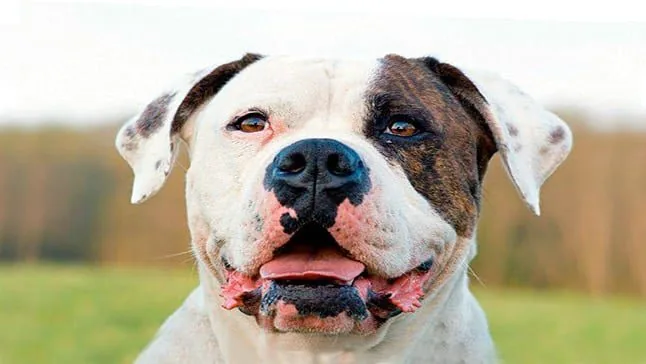
The head is large, wide, with a pronounced stop. A medium-length muzzle — neither flattened nor overly long — powerful jaws and thick lips that don't hang excessively. The ears appear natural, folded forward or rose-shaped; in some countries they're still cropped for aesthetic reasons, an increasingly questioned and restricted practice. Round and well-spaced, the eyes convey alertness without coming across as threatening. Muscular neck, slight dewlap. The topline stays firm, the chest is deep and well-arched, and the tail is set low — hanging at rest, rising in motion — without curling over the back.
Coat short, smooth and lying close to the body, with a texture that leans coarse. Colours range from solid white to combinations with fawn, brindle, red or brown patches in varying proportions. Solid black and dilute blue are colours not every breed club accepts. That said, such a thin coat offers little protection against extreme temperatures. The dog relies more on his fat insulation and on seeking shelter on his own to regulate his temperature.
The American Bulldog has a solid temperament: confident, well-balanced and deeply attached to his people. His protective instinct works with fair precision, since a well-socialised individual can tell perfectly well between someone arriving as an invited guest and someone who shouldn't be there. With children in the family he tends to be patient and affectionate, though his size means play needs supervising so nobody ends up on the ground by accident.
Temperament and life with an American Bulldog
A question that comes up a lot when people take an interest in this breed is whether it's classified as dangerous. In Spain, at the national level, the American Bulldog doesn't appear on that list, so he doesn't need a special licence, mandatory liability insurance or a muzzle in public, unlike other molosser breeds. That said, regional and local legislation can add its own restrictions, so before bringing a puppy home it's worth checking what your local council says.
He can live well in the city, as long as he gets the outings he needs and is exposed early to everything urban life involves: cars, other dogs, noises that show up without warning. Watch out for this: he's not a breed for someone with no experience handling strong-tempered dogs. His tolerance for clumsy or imprecise handling is lower than that of breeds bred purely for companionship, and that makes a real difference. He responds very well to positive training, because a bond built on trust holds up far better than one built on pressure. Coercive methods, with a dog this capable of pushing back, can end up producing exactly what they were meant to prevent.
Care and grooming
Maintaining an American Bulldog is simple compared to long-haired breeds, but that doesn't mean it should be neglected. His short coat benefits from a weekly brush with a rubber curry comb or grooming glove, which removes dead hair, stimulates blood circulation and spreads the skin's natural oils. During seasonal shedding, frequency can go up to two or three times a week to control hair loss around the home. Bathing is reserved for when the dog is visibly dirty or giving off an odour, generally every two or three months, using gentle shampoos that won't disrupt the skin's lipid layer.
Facial folds, where present, need daily attention. The moisture and warmth that build up in these wrinkles create conditions ripe for yeast and bacterial overgrowth. The routine is cleaning each fold with gauze dampened in warm water or a specific cleaning solution, then drying thoroughly afterward with a soft cloth or dry gauze. The ears, floppy in many individuals, should be checked weekly for signs of infection: redness, bad smell or discharge. Cleaning with a veterinary ear product, without inserting cotton swabs into the canal, is enough to keep the ear canal healthy.
Dental care and nail trimming round out the routine. Tartar build-up doesn't just cause bad breath — it can trigger bacterial infections that affect internal organs; brushing with enzymatic dog toothpaste at least three times a week reduces this risk. Nails, if they don't wear down naturally through exercise on abrasive surfaces, should be trimmed every three or four weeks to stop them from scraping the ground and altering the gait, which would have a negative knock-on effect on the joints. Getting the puppy used to this handling from the first weeks turns what could be a struggle into a moment of calm cooperation.
Common health conditions
Hip and elbow dysplasia is, as with almost all large breeds, one of the orthopaedic problems that causes the most concern in the American Bulldog. It has a genetic basis, but excess weight during growth or poorly planned exercise in the first months can make it considerably worse. Pain, lameness and early-onset arthritis are the usual consequences. Looking for breeders who X-ray their breeding stock and certify the degree of dysplasia is the best way to reduce that risk. The anterior cruciate ligament is also injured fairly often, especially in dogs that make sharp turns or don't have well-developed supporting muscle.
On the neurological side, there's a variant of neuronal ceroid lipofuscinosis specifically described in this breed. Signs — dysmetria in all four limbs and paraparesis — usually appear between one and three years of age “A Variant Form of Neuronal Ceroid Lipofuscinosis in American Bulldogs” (2005). The skin can also cause trouble: autosomal recessive congenital ichthyosis causes generalised scaling and erythema with adherent scales in areas of hairless skin, and is linked to a homozygous deletion in the gene involved “A Defect in NIPAL4 Is Associated with Autosomal Recessive Congenital Ichthyosis…” (2017). On the eye front, glaucoma linked to uveal cysts and goniodysgenesis has been documented, presenting with intraocular inflammation and, in a series of three cases, not responding to standard medical treatment “Glaucoma associated with uveal cysts and goniodysgenesis in American Bulldogs: a…” (2012). None of these three conditions affects every individual, but all three are reason enough to run genetic tests and specialist exams before breeding.
Allergies, whether food or environmental, are another common reason for vet visits. Itching, ear infections that keep coming back, irritation in the thinner-skinned areas. Pinning down the trigger — a grain, dust mites, a specific protein — requires an elimination protocol properly guided by a professional; self-medicating gets nowhere. At any change in gait, behaviour or the look of the skin, it's best not to wait: the sooner the problem is caught, the better the treatment options.
Knowing the genetic lines, the real exercise needs and the available health markers in detail changes the buying decision completely. It goes well beyond whether you like how the dog looks. The next step is visiting the breeder in person, observing the parents in their environment, and asking for certificates on dysplasia testing, heart conditions and molecular genetics before committing to a puppy.
IMPORTANT: This article is for informational purposes only and does not constitute veterinary, nutritional or behavioural advice. Every dog is different, and only your trusted vet can advise you on its specific needs.