 Breeds
American Hairless Terrier
The American Hairless Terrier is far more than a genetic curiosity: it's a living example of how a natural mutation can produce a functional, hardy dog full of character. Born in the southern United States, this small terrier combines the hunting tenacity of its ancestors with warm, velvety skin that defies every canine convention.
A Compact, Athletic Build
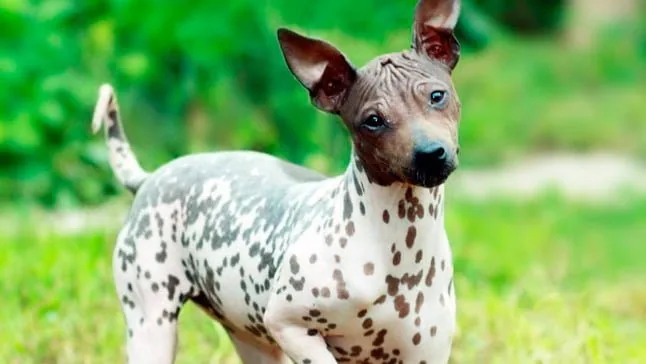
Under the official American Kennel Club (AKC) standard, the American Hairless Terrier is a small dog with a surprisingly sturdy build. Height at the withers ranges from 25 to 45 cm, while weight falls within a proportional range of 3 to 7 kg, with no significant difference between males and females.
Its body is rectangular, with a moderately deep chest and well-sprung ribs revealing lean, defined muscle. The legs, straight with fine but strong bone, give it feline agility. The ears, always erect and V-shaped, along with lively, expressive eyes, round out a silhouette that radiates energy even at rest. This breed's life expectancy runs between 14 and 16 years, notable for a dog of its size.
In the hairless variety, the skin is the most distinctive trait: soft, supple, and warm to the touch, similar to fine suede. It's free of wrinkles and can display any color or spotted pattern a normal coat would have, simply imprinted onto the skin. The coated variety, equally recognized under the standard, has a smooth, dense coat lying close to the body, identical to the original Rat Terrier's.
From Louisiana to the World: A Fortunate Mutation
This breed's story begins in Louisiana, during the 1970s, with an event many breeders would have dismissed. In a litter of Rat Terriers — dogs bred to control vermin on farms — a completely hairless puppy was born. Far from seeing it as a flaw, Edwin and Willie Scott decided to explore this trait and named her Josephine.
Through a meticulous breeding program, the Scotts managed to reproduce the mutation and fix it across successive generations without sacrificing the Rat Terrier's structure, instinct, or health. The result was a distinct line that kept the original hunting ability but added bare skin ideal for people with allergies. The United Kennel Club (UKC) was the first organization to recognize the breed, followed in 2016 by the AKC, which added it to its registry as the only hairless breed of American origin.
Temperament: Pure Terrier Essence
Beneath that unusual skin beats the heart of a classic terrier. The American Hairless Terrier is tireless, curious, and brave, with a spark of energy that never seems to run out. Its heritage as a hunter of rats and small vermin has given it a strong prey drive and a practical intelligence that demands constant stimulation.
At home it's affectionate and loyal with its family, though it can be reserved with strangers. This isn't a decorative or couch-potato dog: it needs to be part of household life and enjoys games that challenge its mind. Its alert temperament makes it an excellent alarm dog, always ready to announce anything new with its characteristic bark. Early socialization is key to tempering its natural intensity and ensuring balanced relationships with other animals.
Quirks That Make It Unique
The most obvious quirk is its total lack of coat, but the fascinating part lies in the genetics behind it. Unlike other hairless breeds, here baldness depends on a dominant gene, meaning just one parent needs to carry it for hairless puppies to be born. This same mutation was analyzed in a scientific study from the National Human Genome Research Institute, which investigated the molecular basis of hairlessness across several domestic breeds and confirmed how unique this terrier's inheritance mechanism is.
Another curiosity is that both varieties — hairless and coated — can appear in the same litter. The standard not only allows this, but considers it beneficial for maintaining genetic diversity and preventing inbreeding issues. Hairless dogs also shed their muzzle whiskers during the first few months, ending up completely smooth, and their skin can tan or lighten with sun exposure, as if wearing an invisible coat.
Health and Care for a Unique Breed
Hairlessness calls for rigorous skin protection. This breed is vulnerable to sunburn, so it needs dog-specific sunscreen for extended sun exposure, and in cold climates, it needs warm clothing to maintain body temperature. The skin also tends to dry out, so it's recommended to moisturize it with hypoallergenic lotions and bathe it with gentle shampoos to prevent irritation.
As for structural health, this is generally a sturdy breed, but it can develop patellar luxation and some dental problems, such as missing premolars, linked to the hairlessness gene. Its energy level calls for moderate daily exercise: active walks, scent games, and mini agility sessions are ideal for keeping it balanced. With proper care, this hairless terrier proves that a lack of coat isn't fragility, but a fascinating adaptation that makes it an exceptional companion.
IMPORTANT: This article is for informational purposes only and does not constitute veterinary, nutritional or behavioural advice. Every dog is different, and only your trusted vet can advise you on its specific needs.