 Breeds
American Pit Bull Terrier: Temperament, Care and Myths
Few dogs carry as much bad reputation with so little historical justification as the American Pit Bull Terrier. In the 19th century, those who bred him removed from their lines any individual that showed aggression toward people, because stability with the handler was a non-negotiable requirement. Here we cover his origin, what he looks like physically, and what his temperament is really like.
History and origin of the American Pit Bull Terrier
The American Pit Bull Terrier originates mainly in the United States, though with ancestors from the British Isles, where crossing the now-extinct Old English Bulldog with various working terriers, such as the Jack Russell Terrier, produced a versatile dog with a unique combination of power, agility and tenacity. These early dogs, generically known as bull-and-terrier types, were selected for farm work, vermin control and, unfortunately, for bull-baiting and later dog-fighting spectacles. The functional selection of that era prioritised stability with people — a dog that bit its handler was culled — which laid the groundwork for an exceptionally loyal, manageable temperament.
With emigration to North America, these dogs went with their owners and adapted to the needs of the new territory. In the United States, breeders refined the type and established the breed under the name American Pit Bull Terrier, sharing a common trunk with the Staffordshire Bull Terrier but developing as separate breeds mainly due to registry and selection criteria. The United Kennel Club recognised the APBT in 1898, while the American Kennel Club recognised the American Staffordshire Terrier in 1936, producing two lines that, though closely related, today show morphological and temperament differences. The Pit Bull's story is, then, that of a dog forged through function, whose adaptability let him excel as a farm dog, all-round hunter and family companion long before the media began stigmatising him.
Understanding this origin is key to correctly interpreting his behaviour today. The terrier heritage explains the persistence and drive he shows when faced with a stimulus, while the influence of the old bulldog contributes physical robustness and a powerful bite. However, no serious historical record supports the idea that these dogs were bred for indiscriminate aggression toward humans; on the contrary, selection always favoured dogs capable of working alongside people in changing environments, a trait that still defines the breed.
Physical appearance: standard and characteristics of the Pit Bull
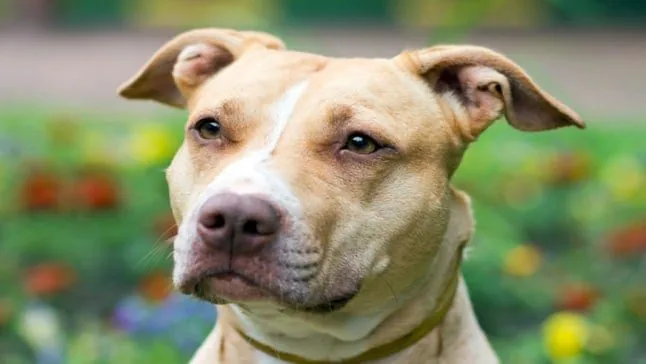
At first glance, the American Pit Bull Terrier makes an impression. There's a muscular density to that compact body that catches the eye before you notice any specific detail. Males run around 16–27 kg and stand 46 to 53 cm at the withers; females run a notch lower, at 14–23 kg and 43–50 cm. That dimorphism between sexes is pronounced and typical of the breed. The body is slightly longer than tall, and that proportion gives a rectangular silhouette without an ounce of coarseness. Seen from above, the head traces a well-recognisable wedge shape, with a flat skull, a moderate stop, wide, well-developed jaws, and a scissor bite that ensures a firm grip.
The coat is short, smooth and glossy, with no undercoat. It's quick to clean, though that same thinness leaves him exposed to cold or intense heat. The standard accepts practically every colour, with the exception of merle, a pattern whose origin in the breed experts have disagreed on for years. The ears can be natural, rose-shaped or semi-erect, or cropped, though across much of Europe the trend now favours leaving them untouched. The tail is set low and tapers toward the tip, never curling over the back. When the dog is well built, the stride is broad and the hindquarters swing with a rhythm of their own that reveals good biomechanical efficiency.
The mesocephalic skull shape doesn't compromise the airway the way it does in brachycephalic breeds. That said, eye health calls for separate monitoring. Mutations in the PDE6B gene can trigger early retinal degeneration called crd2, as documented by the study ‘IQCB1 and PDE6B Mutations Cause Similar Early Onset Retinal Degenerations…’ (2013). Every dog intended for breeding should undergo regular eye exams. As for overall structure, selecting breeding stock means matching muscular power with healthy joints. Pushing morphological extremes predisposes to dysplasia and ligament tears that the dogs end up paying for.
American Pit Bull Terrier: a temperament that doesn't match the myth
Anyone with a Pit Bull at home ends up giving everyone the same explanation: that he's nothing like what people say. The breed standard describes a confident, active dog with solid emotional balance, and those who live with one confirm, point by point, that yes, that's exactly how they are.
The APBT is a dog devoted to people. He doesn't handle indifference or prolonged solitude well, because for him, family is everything. He follows whoever he loves from room to room, gets in the middle of whatever's going on, and forms bonds intense enough to catch even the most sceptical off guard. But there's something else that doesn't match the stereotype. He's a sensitive dog. He picks up on the emotional state of whoever's next to him and adjusts his behaviour accordingly, which makes him an ideal candidate for positive training. He learns fast, anticipates what's about to happen, and comes through new situations well. And he doesn't get worked up easily; for a terrier, it takes quite a lot to put him on guard. If he reacts, there's usually a reason.
All of this needs a foundation. A puppy who hasn't seen the world — different people, noises, new environments — will find it much harder to develop that stable temperament. Socialisation in the first months isn't optional; without it, the qualities that define the breed stay buried under insecurity.
The truth behind the myth
The aggressive-toward-people Pit Bull is a stereotype that falls apart the moment you actually dig into it. Behavioural studies find no genetic predisposition in the APBT toward human hostility. American Temperament Test Society tests show many Pit Bulls passing at notable rates, though experts don't fully agree on how to interpret that data. What does show up more often is aggression toward other dogs, especially in unneutered, unsocialised individuals. That has its explanation in the terrier heritage, and it says nothing about how that animal behaves with people.
What really shapes behaviour is how the animal is raised. A dog kept chained, with no stimulation and no human contact, turns out badly regardless of breed. With the Pit Bull the problem is that his physical power turns any handling mistake into something with serious consequences, but that's not the same as saying the breed is inherently dangerous. Behavioural science has spent decades pointing out that aggression has more to do with an individual's learning, handling and emotional state than with the breed group it belongs to. When a Pit Bull reacts badly, the useful question is what happened to that specific dog, not what's supposedly written in his genes.
The Pit Bull's jaw: what the data says and what the myth invents
The figures circulating on forums and social media about the Pit Bull's bite force have no scientific backing whatsoever. None. Measurements with pressure transducers, under controlled conditions, put the American Pit Bull Terrier at between 235 and 250 PSI. That's a respectable figure, but the German Shepherd or the Rottweiler fall into very similar ranges, and any large molosser breed exceeds them by a fair margin. The claim that the Pit Bull has the strongest bite in the world is, plainly, a myth.
The story of the jaw that "locks" doesn't hold up anatomically at all. No dog has a ratchet-like mechanism that locks the temporomandibular joint in place; a Pit Bull's bones and muscles are the same as any other canine's. What he does have highly developed is prey drive. When he grips, he holds on, and he does it out of determination, not because something got stuck. His masseter and temporal muscles are very powerful, and combined with that tenacity, he can maintain pressure for minutes. But he can let go whenever he wants, and with proper training he does so on the first command. The whole myth comes from confusing "won't let go" with "can't let go". They're not the same thing.
Even so, the bite of any dog this size needs to be taken seriously, and the Pit Bull is no exception. A puppy who learns from an early age to regulate the pressure of his bite, and who gets used to not escalating when play gets intense, grows into an adult who causes no problems. Punitive methods don't work for this. Beyond simply not working, they break trust with the handler. What determines whether a dog is dangerous is self-control, not how many pounds of pressure his jaw can generate.
Life with children and other animals
He gets on wonderfully with children, provided he's been raised properly. A Pit Bull who's grown up in a family home puts up with handling, noise and kids' energy with a patience that surprises anyone who only knows the breed's media image. He seeks out their company. He sticks close to them. And that physical strength that scares so many people appears, paradoxically, kept in check when he interacts with little ones. Socialising him with children from puppyhood — their sudden movements, their shouting, their unpredictability — is what builds that familiarity. Without it, any dog can become a problem.
With other animals, things change. The terrier background can surface as selectivity toward other dogs, especially between males, and that's a pattern seen in many working breeds, not a sign of instability. Even so, the number of homes where a Pit Bull shares the sofa with cats and other dogs is proof enough that it works. The process matters more than the starting point. Gradual introductions, close supervision during the first weeks, and separate space for each animal. Early neutering also helps tone down certain competitive responses.
As with any breed, there are health predispositions worth knowing before taking the step. Anti-Babesia antibodies have been detected in Pit Bull and Staffordshire type dogs from breeders ‘Serosurvey of antiBabesia antibodies in stray dogs and American pit bull…’ (2003), and the first native cases of babesiosis caused by Babesia gibsoni in Europe were documented precisely in this breed ‘First Evidence of Babesia gibsoni (Asian genotype) in Dogs in Western…’ (2007). Watch out for ticks. Rigorous parasite prevention and regular vet check-ups make a real difference in longevity. A serious breeder will hand over health test results without anyone having to ask.
Energy level and daily exercise needs
The American Pit Bull Terrier is a high-energy dog who needs to channel his vitality through structured physical activity and mental stimulation. The minimum daily exercise requirement is 60 minutes, but that time should be seen as a baseline on top of which interactive play, training and exploration sessions get added. A calm walk around the block isn't enough; the Pit Bull needs moments of intensity — running, controlled tug, fetch — that engage his cardiovascular system and satisfy his drive to work. A dog who doesn't burn off his stored energy tends to develop unwanted behaviours such as destructive chewing, excessive barking or hyper-reactivity.
Mental stimulation matters just as much as physical exercise. Scent games, fillable toys, agility circuits or advanced obedience sessions keep his mind occupied and prevent boredom, the main trigger of behavioural problems in this breed. Activities like urban mushing or dock diving are especially rewarding for highly driven individuals, as long as they're introduced gradually and with respect for the puppy's skeletal development.
Planning a realistic exercise routine before adopting a Pit Bull is an exercise in honesty that's genuinely necessary. This isn't a dog suited to sedentary people or those with little free time. The good news is that, once his needs are met, the Pit Bull turns into a calm companion at home, able to relax for hours without demanding constant attention. The balance between activity and rest is the formula that lets you enjoy his affable temperament without that overflowing energy becoming a problem.
Training and education: how to work with a Pit Bull
The American Pit Bull learns fast. He has a real ability to read people and a genuine eagerness to get things right, which makes training easier from the very first days. Sessions should be short and varied, with food, toys or praise as rewards. That way learning sticks and the bond with the handler grows alongside it. Punishment-based techniques are a textbook mistake with this breed. They don't teach what to do, they build distrust, and they can trigger defensive responses in an animal as powerful as he is sensitive.
The socialisation window runs from 3 to 16 weeks. A big part of the dog's future is decided in that window. A puppy exposed during that time to different floors and textures, noises, all kinds of people and other animals develops a much more adaptable mind. The difference with dogs who don't go through that shows up later in how they handle frustration and whether they get overwhelmed by the unexpected. Puppy classes, walks through busy areas, controlled visits to friends' houses. Any well-managed exposure at that stage pays off for the rest of the dog's life.
In obedience work, impulse control and a reliable release command are essential. Exercises like "stay" with increasing distractions, "drop it" taught in exchange for something of higher value, or "heel" with changes of pace and direction, turn the Pit Bull's strength into something focused and precise. The rest comes down to the handler's consistency. A well-trained Pit Bull is one who looks up for instructions before acting, and that alone disproves the reputation for stubbornness he's often saddled with.
Adopting an American Pit Bull with your eyes open to his history, his needs and how he works emotionally completely changes the starting point. The sensible approach is to look for breeders or rescues who assess their dogs' temperament and genuinely support the adjustment period, because that first stage shapes a great deal of what comes after.
IMPORTANT: This article is for informational purposes only and does not constitute veterinary, nutritional or behavioural advice. Every dog is different, and only your trusted vet can advise you on its specific needs.