 Breeds
Staffordshire Bull Terrier
Although its muscular build and powerful jaw make people wary, the Staffordshire Bull Terrier is one of the most affectionate dogs there is, and one of the most tolerant with children. Its aggressive reputation is a myth kept alive by misinformation: a dog well socialized from puppyhood is as gentle as any other breed, though it does need an owner with a firm character and experience.
Physical Characteristics of the Staffordshire Bull Terrier
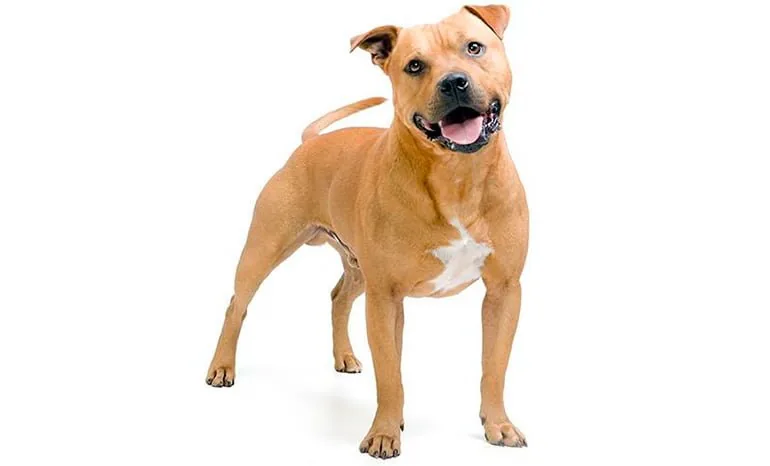
This is a medium-sized dog with a compact, muscular body. The back is wide, short, and straight, while the chest stands out for its width and depth. The neck, thick and well muscled, widens toward powerful shoulders. The tail, set low, is thick at the base and gradually tapers toward the tip.
The head has a cube-shaped skull, fairly wide, with a short face, broad forehead, and well-developed cheeks. The jaws are powerful and the nose is always black. The eyes are dark, matching the coat, and the ears can be rose-shaped or half-pricked.
The coat is short, smooth, and lies close to the body. The most common colors are red, fawn, and blue, as well as black and white. Bicolor and brindle patterns, or patterns with white patches, are also accepted.
- Height: 35-38 cm in males and females
- Weight: 12-17 kg in males; 11-15 kg in females
- Life expectancy: 12-14 years
- Coat type: Short, smooth, and close-lying
History and Origin of the Breed
The Staffordshire Bull Terrier originated in the 19th century in the county of Staffordshire, England, from a cross between Bulldogs and various Terriers. It was originally developed for dog fighting, a brutal sport that was legal at the time. However, the breed has evolved significantly since then.
When dog fighting was banned in the United Kingdom in 1835, breeders redirected the breed toward family life. Unlike its fighting ancestors, the modern dog was selected for its gentle temperament toward people, not for aggression. That deliberate shift is one of the greatest achievements of selective breeding.
The Staffordshire Bull Terrier was originally bred for dog fighting in the 19th century, but its temperament today is completely different from that of its ancestors: it's a family dog now, not a fighting one.
The British Kennel Club officially recognized the breed in 1935. Since then, it has grown in popularity as a companion dog worldwide, though it still suffers from unfounded prejudice.
Temperament and Personality
Despite its intimidating appearance, it has a gentle, deeply affectionate temperament. It shows exceptional tolerance with children, making it an ideal companion for families with kids.
Nothing makes it happier than spending time with its people: it loves curling up on the sofa, joining you on walks, or simply being present in everyday life. This is a breed that needs constant companionship. Leaving them alone for long periods causes anxiety and destructive behavior. People are the center of its universe, and it wants to take an active part in all family activities.
Although it's protective of its family and stays alert to potential threats, it doesn't stand out as a guard dog. Its friendliness toward strangers and lack of wariness make it fairly ineffective for watchdog duties.
Aggression: Myth Versus Reality
A well-bred dog socialized from puppyhood has an impeccable temperament with people. The problem arises when this breed gets confused with the Pit Bull, or when stereotypes based on its historical past are kept alive.
With other dogs, behavior is more variable. Some get along fine with fellow dogs; others show territoriality, especially toward dogs of the same sex once they mature. Early, ongoing socialization is essential to minimize these tendencies. With firm training from puppyhood and positive reinforcement, you get a calm, tolerant dog.
It's worth noting that although it's legally listed among potentially dangerous breeds in some countries, its temperament is perfectly compatible with family life when it receives proper training.
Difference Between the Staffordshire Bull Terrier and the Pit Bull
They're not the same breed, although they share common ancestors. The Staffordshire Bull Terrier emerged from crossing Bulldogs with various Terriers in 19th-century England. The Pit Bull, meanwhile, is a broader category that includes several breeds and types, and it's banned in the United Kingdom.
The Staffordshire is registered and recognized by the Kennel Club, with a clearly defined breed standard. Although the American Staffordshire Terrier and other variants descend from the original Staffordshire, each has its own characteristics and temperament. If you want to dig deeper into these differences between bull-type breeds, you'll find detailed information on their particular traits. Confusion between these breeds has contributed significantly to the prejudice against this one.
Training and Education
It's intelligent but not especially docile. It tends to do things its own way, which calls for an owner with firm leadership and experience. Adoption isn't recommended for people with a flexible personality or no prior experience with strong-willed breeds.
Early socialization is critical. From puppyhood it should be exposed to different people, environments, and, especially, other dogs to counter its territorial instincts. Without this foundation, it can develop aggression toward fellow dogs.
Training should be based on positive reinforcement combined with clear boundaries. They respond well to motivation through treats and praise, but need to understand that the owner is the one making decisions. Sessions should be short, consistent, and fun to hold their interest.
Daily Care and Needs
It requires regular but moderate exercise. Two daily walks of 30-45 minutes are enough to keep it balanced. Although it's muscular, it doesn't need intense training sessions; excessive exercise can damage its joints. If you're unsure how much physical activity it needs, factor in its age, weight, and individual fitness level.
It's a natural digger, so don't be surprised to find your yard full of holes. Make sure fences are buried deep enough, since they may try to escape underneath them. The urge to chew is strong, especially in puppies, so it needs constant access to sturdy, safe toys.
Coat care is simple: weekly brushing with a short-bristle brush is enough. Bathe monthly or as needed. Nails should be trimmed regularly and ears checked weekly to prevent infection.
BOOST ITS IMMUNE SYSTEMA balanced diet with omega-3 fatty acids strengthens the immune system and improves skin and coat health, reducing the incidence of allergies.
Common Health Problems
It's a fairly hardy breed, but it can suffer from certain hereditary conditions. Hip dysplasia is the most common, affecting the joint and causing pain or limping. It can also suffer from elbow dysplasia and patellar luxation.
On the eye front, it can develop hereditary cataracts and persistent hyperplastic primary vitreous. L-2-hydroxyglutaric aciduria (L2-HGA) is a hereditary genetic disease that affects the brain and, in some cases, shows up as altered behavior resembling dementia.
Skin allergies and demodectic mange are also common issues. The Kennel Club recommends regular eye tests and DNA screening to detect hereditary cataracts and L2-HGA before breeding.
- Hip dysplasia: Joint deformity that causes pain and restricted movement
- Hereditary cataracts: Clouding of the lens that affects vision
- L-2-hydroxyglutaric aciduria: Hereditary metabolic disorder affecting the nervous system
- Skin allergies: Allergic reactions that cause itching and dermatitis
- Patellar luxation: Displacement of the kneecap out of its normal position
Is the Staffordshire Bull Terrier the Right Dog for You?
This breed is ideal for active families looking for a loyal, affectionate companion who's tolerant of children. That said, it requires an owner willing to invest time in socialization, firm training, and regular exercise. It's not a dog to leave in the yard, nor one for people with little experience handling strong-willed breeds.
If you live in a small apartment, it can adapt as long as it gets enough exercise and mental stimulation. Its medium size and moderate activity needs make it more flexible than larger breeds. What it won't tolerate is prolonged loneliness: it needs to be part of family life.
Before adopting, make sure your lifestyle allows time each day for walks, play, and training. A well-trained dog is an extraordinary companion; one left to fend for itself becomes a problem. The choice is yours, but the responsibility is entirely yours too.
IMPORTANT: This article is for informational purposes only and does not constitute veterinary, nutritional or behavioural advice. Every dog is different, and only your trusted vet can advise you on its specific needs.