 Breeds
American Staffordshire Terrier
Anyone who has lived with an American Staffordshire Terrier (also called Amstaff) agrees on its qualities. This is a dog with real talent as a guardian, one that earns a place in your heart with very little effort.
Despite its stocky build, these dogs move with grace and elegance, a sign of self-confidence. Let's look at their main strengths and what precautions to keep in mind.
Characteristics of the American Staffordshire Terrier
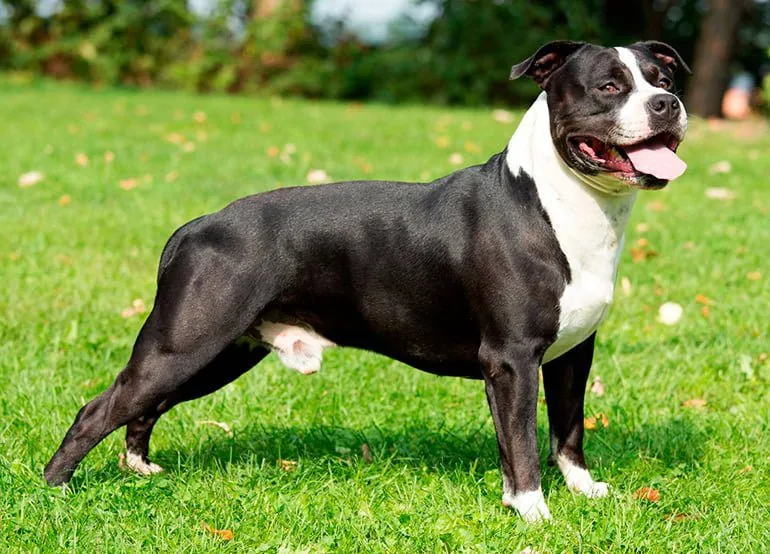
Dogs of this breed carry an innate courage, with a robust, muscular build. They are noticeably taller and more streamlined than their cousins, the English Staffordshire Bull Terriers, though their lines should give an impression of solidity rather than lightness. The back is short and muscular, the chest deep and wide, while the belly is not usually held very tucked up.
Their legs are fairly short, with no angulation in the front; the hindquarters are well developed. The tail is set low and relatively short in proportion to the rest of the body, thick at the base and tapering toward the tip.
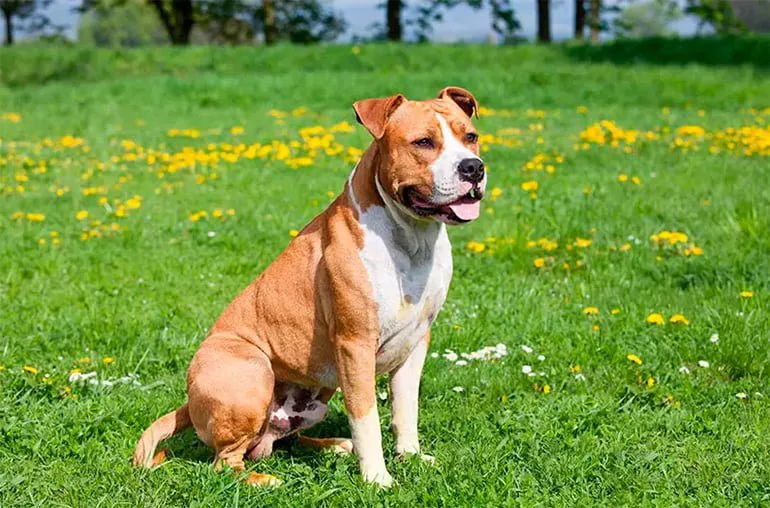
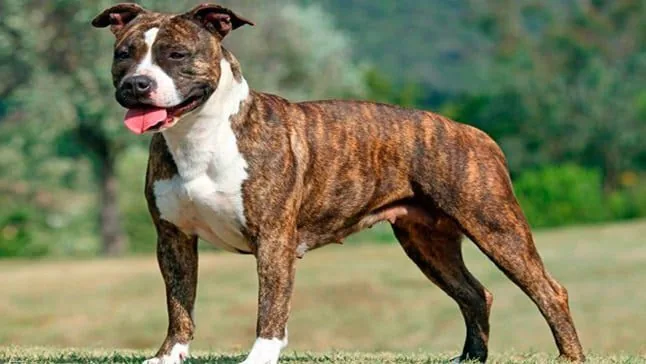
The skull is broad, with muscular cheeks, a muzzle with powerful jaws and a wide forehead. The nose is always black. The eyes are round and rather dark, set well apart. The ears are set high, medium-sized and rose-shaped.
The coat is glossy, hard to the touch but not overly coarse. Common colours are red, black, fawn and blue tones, though bicoloured dogs with white markings can also be found.
 Height of 46 to 48 cm in males and 43 to 46 cm in females
 Weight of 25 to 31 kg in males and 18 to 25 kg in females
 Short coat, close to the body
 Brave, protective and sociable temperament
 Strong health, though prone to hip and elbow dysplasia
 Estimated life expectancy of 12 to 16 years
What is the American Staffordshire Terrier's temperament like?
The American Staffordshire Terrier genuinely enjoys human company, making it an excellent family dog. A well-balanced Amstaff will want to join you on a walk or curl up beside you while you watch your favourite show. They are tremendously affectionate and can smother you in licks within seconds of you getting home.
They're very tolerant with children, especially if raised alongside them. Still, given their considerable physical strength, shared play should always be supervised. With other dogs the relationship tends to be difficult, owing to their heritage as fighting dogs. Living with small animals isn't advisable either, as they may see them as prey.
Loneliness is not their friend. They dislike being left alone and will show it through barking, digging holes in the garden, wrecking the plants or chewing up your favourite shoes.
Their eagerness to please makes them relatively easy to train, though a firm trainer who knows how to set boundaries is essential. Early socialisation helps temper their aggressive instincts toward other dogs, though these will never disappear entirely.
Care an American Staffordshire Terrier needs
These are dogs full of vitality that need intense daily exercise. Ideally they'd have a garden to romp around in, though they'll always prefer sharing the fun with someone over playing alone. They can adapt to flat living without a garden, but regular exercise outdoors is essential.
They need at least two long daily walks to stay balanced. They should always go out on a lead to avoid run-ins with other dogs or chasing small animals. A muzzle is mandatory, as in Spain they're classed as a Potentially Dangerous Breed (PPP). Never let them walk ahead setting the pace, as they'll take that as a sign they're the leader. They should always leave the house after you.
In normal periods they only need weekly brushing, though during their two annual moults you'll need to do it daily. Baths are needed two or three times a year, or whenever they get particularly dirty. Their coat doesn't usually give off the typical "wet dog smell," though their breath is known to be less than pleasant. Brushing their teeth daily helps with that.
History of the American Staffordshire Terrier
Although it descends from old English varieties such as the Bulldog and the Staffordshire Bull Terrier, it's considered a genuinely American breed, since it finished developing on American soil. The first dogs reached North America in the mid-19th century with settlers seeking their fortune in the West, who used these dogs for protection in a hostile environment.
At first they were indistinguishable from American Pit Bulls, though the two breeds diverged over the years and today their traits are clearly defined. By the 20th century they had become one of the American public's favourite varieties, though it took them time to shake off a reputation for aggression. Today they're highly valued as members of security forces, and also for their outstanding sporting ability.
Fun facts about the American Staffordshire Terrier
Although American Staffordshire Terriers are classed as a PPP breed under Spanish law, the truth is they tend to be very friendly and trustworthy with people. Properly socialised and trained, they pose no threat.
Their reputation for violence stems partly from being mistaken for Pit Bulls, a breed that can be more aggressive under certain circumstances. While both lines share the same ancestors, Amstaffs are far more stable and sociable with people.
They were very popular in the US for much of the 20th century, especially thanks to Stubby, a dog of this breed who served in the First World War. This dog was promoted to Sergeant for his actions in combat and remains the most decorated military dog in the country's history.
IMPORTANT: This article is for informational purposes only and does not constitute veterinary, nutritional or behavioural advice. Every dog is different, and only your trusted vet can advise you on its specific needs.