 Breeds
Barbet: Everything About the French Water Dog
The Barbet is a French water dog with a curly, nearly waterproof coat. Behind that endearing look lies an unusual genetic history, since today's entire population descends from a very small handful of founding individuals. A hunter in marshland, a natural retriever, a good companion at home. Nothing close to the Beagle's popularity, but the breed has been gaining ground for years.
Origin and history of the Barbet
The earliest documents mentioning the Barbet date from the 16th century, though earlier engravings and paintings already show curly-coated dogs very similar to him. The name comes from the French barbe, meaning beard, referring to the hair framing his muzzle. For generations he was the hunting companion in the marshes and wetlands of regions like the Camargue or Lower Normandy, going into the water without hesitation to retrieve downed game. His waterproof coat and compact musculature made him especially useful on boggy ground and in cold water other dogs avoided.
The two World Wars and the decline of traditional hunting nearly wiped the breed off the map. Recovery began in the 1970s thanks to a small group of French breeders who worked with very few founding individuals, leaving a narrow genetic base. That bottleneck shows up in the data from the study ‘Genetic variability in French dog breeds assessed by pedigree data’ (2006), which recorded an extraordinarily small effective number of ancestors for Barbet dogs in that period. To broaden that genetic pool somewhat, crosses were made with Portuguese Water Dogs and unregistered individuals of clear Barbet type, all under the supervision of the Société Centrale Canine. The Fédération Cynologique Internationale had already recognised him in 1954, though the standard applied today is the result of later reconstruction work. Outside France he remains an uncommon breed, with a bigger presence in the United States, Canada and the Netherlands, and still a modest arrival in Spain.
Watch out for reducing him to just a retriever. In the rural settings of earlier eras he also served as a companion, and sailors and millers used him as a watcher or messenger, trusting his memory and his tendency to stay close to the family. That combination — tireless worker in water, calm animal at home — is exactly what still characterises the breed today. Centuries of selection for cooperative work with people have left him with a predisposition to retrieving and a practical intelligence that hasn't gone away, even though hunting is no longer his usual destiny.
Physical characteristics of the Barbet
A medium-sized dog. That's the first thing you notice about the Barbet, though stopping there would be selling him short. The body is compact, well-muscled, with a solid bone structure that never becomes heavy, and that combination lets him move efficiently both in water and over difficult ground — mud, dense vegetation, waterlogged banks. The chest drops down to elbow level, a proportion giving him good lung capacity and letting him hold up through long working days without flagging.
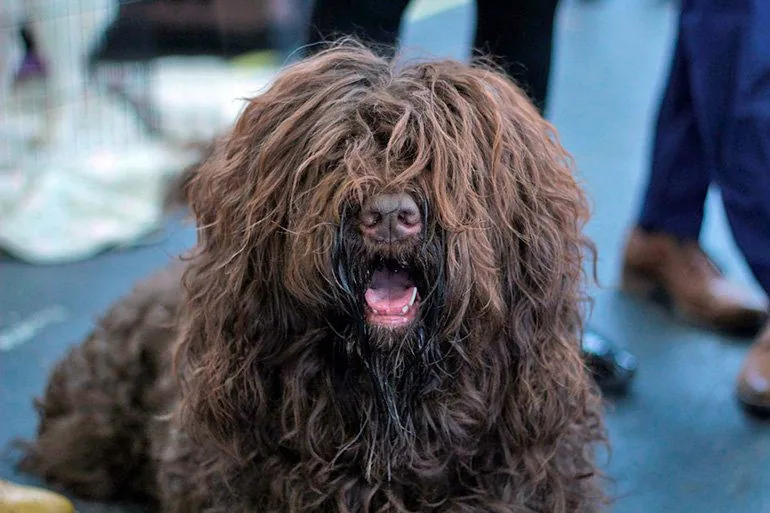
The coat is what sets the Barbet apart most at first glance. Curly, woolly and waterproof, it forms thick, elastic locks quite different from the tight curls of the Poodle, though they can look similar at a glance. It covers the whole body — head, tail, legs — and acts as natural insulation against cold water, the environment this breed was developed for. Colours accepted by the standard are black, grey, brown, fawn and white, either as a solid coat or with white markings on the chest, legs and muzzle. As for texture, it needs to be just right. If it's too fine or too coarse, the coat loses its function. Properly formed, it repels water and protects the skin from constant moisture; if not maintained regularly, it tends to mat and problems aren't far behind.
The head is well-proportioned, with a rounded skull and a moderate stop. The eyes — hazel or dark brown depending on the coat shade — carry an expression both gentle and lively, common in dogs bred to work close to people; the characteristic fringe partly covers them too. The ears are set low, fall close to the face and are covered in long, wavy hair. The tail, medium-length, is carried with a slight curve without ever curling over the back. Taken together, the Barbet conveys sturdiness with no exaggeration. Nothing in his build is there to impress in a show ring. Everything follows the logic of an animal bred to work in tough conditions.
Barbet temperament and behaviour
The Barbet's history working alongside the hunter has left its mark. Centuries of retrieving game in close coordination with a human have produced a dog who sees cooperation as something completely natural. He's sociable, even-tempered and deeply attached to his family. With strangers he doesn't rush in, but he doesn't put up an exaggerated guard either; he needs a moment to observe, and once he decides everything's fine, he shows it. With other dogs he manages without conflict, provided he's had decent early socialisation. Aggression doesn't fit what this breed is; in well-bred individuals it's practically nonexistent.
That said, there's plenty of dog underneath that calm. His retrieving instinct and pull toward water are still fully intact, and if not channelled, they'll find an outlet wherever they can. Swimming, search games, agility or tracking — a discipline where breeds like the Basset Hound excel — suit him wonderfully. Without a regular occupation, frustration shows fast. Barking for no reason, chewed objects, an underlying restlessness that's hard to ignore. His intelligence is high, but not the kind that executes mechanical commands without blinking. Offer him something varied, something that makes him think, and he responds beautifully. Make him repeat the same exercise ten times and he loses interest. He also picks up on his handler's mood with disconcerting precision; coercive methods or inconsistent guidance work terribly with him.
At home, with tired legs and an occupied mind, the Barbet is a calm, very tactile companion. He likes staying close to his people, following them from room to room, keeping a constant presence. The downside of that attachment is that, if left alone for many hours without gradual prior work on solitude, he can develop separation anxiety. He isn't a compulsive barker, though he'll alert when he notices something out of the ordinary. With a daily physical activity routine and consistent handling, he gives his best; without that, he comes apart at the seams.
Barbet training and education
For the Barbet, everything starts as a puppy. Early socialisation — water included, since he'll carry that love for life — is what separates a balanced adult from one who gets nervous at every novelty. Every walk through a market, every encounter with a stranger, every unexpected sound can become an opportunity if handled thoughtfully and without rushing.
He learns fast, which has its upside and its complicated side. A Barbet given the same exercises over and over starts inventing his own solutions, and they rarely match what the handler had in mind. He works very well with positive reinforcement. A treat given at the exact right moment, a calm but firm tone of voice, consistent body language. Harsh corrections shut him down and damage trust, something very hard to win back afterward.
Ten or fifteen minutes of work several times a day suits him far better than one long session. Overloading him gets nowhere. Bringing variety into the exercises — scent work, object searches, obstacle circuits — keeps his attention and makes each session feel different. Working on recall and impulse control around distractions is another level; if he spots a pigeon and hasn't internalised that control, obedience evaporates.
Teaching him to stay alone needs to start as early as possible, without waiting for the problem to show up. Very short absences at first, something entertaining to distract him, clear rules with no exceptions. With that foundation, an adult Barbet is a reliable dog, one you're happy to take out and who doesn't turn every routine into a headache.
He fits very well into a family, as long as there's movement. With children he has plenty of patience and a playful streak kids love, though adult supervision remains essential, as with any breed. That said, the movement needs to be real. An hour a day of genuine physical activity — free play, swimming, retrieving exercises — not short lead walks that barely engage him.
Spending many hours alone at home doesn't suit him. He needs to feel part of what's going on around him, take part in routines, be present. In families keen on heading out to the countryside, swimming in the river or doing canicross, he becomes a tireless companion. In sedentary households or ones with long absences, stress ends up coming out somehow, and it's rarely pleasant.
He gets on well with other dogs; he doesn't impose hierarchy, avoids conflict and generally fits in without drama when there's more than one dog at home. Watch out with small pets like rabbits or birds, though, since the retrieving instinct can surface if socialisation wasn't properly worked on from the start. Being medium-sized makes things easier. A flat or a house with a garden both work, though without guaranteed daily exercise, neither does.
Barbet care
Coat maintenance is the most demanding part of caring for a Barbet. His curly, woolly coat needs brushing two or three times a week with the right tools — a rotating metal-pin comb, a soft undercoat rake and, occasionally, a tool to break up incipient tangles — to stop the hair matting into patches that pull on the skin and can cause irritation. During shedding, which in this breed is light but continuous, brushing helps remove dead hair trapped between the curls. Bathing should happen roughly every four to six weeks, using shampoos specific to the breed that don't strip the coat's natural protective oils, and it's essential to dry the coat thoroughly down to the root to prevent fungal growth in damp areas.
Anyone wanting to know what care a Barbet needs will find ear hygiene deserves special attention. Floppy, hair-covered ears create conditions ripe for moisture and dirt build-up, which can lead to ear infections if not checked and cleaned regularly. A weekly clean with an ear product recommended by the vet, plus careful drying after every bath or swim session, is enough. The eyes also need watching: the fringe can irritate the cornea if it grows too long, so it's worth trimming it or tying it back with a gentle band to keep the eye area clear.
A minimum of an hour of daily exercise isn't negotiable for this breed. That hour should include aerobic activity — running, swimming, playing fetch — as well as time for free sniffing exploration, which contributes to his mental balance. Nails need periodic trimming if natural wear isn't enough, and his teeth benefit from regular brushing with dog-specific toothpaste. Diet needs to match his activity level and age, opting for quality kibble or a diet supervised by a professional. A well-cared-for Barbet doesn't just show a healthy, glossy coat — he keeps a lively, cooperative attitude throughout his life.
Barbet health
He's generally a healthy breed, but his narrow genetic base — a consequence of a historically small population — makes him prone to certain problems worth knowing about in advance. The most documented are hip dysplasia and elbow dysplasia, which affect joint development and present with lameness, pain or difficulty moving, sometimes in young dogs and other times in adults.
On the eye front, the two most recorded conditions are progressive retinal atrophy and hereditary cataracts. The first gradually deteriorates vision; early diagnosis doesn't cure it, but it allows the environment to be adapted so the dog keeps a good quality of life. An annual eye exam makes sense precisely for that reason. Hypothyroidism and skin allergies, usually presenting with persistent itching and red skin, show up less often. If the dog's behaviour changes, his eating habits shift or his coat loses condition, see the vet without waiting.
Controlling weight is perhaps the most direct preventive measure. Joint overload speeds up dysplasia problems, and in a breed with that predisposition, extra kilos count double. Regular exercise — always adjusted to age — builds the muscle that protects the joints better than any supplement. A quality diet, with a good presence of omega-3 fatty acids, also contributes to skin and coat health. There are no precise figures on the exact prevalence of these conditions in the current Barbet population, but clinical experience leaves little doubt on the matter. Ethical breeding and responsible management are, long term, what determines these dogs' health the most.
Between €1,200 and €2,000 is what a specialist breeder in Spain asks for a Barbet puppy with all the documentation in order. That amount covers the breeding stock's health tests — hip and elbow X-rays plus eye exams — registration in the studbook, vaccinations, deworming, microchip and follow-up through the first weeks of life. Breeders with early socialisation programmes, high-end diets and written health guarantees tend to sit at the top of that range.
The initial outlay is just the first chapter. A dog this size and activity level needs between €400 and €600 a year in quality food. Routine vet visits — annual check-up, vaccines, deworming — add another €200-400 a year with no health problems involved. Opting for professional grooming every six to eight weeks means budgeting €300-500 more. Liability and vet-cover insurance are optional, though quite a few families take them out to have unexpected costs covered.
Adopting an adult Barbet through rescue associations specialising in water dogs cuts the cost considerably. The adoption fee rarely exceeds €200-300, covers basic vet expenses, and has the advantage that the animal has already left behind the most chaotic puppy phase. Whichever path is chosen, the first thing is thinking honestly about whether the family's pace of life genuinely fits what this breed needs. More than ten years of living together are at stake.
Before deciding, visit more than one breeder and ask to meet the parents in person. Health documentation — hip, elbow and eye tests — should be available without having to ask twice. A breeder who does things properly has no problem showing it or answering everything you ask.
IMPORTANT: This article is for informational purposes only and does not constitute veterinary, nutritional or behavioural advice. Every dog is different, and only your trusted vet can advise you on its specific needs.