 Breeds
Basset Hound: Complete Guide to the Most Charismatic Breed
Few breeds win over hearts as instantly as the Basset Hound. Behind that seemingly mournful gaze and those endless ears hides a tireless tracker, a hound whose whole world revolves around its nose. Living with one means accepting an independent character and a scent-driven determination that has no time for hurry or strict commands.
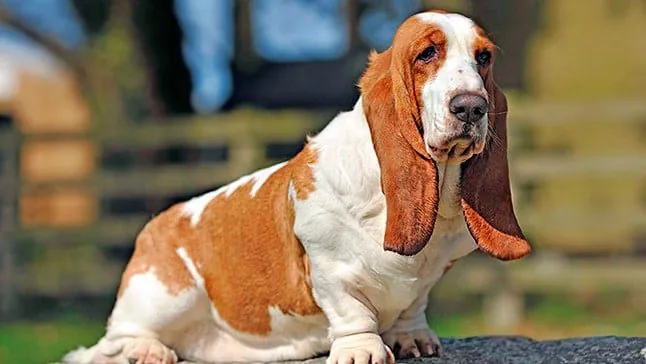
Physical traits that defy logic
The Basset Hound has a solid body and extremely short legs, a combination that catches people off guard at first glance. According to the official American Kennel Club (AKC) standard, its height at the withers doesn't exceed 35.5 cm, while weight ranges from 18 to 29 kg in males and 18 to 25 kg in females. This mismatch between body and limbs comes from a form of chondrodystrophic dwarfism that shortens the long bones without reducing overall body size.
The head is broad and domed, with a well-defined stop. The diamond-shaped eyes show the lower eyelid's conjunctiva, which heightens that characteristic melancholy expression. The ears, set low and velvety in texture, are so long they brush the ground when the dog lowers its muzzle. The skin forms generous folds on the face and a full dewlap at the neck. The coat is short, dense and smooth, and accepts any hound colour; the most popular is tricolour (black, white and tan), followed by lemon and white. Life expectancy falls between 10 and 13 years.
From French hunting grounds to the British parlour
The Basset Hound was born in 19th-century France to meet a very specific need of the hunting aristocracy: a hound with an exceptional nose but a low build, one that could be followed on foot rather than on horseback. The word "Basset" comes from the French "bas," meaning low, describing its stature literally. Short-legged hunting dogs already existed in earlier centuries, but it was in this era that deliberate genetic selection began to fix the type.
The modern Basset Hound owes much of its current look to British breeders' work. In Britain, crosses with the Bloodhound were introduced to sharpen the nose further and emphasise traits such as the extremely long ears and loose skin. That influence cemented the Basset Hound as a small-game specialist —rabbits and hares— and laid the groundwork for the dog we know today. Its leap from hunting grounds to living rooms as a companion animal took place over the course of the 20th century, driven by its distinctive looks and easy-going temperament.
A stubborn hound with a companion's heart
The Basset Hound is, above all, a pack hound with a gentle, sociable temperament. At home it's patient, affectionate and surprisingly tolerant of children and other dogs. It isn't a guard dog or especially watchful; its nature leans more toward a slow wag of the tail than barking at every noise.
Once an interesting scent catches its attention, however, its tracking instinct overrides everything else. That nose-driven determination translates into a legendary stubbornness that can frustrate first-time owners. It doesn't respond well to sharp commands or training built on mechanical repetition; it prefers positive motivation, and above all, food. It's intelligent but independent, and tends to make its own calls whenever a trail crosses its path.
Secrets unique to the Basset Hound
Few people know that its iconic ears aren't just decoration: as they drag along the ground, they stir up and channel scent particles toward its nose, working like a true scent radar. Combined with the skin folds, which trap smells, they turn this dog into a precision tracking machine.
Its characteristic low stature comes from a form of chondrodystrophic dwarfism that shortens the long bones. This defining breed trait is linked to a specific retrogene, as shown by a scientific study from the National Human Genome Research Institute, which identified the mutation responsible for chondrodysplasia in domestic dogs. What's more, the melancholy expression that so many humans find endearing isn't sadness at all, but a visual effect caused by the visible conjunctiva of the lower eyelid, a trait typical of the breed.
Health and care of the short-legged hound
The elongated build and short legs predispose the Basset Hound to spinal problems, such as intervertebral disc disease, so it should avoid frequent stair climbing or jumping from height. Obesity is another serious risk, since excess weight puts even more strain on its fragile back; keeping food intake under control is essential.
The facial folds and long ears need weekly cleaning to prevent infections from trapped moisture and dirt. As for exercise, it doesn't need exhausting runs: calm daily walks, always on a lead so an interesting smell doesn't lead it astray, are enough to keep it in shape. Its short coat only needs an occasional brushing to remove dead hair.
IMPORTANT: This article is for informational purposes only and does not constitute veterinary, nutritional or behavioural advice. Every dog is different, and only your trusted vet can advise you on its specific needs.