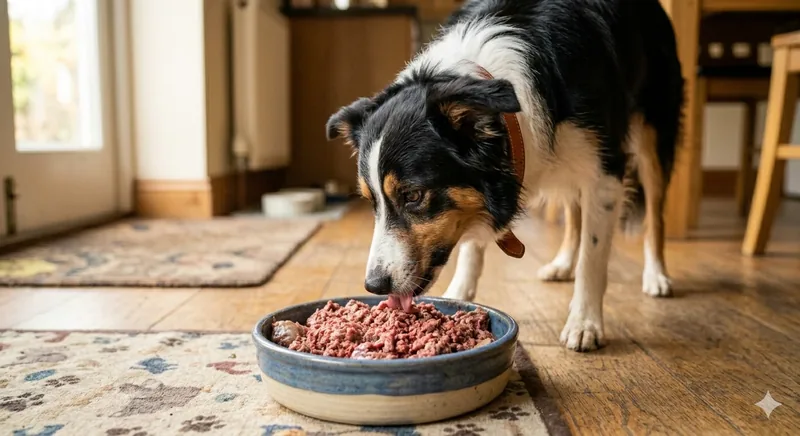
 Nutrition
Before Buying CRU BARF You Should Know…..
If you're reading this it's because you've already heard about the BARF diet and you're wondering whether it's really worth it, whether it's as complicated as it seems, or whether your dog specifically could benefit from it. This guide is real information, checked against scientific studies and the official nutritional data for CRU BARF products, a Spanish company that has spent years working on natural canine feeding under what they call the CRU Method.
We're going to talk about what the BARF diet is, what the science says about it, what menus CRU BARF offers (with all their nutritional data taken directly from their product sheets), and which type of dog each one suits best.
1. What Is the BARF Diet, and Where Does It Come From?
BARF stands for Biologically Appropriate Raw Food, a concept popularised in the 90s by Australian vet Ian Billinghurst. The central idea is simple: a dog's digestive system is designed to process raw food — meat, bone, offal, some vegetables — and not to digest the large amounts of carbohydrate or ultra-processed ingredients that characterise much of the conventional pet food industry.
It's worth qualifying something from the start: the domestic dog isn't a wolf, and claiming their diet should be identical to that of a wild predator would be oversimplifying. Dogs have spent thousands of years co-evolving with humans and have developed a greater ability to digest starch than their ancestors. That said, their digestive system remains fundamentally carnivorous, with a highly acidic gastric pH and a short intestinal transit time — characteristics that favour digesting raw animal protein.
Scientific note: A study published in the Journal of Animal Science (Algya et al., 2018, University of Illinois) showed that dogs fed raw or lightly cooked diets showed high palatability and digestibility, with lower blood triglyceride levels than those fed extruded kibble, while maintaining normal wellbeing parameters throughout the study. (Source: PMC/PubMed)
1.1 What Does the Science Say About the BARF Diet?
The scientific literature on the BARF diet has grown considerably in recent years. There's interesting data, but also important nuances worth knowing.
Gut microbiome and digestibility. Several studies published on platforms such as PubMed and BMC Veterinary Research point out that raw-food-based diets produce significant changes in the canine faecal microbiome, with differences in bacterial diversity compared with extruded diets. A study in BMC Veterinary Research (Sandri et al., 2017) concluded that a raw diet with vegetables promoted more balanced bacterial growth and positive changes in gut health markers.
Immune system. A 2024 study published in Frontiers in Veterinary Science (Hiney et al.) found that dogs fed a raw diet had significantly higher levels of faecal IgA — a marker of intestinal immune response — compared with dogs fed kibble, even though the former were older. This suggests a possible link between raw feeding and a better gut immune response. (See the full study)
What still isn't entirely clear. A review published in the Journal of Small Animal Practice (Davies et al., 2019, on PMC) points out that, although there's consistent evidence for improved digestibility and stool quality, many of the broader benefits attributed to the BARF diet still lack high-quality studies backing them up conclusively. What does exist is solid scientific grounding for certain digestive and immune benefits, and no evidence of harm in properly formulated diets.
Real risk: Poorly formulated BARF diets — especially home-made ones with no nutritional supervision — can cause mineral imbalances or vitamin shortfalls. That's why it matters that commercial menus like CRUBARF's are formulated by specialist nutritionists.
2. CRU BARF and the CRU Method: How Do They Work?
CRU BARF is a Spanish natural food company for dogs (and cats) delivering to mainland Spain, the Balearic Islands and Portugal. Although the BARF diet is one of its pillars, its offering goes further: they work exclusively with natural ingredients across all their product lines, aiming to improve animals' health and quality of life through feeding. Their BARF menus are made under what they call the CRU Method, a formulation developed by specialist nutritionists that follows a clear proportional structure and respects a dog's digestive physiology.
2.1 The Basic Structure of Their Menus
According to CRU BARF, all their menus follow roughly this proportion:
- 40% raw meaty bones (wings, carcasses, windpipes…)
- 30% fresh meat or fish
- 10% offal (with a minimum of 5% liver)
- 20% natural fruit and vegetables
What sets their offering apart is that they use no meal, by-products, preservatives, additives or supplements. Preservation is done solely through blast-freezing, which preserves the ingredients' nutritional profile with no need for chemical treatments. All their ingredients are domestically sourced, which also guarantees greater traceability.
The nutrition team is led by Sandra Moya, a nutritionist specialising in natural nutrition and the BARF diet for dogs and cats, directly reachable through the website to answer personal questions.
2.2 Formats Available
CRUBARF offers its BARF menus in several formats:
- 500 g bag format: ideal for small and medium dogs, or for easily rotating proteins.
- 800 g medallion format: for the fish menus (Salmon and Chicken, Cod and Turkey).
- 900 g medallion format: designed for medium and large dogs. The medallions make portioning easier.
- Packs and boxes (Super CRU Box / Ultra CRU Box): boxes of 24 or 30 packs offering a saving of between 6% and 10% on the individual price.
- BARF starter pack with no offal (€7.99): designed specifically for dogs starting on the BARF diet who aren't yet used to offal.
Every frozen menu is shipped with dry ice to keep the cold chain intact. Shipping costs for frozen orders are €10 for orders between €50 and €99, and free from €99. For orders under €50 (for example, just 2 packs), shipping costs €20. Combining different menus — even dog and cat ones — makes it easy to reach the €50 minimum and get the cheaper shipping.
They also have a monthly subscription (My CRU) that includes a fixed 10% discount on every order, personalised email follow-up with a nutritionist (valued at €50 a month) and other exclusive benefits.
https://www.youtube.com/watch?v=Kb7SXqhsK4Q
3. CRUBARF's BARF Menus: Complete Table With Official Data
Below is a detailed breakdown of every menu currently available in CRU BARF's BARF diet for dogs section, with nutritional data and ingredients taken directly from their official product sheets on crubarf.com.
MONOPROTEIN Chicken ✅ In stock Format500 g (minced) Price€5.10 Energy140 kcal/100g Protein15.5% Fat7% Moisture75% Fibre0.5% Ash<0.5% MONOPROTEIN Free-Range Chicken ✅ In stock Format900 g (medallions) Price€9.90 Energy148 kcal/100g Protein15.9% Fat8.6% Moisture71.5% Ash2.3% MONOPROTEIN Turkey ✅ In stock Format900 g (medallions) Price€9.90 Energy166 kcal/100g Protein16.2% Fat10.09% Moisture69.3% Ash2.9% MONOPROTEIN Rabbit (minced) ✅ In stock Format500 g (minced) Price€6.60 Energy140 kcal/100g Protein17% Fat7% Moisture75% Fibre0.5% Ash<0.5% MONOPROTEIN Rabbit (sausages) ✅ In stock Format500 g (sausages) Price€6.60 Energy140 kcal/100g Protein17% Fat7% Moisture75% Fibre0.5% Ash<0.5% Beef and Chicken ✅ In stock Format500 g (minced) Price€5.60 Energy146 kcal/100g Protein15% Fat8.5% Moisture74.5% Fibre<1% Ash<1% Lamb and Chicken ✅ In stock Format500 g (minced) Price€5.30 Energy165 kcal/100g Protein15% Fat11% Moisture73.5% Fibre0.5% Ash<0.5% Lamb and Turkey ✅ In stock Format900 g (medallions) Price€9.90 Energy220 kcal/100g Protein15.4% Fat16.8% Moisture63.6% Ash2.3% Turkey and Anchovy ✅ In stock Format500 g (minced) Price€5.40 Energy165 kcal/100g Protein15% Fat11% Moisture73.5% Fibre0.5% Ash<0.5% Salmon and Chicken ✅ In stock Format800 g (medallions) Price€8.29 Energy201 kcal/100g Protein13.1% Fat15.9% Moisture68% Fibre<1% Cod and Turkey ✅ In stock Format800 g (medallions) Price€8.95 Energy138 kcal/100g Protein13.9% Fat7.34% Moisture73.2% Fibre<1% Menu Format Price kcal/100g Protein Fat Fibre Moisture Ash Stock MONOPROTEIN Chicken500 g (minced)€5.1014015.5%7%0.5%75%<0.5%✅ MONOPROTEIN Free-Range Chicken900 g (medallions)€9.9014815.9%8.6%—71.5%2.3%✅ MONOPROTEIN Turkey900 g (medallions)€9.9016616.2%10.09%—69.3%2.9%✅ MONOPROTEIN Rabbit500 g (minced)€6.6014017%7%0.5%75%<0.5%✅ MONOPROTEIN Rabbit500 g (sausages)€6.6014017%7%0.5%75%<0.5%✅ Beef and Chicken500 g (minced)€5.6014615%8.5%<1%74.5%<1%✅ Lamb and Chicken500 g (minced)€5.3016515%11%0.5%73.5%<0.5%✅ Lamb and Turkey900 g (medallions)€9.9022015.4%16.8%—63.6%2.3%✅ Turkey and Anchovy500 g (minced)€5.4016515%11%0.5%73.5%<0.5%✅ Salmon and Chicken800 g (medallions)€8.2920113.1%15.9%<1%68%—✅ Cod and Turkey800 g (medallions)€8.9513813.9%7.34%<1%73.2%—✅Source: official product sheets from crubarf.com/collections/dieta-barf-perros. Fields marked as — correspond to parameters not published on the product's official sheet at the time of checking (April 2026). Prices in €, VAT included. Availability subject to change. For always up-to-date information, check the official website directly.
4. Complete Ingredients of Each Menu
Below is the full composition of each menu, according to CRUBARF's official sheets:
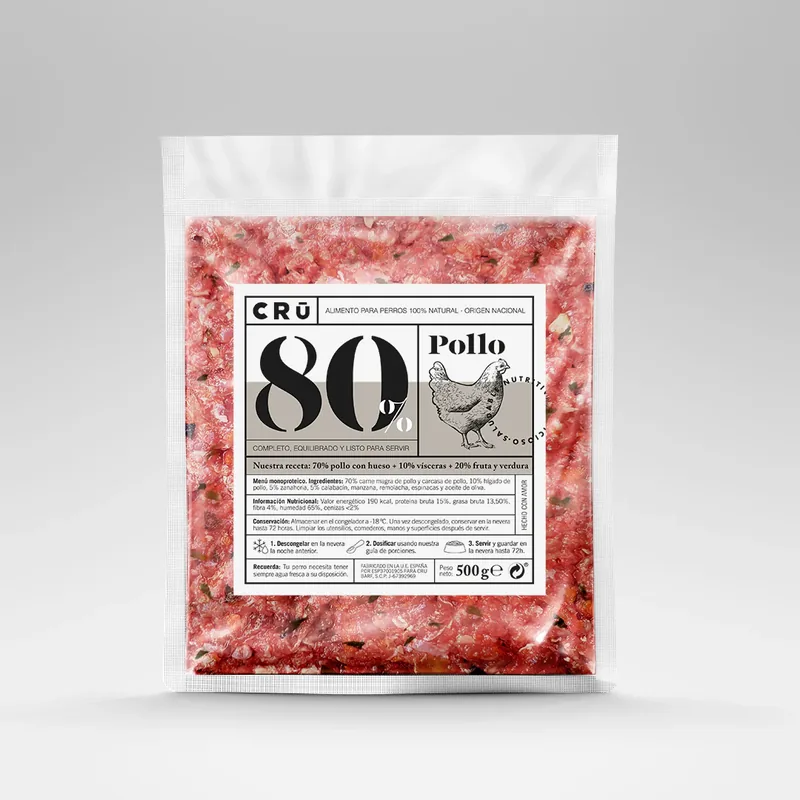
4.1 BARF Chicken Menu — 500 g (Minced)
- Ingredients: 70% lean chicken meat and chicken carcass, 10% chicken liver, 5% carrot, 5% courgette, apple, beetroot, spinach and olive oil.
- Nutritional data (per 100 g): Energy value 140 kcal | Crude protein 15.5% | Crude fat 7% | Fibre 0.5% | Moisture 75% | Ash <0.5%.
- Website: https://crubarf.com/products/menu-barf-de-pollo-para-perro-500g
Chicken is one of the most widely used proteins in canine feeding for objective reasons: it's highly digestible, has an excellent essential amino acid profile and its fat content is relatively moderate. With just 140 kcal/100 g and 7% fat, it's suitable for dogs prone to weight gain, neutered dogs or those with low physical activity. It's also the ideal menu for starting the transition to the BARF diet, since chicken is a familiar protein well tolerated by most dogs. It's suitable for puppies and senior dogs. In monoprotein format, it's also useful as a base for elimination diets when an intolerance is suspected.
4.2 BARF Free-Range Chicken Menu — 900 g (Medallions)
- Ingredients: 65% whole free-range chicken, 10% courgette, 10% chicken heart, 10% carrot, 5% chicken liver.
- Nutritional data (per 100 g): Energy value 148 kcal | 617 kJ.
- Website: https://crubarf.com/products/menu-barf-de-pollo-de-corral-para-perro-medallones-900g/
A medallion version of the chicken menu, made with whole free-range chicken, which adds an extra quality component compared with the 500 g format. Ideal for medium and large dogs already established on BARF, with the added benefit of easy portioning that the medallion format offers.
4.3 BARF Turkey Menu — 900 g (Medallions)
- Ingredients: 35% lean turkey meat, 35% meaty turkey bone, 10% carrot, 5% courgette, 5% turkey heart, 5% turkey liver, 5% turkey gizzard.
- Nutritional data (per 100 g): Energy value 166 kcal | 691 kJ.
- Website: https://crubarf.com/products/menu-barf-de-pavo-para-perro-medallones-900g/
A monoprotein turkey menu, a white meat with a very clean nutritional profile: high protein, low saturated fat and good digestibility. Being monoprotein, it's very useful for dogs with food allergies or sensitivities and in elimination diet protocols. The 900 g medallion format makes portioning easier for medium and large dogs.
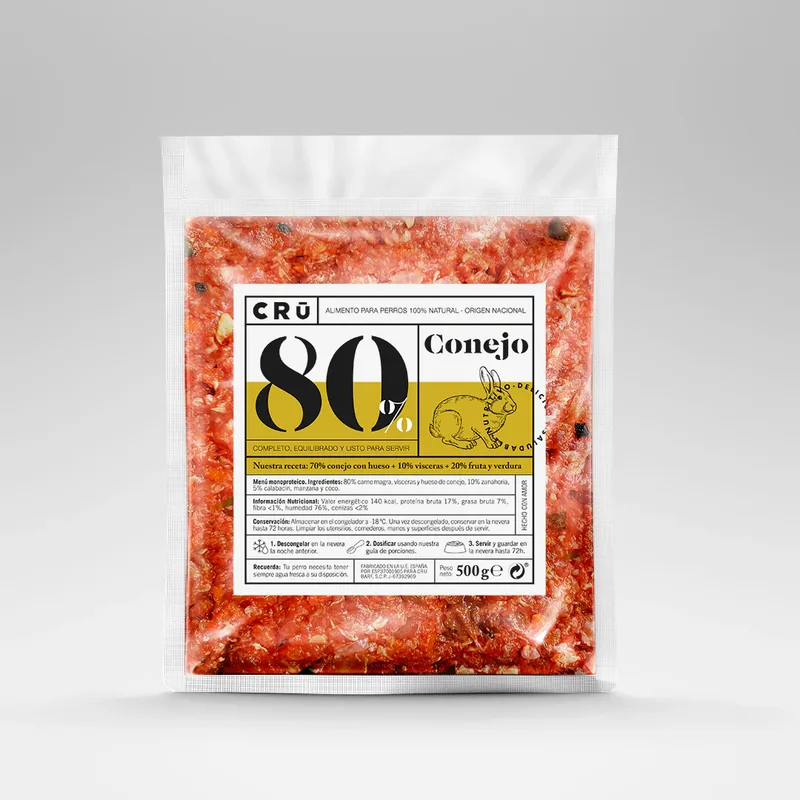
4.4 BARF Rabbit Menu — 500 g (Minced and Sausages)
- Ingredients: 80% lean meat, offal and bone from rabbit, 10% carrot, 5% courgette, apple and coconut.
- Nutritional data (per 100 g): Energy value 140 kcal | Crude protein 17% | Crude fat 7% | Fibre 0.5% | Moisture 75% | Ash <0.5%.
- Website: https://crubarf.com/products/menu-barf-conejo-para-perro-500g/
Rabbit is a novel or uncommon protein for most dogs, which makes it the ideal option in contexts of food allergies and intolerances. It's the richest protein in the 500 g range (17%), low in sodium and easy to digest. The sausage format makes portioning easier for very small dogs or those starting out on BARF. Note: currently out of stock in both formats, available for a restock alert.
4.5 BARF Beef and Chicken Menu — 500 g (Minced)
- Ingredients: 30% lean beef, 30% lean chicken meat and chicken carcass, 5% beef liver, 5% beef windpipe, 5% apple, 4% green tripe, carrot, courgette, beef heart, beef kidneys, beef lung, beetroot, red pepper, blueberries and olive oil.
- Nutritional data (per 100 g): Energy value 146 kcal | Crude protein 15% | Crude fat 8.5% | Fibre <1% | Moisture 74.5% | Ash <1%.
- Website: https://crubarf.com/products/menu-barf-ternera-y-pollo-para-perro-500g/
Beef provides a different nutritional profile from chicken: more haem iron (highly bioavailable), more zinc and a different fatty acid ratio. Green tripe — unwashed beef rumen — provides digestive enzymes and beneficial bacteria that support gut flora. This is a menu especially recommended for active or sporting dogs, since beef's haem iron supports oxygen transport in the blood.
4.6 BARF Lamb and Chicken Menu — 500 g (Minced)
- Ingredients: 50% lean chicken meat and chicken carcass, 20% lean meat, heart and lungs from lamb, 10% lamb liver, 5% apple, 5% carrot, 5% courgette, 3% blueberries, olive oil and brewer's yeast.
- Nutritional data (per 100 g): Energy value 165 kcal | Crude protein 15% | Crude fat 11% | Fibre 0.5% | Moisture 73.5% | Ash <0.5%.
- Website: https://crubarf.com/products/menu-barf-cordero-y-pollo-para-perros-500g/
Lamb has a higher energy density than chicken or rabbit (165 kcal/100 g), with 11% fat. It provides an interesting ratio of omega-6 fatty acids that support skin health and coat shine, and is especially rich in zinc and selenium. Because of its higher calorie content, this menu is especially suited to active, working dogs or ones with high energy demands. Blueberries provide antioxidants (anthocyanins) and brewer's yeast is a source of biotin, useful for maintaining skin and coat.
4.7 BARF Lamb and Turkey Menu — 900 g (Medallions)
- Ingredients: 35% meaty turkey bone, 20% lean turkey meat, 15% lamb pluck, 10% lamb liver, 10% carrot, 5% lamb caul fat, 5% lamb tripe.
- Nutritional data (per 100 g): Energy value 220 kcal | 916 kJ.
- Website: https://crubarf.com/products/menu-barf-de-cordero-pavo-para-perro-medallones-900g/
The highest-energy-density menu across the whole medallion range, at 220 kcal/100 g. The lamb-turkey combination offers two complementary protein profiles: lamb provides greater energy density and richness in minerals such as zinc, while turkey provides digestive lightness. It's the most suitable menu for dogs with high energy demands, large breeds doing active work, or dogs needing to gain weight.
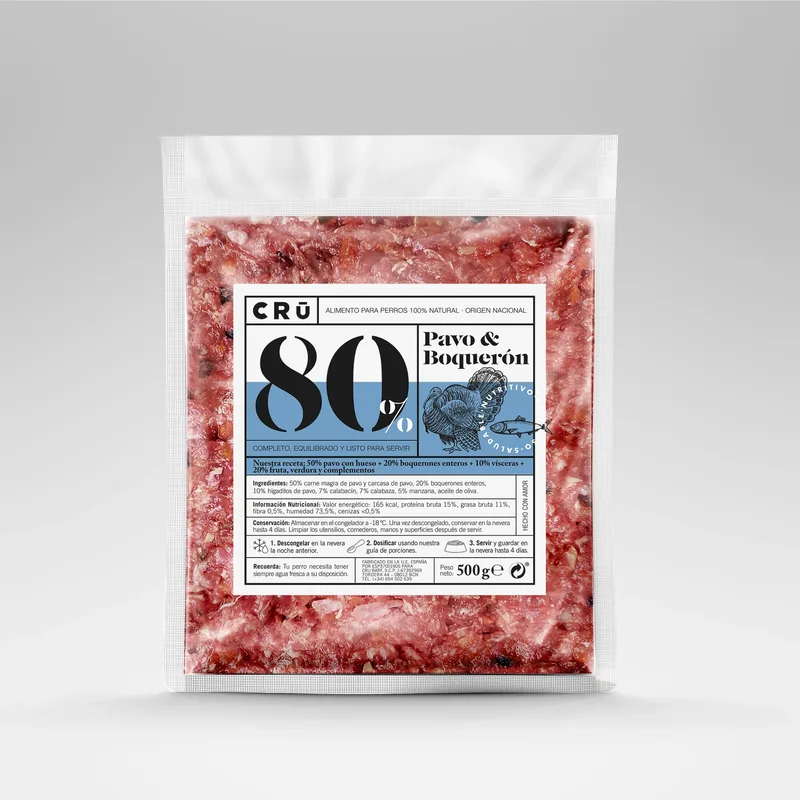
4.8 BARF Turkey and Anchovy Menu — 500 g (Minced)
- Ingredients: 50% lean turkey meat and turkey carcass, 20% whole anchovies, 10% turkey livers, 7% courgette, 7% pumpkin, 5% apple, olive oil.
- Nutritional data (per 100 g): Energy value 165 kcal | Crude protein 15% | Crude fat 11% | Fibre 0.5% | Moisture 73.5% | Ash <0.5%.
- Website: https://crubarf.com/products/menu-barf-pavo-y-boqueron-para-perros-500g/
Anchovy is a small oily fish, very rich in long-chain omega-3 fatty acids (EPA and DHA), with the advantage of sitting low in the food chain, which reduces the build-up of heavy metals such as mercury. This combination is very interesting for dogs with joint problems, chronic inflammation or skin conditions, thanks to the omega-3 anchovy provides. Note: currently out of stock.
4.9 BARF Salmon and Chicken Menu — 800 g (Medallions)
- Ingredients: Salmon (20.8%), chicken carcass (17.9%), chicken heart (17.6%), carrot (12.1%), chicken meat (7.2%), chicken liver (7.2%), chicken gizzards (4.8%), beef spleen (4.5%), apple (4.3%), fermented carrot (1%), parsnip (0.8%), coconut (0.8%), papaya (0.5%), egg yolk, rosehip shell, ascophyllum nodosum (seaweed).
- Nutritional data (per 100 g): Energy value 201 kcal.
- Website: https://crubarf.com/products/menu-barf-salmon-y-pollo-para-perro-medallones-800-g/
The richest menu in omega-3 across the range, thanks to salmon as the main ingredient. The seaweed (Ascophyllum nodosum) present in this menu is especially interesting: besides providing iodine and trace minerals, this specific seaweed has shown a positive effect on canine oral health (tartar reduction) in scientific studies. Fermented carrot provides natural prebiotics, and papaya provides digestive enzymes (papain) that support protein breakdown. It's an excellent option for dogs with joint problems (osteoarthritis, dysplasia), for senior dogs with declining cognitive function, and for dogs with skin and coat problems.
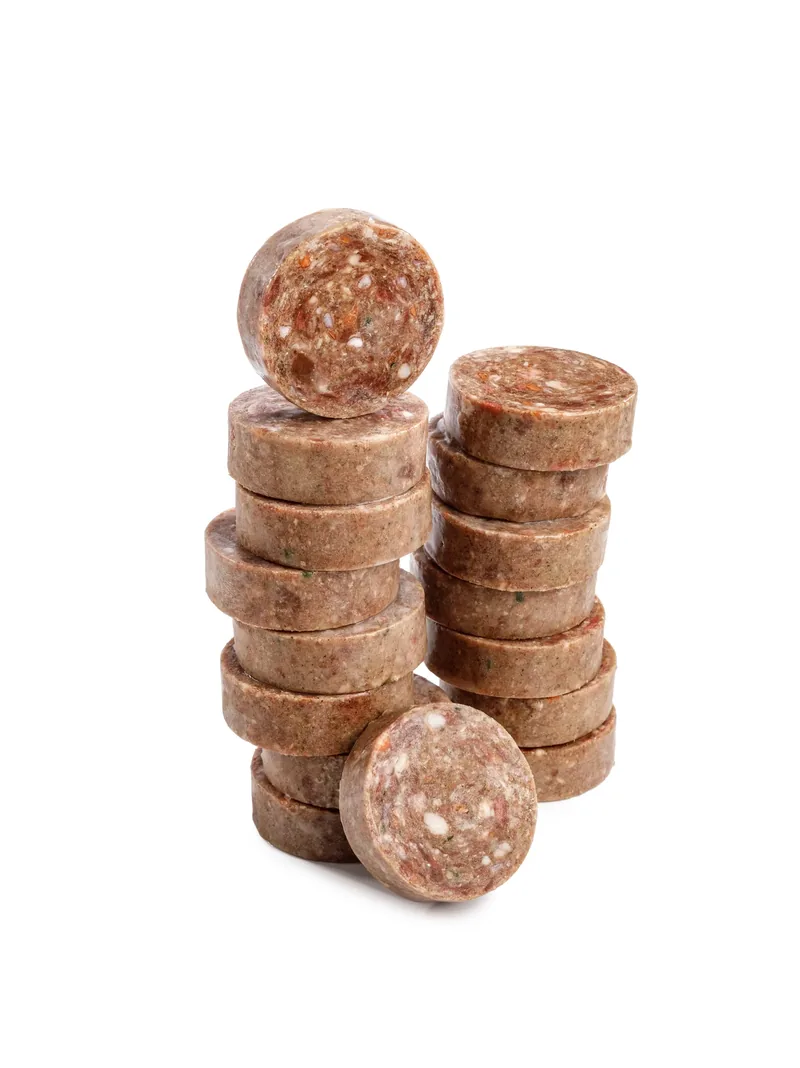
4.10 BARF Cod and Turkey Menu — 800 g (Medallions)
- Ingredients: Cod (32%), turkey meat with skin (17.6%), turkey carcass (16%), turkey heart (7.2%), turkey liver (7.2%), carrot (5.6%), apple (4.6%), endive (3.2%), fermented carrot (3%), sunflower seeds, apricot and yellow plum, cod liver oil, buckwheat germ.
- Nutritional data (per 100 g): Energy value 138 kcal.
- Website: https://crubarf.com/products/menu-barf-bacalao-y-pavo-para-perro-medallones-800-g/
The lowest-calorie menu across the whole range (138 kcal/100 g), making it the most suitable for overweight or obese dogs, for neutered dogs with a slower metabolism, and for sedentary dogs or those with reduced mobility. Cod is a low-fat white fish, with high-quality, highly digestible protein. Cod liver oil provides vitamins A and D on top of omega-3. Fermented carrot is a natural probiotic that supports the gut ecosystem.
5. Which Menu Suits Which Type of Dog Best?
5.1 Healthy Adult Dogs With No Medical Conditions
If your dog is an adult, healthy and with no special condition, you have the most freedom to choose and rotate. The key here isn't a single menu but protein rotation: switching between different meats through the month provides a more complete nutritional spectrum. A common pattern could be: Chicken (base), Beef and Chicken (variety), Lamb and Chicken (extra energy) and a fish menu monthly (omega-3). The boxed menus (Super CRU Box or Ultra CRU Box) are designed precisely to make that rotation easier at a discount.
5.2 Dogs Transitioning to BARF (First Steps)
CRUBARF recommends starting with a single monoprotein menu during the first week (chicken for dogs with no history of problems, rabbit if sensitivities are suspected). This lets the digestive system adapt gradually without overloading it with several new proteins at once. The BARF Starter Pack with no offal is a good entry point for dogs with especially sensitive stomachs.
5.3 Dogs With Food Allergies or Intolerances
The Rabbit menu is the most suitable starting point for an elimination diet, being a generally novel protein for most European dogs. Turkey (in 900 g medallions) is also monoprotein and can be another alternative. Cod and Turkey can work for those sensitive to land-animal proteins.
*Check with your trusted vet beforehand so they can tell you the best option based on your dog's needs.
5.4 Overweight or Obese Dogs
The lightest menus are Chicken 500 g (140 kcal/100g, 7% fat), Rabbit 500 g (140 kcal/100g, 7% fat) and Cod and Turkey 800 g (138 kcal/100g). These are most advisable for neutered dogs, breeds prone to weight gain (Labrador, Beagle, Cocker Spaniel, Basset Hound and so on) or simply low-activity dogs.
5.5 Dogs With Joint Problems (Osteoarthritis, Dysplasia)
The Salmon and Chicken menu is the most directly beneficial option thanks to the DHA from salmon and seaweed. If that's not available, Turkey and Anchovy also provides quality anti-inflammatory omega-3. In dogs with dysplasia or osteoarthritis, diet alone doesn't cure the condition, but it can contribute significantly to modulating systemic inflammation.
5.6 Senior Dogs (Over 7-8 Years Old)
In older dogs, there are two main priorities: maintaining muscle mass and supporting cognitive and joint function. The Salmon and Chicken menu meets both goals well thanks to the DHA and complete protein profile. The Rabbit menu is also interesting for its high protein (17%) and low fat. Transitioning senior dogs should be done more slowly (2 weeks on a single menu before rotating), as CRUBARF advises.
5.7 Puppies
CRUBARF states their menus are suitable for puppies, but need a longer adaptation period. The Chicken or Rabbit menu are the safest options to start with. It's important to note that in large-breed puppies, the calcium/phosphorus ratio is especially critical, so if you decide to feed a large-breed puppy BARF, it's highly advisable to have the support of a vet nutritionist who checks the proportions.
5.8 Dogs With High Energy Demands
The highest-calorie menus in the range are Lamb and Turkey in medallions (220 kcal/100 g), followed by Salmon and Chicken (201 kcal/100 g) and Lamb and Chicken / Turkey and Anchovy (165 kcal/100 g). These are suitable for working dogs, agility dogs, herding breeds, breeds with high energy demands, or dogs needing to gain weight and muscle mass.
💡 Remember: If you're going to switch to natural feeding, you can use the coupon SUP15 on crubarf.com to get a 15% discount on your order.6. Personalised Nutritional Consultations
Beyond the standard menus, CRU BARF offers a personalised nutritional consultation service especially useful for dogs with medical conditions or special needs. The team designs custom diets for every kind of dog, cat and other animal, taking into account conditions such as chronic allergies, kidney, liver, digestive or oncological illness, dysplasia, obesity or any other condition needing a specific nutritional approach.
If your dog has a specific condition and you want to make sure their food is properly formulated, a consultation with CRU BARF's nutritionist is a highly advisable option before making the switch on your own.
The SUP15 coupon also applies to nutritional consultations, so you can access this service with a 15% discount.
👉 See nutritional consultations on crubarf.com — Use the coupon SUP15 when booking.
7. Preparation, Storage and a Few Practical Things
7.1 How Is It Prepared and Served?
Preparation is simple: thaw it in the fridge (never at room temperature, to prevent bacterial growth), and serve at room temperature — not straight from the fridge cold, since that can cause digestive discomfort. There's no need to cook it: heat would destroy the natural enzymes and alter the amino acid profile.
7.2 How Often?
For medium and large adult dogs, CRUBARF recommends a single meal a day. For small dogs or during the transition, two meals make digestive adaptation easier. What matters is the total daily amount and the quality of the food.
7.3 Is It Safe in Terms of Bacteria?
Raw animal-based foods can contain pathogens such as Salmonella, Listeria or Campylobacter. Even so, a dog's gastric pH is significantly more acidic than a human's, giving them greater natural resistance to many of these pathogens. The risks exist but can be minimised with good handling practices: proper thawing in the fridge, hygiene when handling it, and not leaving the food at room temperature longer than necessary. Immunosuppressed people in the household should be especially careful when handling these foods.
8. CRU BARF Discount Coupon for SoyUnPerro Readers
If you feel like starting out on natural feeding, whether with the BARF diet or a personalised diet for your dog, you can do it with an exclusive 15% discount that CRU BARF has created for all this site's readers.
Simply use the discount coupon: SUP15
The coupon is valid for both BARF menus and personalised nutritional consultations.
Our View
A properly formulated BARF diet has a growing, reasonable scientific basis, especially when it comes to digestibility, gut microbiome and immune response markers. It's not the cure-all some radical advocates claim, but nor is it the baseless danger some detractors proclaim.
CRU BARF offers a range of menus formulated by nutritionists, transparent about ingredients and nutritional data, made with domestically sourced raw materials and preserved with no additives. Their offering goes beyond the BARF diet: they work exclusively with natural ingredients across all their lines, which translates into real improvements in animals' health and quality of life. The variety of proteins — chicken, beef, rabbit, lamb, turkey, salmon, cod, anchovy — lets you adapt the diet to different canine profiles and makes the rotation every nutritionist recommends easier. Their formats (500 g, 800 g, 900 g medallions, packs, subscription) give real flexibility for different dog sizes and consumption rates.
If you're thinking about trying BARF with your dog, the sensible approach is to start slowly, with a simple protein, watch how your dog responds and adjust. And if you have doubts about whether it's suitable for a specific condition your dog has, checking with a vet or with CRU BARF's nutritionist before making the switch is always the smartest decision. Remember you can use the coupon SUP15 to get a 15% discount on both menus and consultations.
Sources and Scientific References
- Algya et al. (2018). Apparent total-tract macronutrient digestibility, serum chemistry, urinalysis, and fecal characteristics, metabolites and microbiota of adult dogs fed extruded, mildly cooked, and raw diets. Journal of Animal Science. PMC
- Hiney et al. (2024). Fecal microbiota composition, serum metabolomics, and markers of inflammation in dogs fed a raw meat-based diet compared to those on a kibble diet. Frontiers in Veterinary Science. PMC
- Sandri et al. (2017). Raw meat based diet influences faecal microbiome and end products of fermentation in healthy dogs. BMC Veterinary Research. BMC
- Schmidt et al. (2018). The fecal microbiome and metabolome differs between dogs fed Bones and Raw Food (BARF) diets and dogs fed commercial diets. PLOS ONE. PubMed
- Davies et al. (2019). Raw diets for dogs and cats: a review, with particular reference to microbiological hazards. Journal of Small Animal Practice / PMC. PMC
- Solís et al. (2022). Microbiological Quality and Presence of Foodborne Pathogens in Raw and Extruded Canine Diets. Frontiers in Veterinary Science. PubMed
- Gaines et al. (2024). Apparent total tract nutrient digestibility of frozen raw, freeze-dried raw, fresh, and extruded dog foods. PubMed
Product data source: All CRU BARF menus' nutritional sheets have been taken directly from crubarf.com/collections/dieta-barf-perros. Article prepared using official CRU BARF data and checked scientific references. This does not constitute individualised veterinary advice.
IMPORTANT: This article is for informational purposes only and does not constitute veterinary, nutritional or behavioural advice. Every dog is different, and only your trusted vet can advise you on its specific needs.