 Breeds
Belgian Malinois
Bred as working dogs, Malinois are true workaholics of the canine world. They'll carry out whatever task you give them to perfection, but in exchange they'll want time by your side and enough energy to keep up with them.
With an appearance similar to the German Shepherd, they're smaller and leaner, but also more active. Their versatility makes them ideal as herding dogs, guard dogs, police dogs, or search-and-rescue dogs. And at home, they'll get along great with children too. Want to know more about this extraordinary breed?
What Is a Belgian Malinois Like? Physical Characteristics
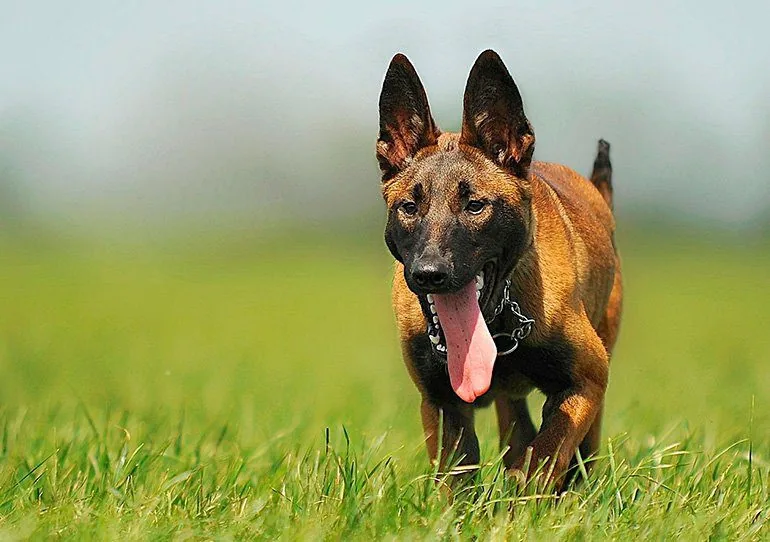
This is a streamlined dog, agile in appearance yet sturdy. It has a medium-sized, well-muscled body that, seen in profile, looks almost square. It has a powerful neck, a straight back, and a chest that's deep but not wide. The tail, thick at the base, is carried high and curved without ever forming a hook while the dog is in motion.
The head, always carried high, gives it a proud bearing, complemented by an intelligent expression. The eyes are medium-sized, slightly almond-shaped, and brown. A black mask, typical of the breed, covers the area around the eyes. The ears, always erect and also dark, look like equilateral triangles when viewed from the front.
 Height between 60 and 66 cm in males and between 55 and 60 cm in females
 Weight between 27 and 36 kg in males and between 18 and 27 kg in females
 Short, hard coat, close to the body. The breed's typical coat color is fawn, also known as the "deer" shade
 Active, friendly, and protective temperament
 Strong health
 Estimated life expectancy of between 14 and 16 years
What Is the Official Standard for the Malinois Variety?
Males under 58 cm or over 68.5 cm tall, and females under 53 cm or over 63.5 cm tall, fall outside the standard. Overly aggressive or fearful individuals are also not tolerated. Likewise, missing one or more teeth is not accepted.
The ears must be erect and never dropped or semi-erect. White markings are only permitted on the tips of the toes and a single spot of that color on the chest. Docked or amputated tails are not permitted.
The French Line of the Belgian Malinois
Breeders in different countries have gone on to define different lines within the standard, depending on the purpose being pursued. While the original line stands out for having the sturdiest dogs within the Malinois variety, the French line (with a strong presence in Spain) produces lighter dogs, more compact in size, and more sensitive to the environment around them. These dogs are more responsive to their handler, which makes them easier to manage as working dogs.
Temperament of the Malinois Breed
Malinois adapt to home life without any trouble, as long as they get to take part in shared family life. They'll build strong, rewarding relationships with their family. They're highly intelligent dogs but complex to train, so they're not recommended for inexperienced owners.
The Belgian Malinois is a workaholic with tireless energy. To keep them balanced you need to give them a job, whether it's watching the house, practicing a sport, or joining you for a run. Otherwise they'll focus on herding children and adults alike, nipping at their heels to steer them where they want them to go. If you have a yard, you'll see them moving in circles, a behavior typical of sheepdogs.
Their personality makes it difficult, though not impossible, to live in small homes like apartments or townhouses. They're also not suited to sedentary people, to those who are rarely home, or to those who travel a lot. They need space and time, two things without which they'll become fearful and timid, which over time will lead them to develop aggressive behavior.
The Belgian Malinois isn't a breed that forms bonds quickly. It first needs to get to know people well before showing them affection. If it's been raised with other dogs or cats at home, it will behave in a friendly way. With unfamiliar animals, on the other hand, it can be more territorial.
A well-balanced Malinois is one that's been socialized from puppyhood. It's an excellent guard dog, protecting its family or home bravely and without attacking unless it's truly unavoidable. It typically shows composure and self-confidence in all kinds of situations.
What Care Does a Belgian Malinois Need?
Exercise and daily outings are essential for keeping a Belgian Malinois happy. They need at least three or four outings a day, of at least 20 minutes each. These dogs won't be satisfied with a leisurely stroll. Ideally, they should be able to move around freely off-leash in a safe area. They'll also be happy joining you for a run or a bike ride. Sports are another great option. They'll excel at any of them, whether it's agility, tracking, obedience, or Schutzhund.
Despite their restless nature, they prefer living inside the house, since they need to be part of the family's daily life. A house with a yard is the ideal setting for them. They have no trouble with very cold temperatures. In fact, they prefer them to overly hot climates.
Coat care is simple: brushing once a week is enough to keep them tidy. That said, keep in mind they shed a lot throughout the year, especially during their two annual coat blows. Bathing doesn't need to be regular — only do it when the dog is genuinely dirty.
What Special Care Do Puppies Need?
Although they're just as energetic as adults, puppies have special exercise needs:
- Between 9 weeks and 6 months you should only give them two sessions a day — morning and afternoon — of about 20 minutes, playing fetch in your yard.
- Between 6 months and a year, a daily walk of about 800 meters plus one long play session of about 45 minutes is recommended, though never under strong sun.
- From one year of age, they can join you for runs, as long as the distances aren't too long, and you make sure to stop if you notice them getting tired.
- Don't run them on hard surfaces during their growth period. As they mature, you can gradually increase both distance and exercise intensity.
Following these guidelines will protect their bone and muscle structure, which will help keep their health more stable in adulthood.
This breed is known for its sturdiness, since it doesn't have many associated health conditions. Even so, you should watch for bone conditions like hip and elbow dysplasia, as well as progressive retinal atrophy.
Having very little body fat, the Belgian Malinois is also highly sensitive to anesthesia. The average death rate from complications during surgery or dental procedures is higher than in other breeds. Your vet should be aware of this fact.
History of the Belgian Malinois and Fun FactsThe Belgian Malinois is one of the four varieties within the Belgian Shepherd breed, which was developed in Belgium in the late 19th century. The varieties differ mainly by coat type, with the Malinois having a short, hard coat.
Coming from the city of Mechelen (Malines), in western Belgium, breeders of these dogs focused on developing dogs with a strong capacity for work, which is why they were always considered one of the best varieties for controlling sheep and cattle.
By the 20th century, their versatility made them well suited as guard dogs and police dogs. During the First World War they were used as messengers and as Red Cross assistants. With the arrival of the Second World War, the breed nearly disappeared. It wasn't until 1960 that a few enthusiasts began breeding them again, first in Belgium and later around the rest of the world. Although in Europe the Malinois shares its standard with the other Belgian Shepherd varieties, in the U.S. it's considered a separate breed.
If you want to learn more about the breed, talk to people who live with a Belgian Malinois, or see photos of these beautiful dogs, we recommend visiting their Facebook page:
IMPORTANT: This article is for informational purposes only and does not constitute veterinary, nutritional or behavioural advice. Every dog is different, and only your trusted vet can advise you on its specific needs.