 Breeds
German Shepherd: Complete Guide to Care and Temperament
In 1899, Captain Max von Stephanitz picked a single dog —Horand von Grafrath— and built an entire breed on him: one meant to work, not to decorate anyone's living room. Everything traces back to that.
German Shepherd breed profile
The pages that follow go over how that selective breeding began, what the official standard says about the dog's build, and what it really means to live day to day with an animal that needs to move and keep its mind busy.
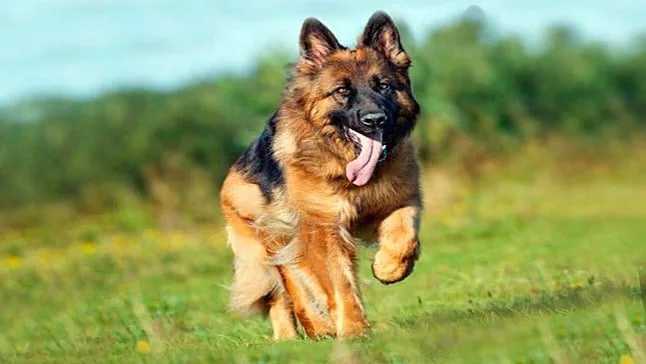
The German Shepherd is a large, muscular dog with a noble expression that has become one of the most versatile breeds in the world. Males stand 60 to 65 cm at the withers, while females measure between 55 and 60 cm. Ideal weight ranges from 30 to 40 kg, always in balanced proportion to height. Life expectancy falls between 9 and 13 years, though responsible breeding and proper care can help the dog stay active and healthy toward the upper end of that range.
This is a working dog through and through, classified in Group 1 (herding and droving dogs) by the Fédération Cynologique Internationale — the same group as the Australian Shepherd. Its slightly elongated frame, with a length-to-height ratio of roughly 10:9, combines solidity, stamina and agility. The breed carries a double coat: a dense woolly undercoat and an outer guard coat that may be short and harsh or long and soft, the latter not accepted in the breeding standard. Official colours include black with tan, red or yellow markings, as well as solid black and sable.
The head, well chiselled and proportionate, holds almond-shaped eyes with an intelligent expression and erect, high-set ears that point forward. The sabre-shaped tail reaches at least to the hock and hangs with a slight curve. Beyond the numbers, understanding the breed profile means accepting that the German Shepherd is no ordinary companion dog: its activity level demands a minimum of two hours of daily exercise, blending structured physical work with mental challenges. Without that commitment, the breed tends to develop unwanted behaviour born of boredom and frustration.
History of the German Shepherd breed
By the end of the 19th century Germany had several herding dogs that handled livestock capably, but each region had its own and no one had thought to unify them under a single standard. That changed in 1899, when cavalry captain Max von Stephanitz was captivated by a dog at a canine show. The dog was called Horand von Grafrath, and he became the first to be registered as a German Shepherd. That same year von Stephanitz founded the Verein für Deutsche Schäferhunde (SV), laying the foundations of a breed built for work above all.
His vision was clear, and fairly radical for the time. No breeding for the show ring or rewarding pretty outlines; what mattered was that the animal could do the job. The motto he repeated endlessly, "utility and temperament," shaped decades of selection and steered the breed toward herding, guarding and protection — the same calling shared by the Majorca Shepherd. When German industrialisation emptied the countryside and the flocks began to vanish, von Stephanitz redirected the breed toward police and military work, where its intelligence, obedience and courage opened every door.
The two world wars did the rest. Messenger, rescue dog, guardian, mine detector. The breed multiplied across the front lines and its fame spread beyond Germany. The trouble came afterwards. With the massive post-war expansion, breeding split in two. Working lines, determined to preserve the original's abilities, pulled in one direction; show lines, where aesthetic standard and movement rule, pulled the opposite way. That split remains open today, and it explains the differences in temperament and health seen within the breed.
Physical characteristics of the German Shepherd
The efficient trot explains everything. The German Shepherd's body was built around that gait, with a long, muscular back, a well-let-down chest that leaves room for lungs and heart, and a gently sloping croup that turns rear drive into a long stride. The angulation of the hindquarters —long femurs, well-angled tibiae— lets the dog cover miles without wearing itself out. The problem comes when that angulation is taken to an extreme, something that has happened in certain show lines, and the result is dogs that look spectacular in the ring but whose joints break down early.
The head has character. The stop is moderate, the muzzle forms a well-defined wedge, the nose is always black and the bite a full scissor bite. When the dog is alert, the medium-sized ears stand vertical and point forward, and together with the dark, slightly oblique eyes they produce that calm, watchful expression that defines the breed. The outer coat is dense and lies close to the body, with a coarse texture that lets mud and moisture slide off; beneath it, the undercoat insulates against both cold and heat.
With the coat, things change by variety. The stockhaar has short, harsh hair with plenty of undercoat; the langstockhaar is long and soft, often with insufficient undercoat. Since 2011 the FCI has recognised both —stockhaar and langstockhaar— as equally valid, though in practice the SV and most national clubs still close official working trials to the long-haired variety. As for colour, black and tan is the most common, though the standard also allows solid black and sable. What is not negotiable is the depth of pigmentation or the requirement that the nose be black.
Working lines vs show lines (FCI standard)
Before you bring a German Shepherd home, there's one question that changes the whole picture. Which line does it come from? Working dogs are bred with the focus on the head, not the looks. Steady nerves, drive for prey play, the capacity to hold up under pressure, physical stamina. The build follows suit: a more horizontal back, restrained rear angulation, a body meant to stay active for more years. The trade-off is intensity. These are dogs that need daily work, mental as much as physical, and if they don't get it, that energy comes out somewhere else. Put one in a flat with nothing to do and you're asking it to chew the place apart.
Show lines have a different profile. Selection has spent decades prioritising the first impression in the ring, with a steeply sloping croup and rear angulation that produce that eye-catching movement. They look impressive, no question. The problem comes later, because that build carries a greater predisposition to bone and joint problems. On top of that, temperament tends to be more variable than in working lines. The FCI works from a single standard describing the German Shepherd as a balanced, confident dog with great working ability, but every breeder reads it their own way, and the distance between one line and another makes that plain. For anyone after a sport or protection dog, working lines are more predictable. If looks are what matter, show lines can fit — but check the parents' health thoroughly before signing anything.
Whatever the line, living with a German Shepherd comes with its own rules. These are enormously loyal dogs with their own people and naturally wary of strangers, though without gratuitous aggression — an attitude shared by the Catalan Sheepdog. The intelligence they have demands that you give them something to think about. At home, a well-balanced dog is calm and protective, but that doesn't make it a couch dog. They need work. Every day.
Temperament of the German Shepherd breed
The German Shepherd's temperament is the result of genetic selection oriented toward usefulness for over a century. It is marked by exceptional nervous stability, which lets the dog stay calm and focused in changing environments or under pressure. That stability doesn't mean passivity: the dog is permanently alert, reading its surroundings with a discernment that lets it tell real threats from everyday situations. Courage and combativeness, two essential traits in the standard, show only when the situation calls for them, never as an impulsive or uncontrolled reaction.
The German Shepherd's functional intelligence is one of its most notable attributes. It isn't just the ability to learn commands —a virtue it shares with the Shetland Sheepdog— but an advanced social cognition that lets it anticipate its handler's intentions, solve problems on its own and adapt its behaviour to context. That intelligence, combined with a strong drive to cooperate, makes it an extraordinarily trainable dog, but it also means boredom or lack of direction can spill into redirected behaviours such as destructive chewing, excessive barking or hypervigilance. The bond with its family is deep and exclusive: once formed, the dog develops a sense of responsibility toward its social group that leads it to protect them naturally, with no specific guard training.
Early socialisation is the factor that shapes how these traits are expressed. A German Shepherd that hasn't been exposed, in a controlled way, to varied stimuli during the critical period can turn fearful or reactive, misreading neutral situations as threats. A well-socialised dog, by contrast, shows a serene confidence: it observes, assesses and acts in proportion. This breed is not suited to people looking for an independent dog or one that will tolerate long hours alone; it needs to feel an active part of family life and to take part in daily activities.
Genetic health: essential tests for responsible breeders
Responsible German Shepherd breeding demands rigorous control of the hereditary diseases affecting the breed. Hip dysplasia is the best-known condition, and screening it by official X-ray is a mandatory test for any breeder seeking certification. This disease, polygenic in origin and worsened by environmental factors such as excess weight or inappropriate exercise during growth, causes a malformation of the hip joint that leads to pain, lameness and early arthritis. Elbow dysplasia, though it gets less attention, follows a similar pattern and must also be evaluated before breeding.
There are other conditions with a genetic basis that warrant attention. Degenerative myelopathy is a progressive neurodegenerative disease linked to a mutation in the SOD1 gene that destroys white matter in the thoracolumbar spinal cord; its management includes exercise, supplements and palliative care, though there is no cure "Degenerative myelopathy" (1992). Middle-aged German Shepherds are the most affected by perianal fistulas, a painful, chronic condition with possible genetic susceptibility; its immune-mediated pathogenesis is now recognised and long-term medical management is indispensable "Canine Perianal Fistulas: Clinical Presentation, Pathogenesis, and Management" (2019). In addition, a mutation in the German Shepherd's BHD gene is associated with hereditary multifocal renal cystadenocarcinoma and nodular dermatofibrosis, a syndrome marked by bilateral kidney tumours and skin lesions that usually appear in adult dogs "A mutation in the canine BHD gene is associated with hereditary…" (2003).
A responsible breeder not only provides the official hip and elbow X-rays but also runs genetic testing for degenerative myelopathy and screens breeding stock to prevent passing these diseases on. At any clinical sign —intermittent lameness, difficulty getting up, excessive licking of the perianal area or skin nodules— specialist veterinary assessment is the only way forward. Prevention comes down to choosing a puppy whose parents have all their health tests up to date and keeping regular veterinary check-ups throughout the dog's life.
Feeding, exercise and coat care in the German Shepherd
A German Shepherd eats according to what it does and the life stage it's in. What belongs in the bowl varies a great deal between a growing puppy, an active adult and an older dog with already-tender joints. During growth, watching the calcium-to-phosphorus balance is essential, and a high-end food formulated for large breeds usually covers that need well. Another weak point of the breed is the digestive system, which is fairly sensitive. Splitting the ration into two or three meals a day, waiting a while before intense exercise after eating and choosing highly digestible proteins are habits that prevent trouble. Weight is worth checking every month. The ribs should be felt under the hand without being visible at a glance, and from above there should be a defined waist.
Two hours of activity a day. That's the minimum, with no room to cut it. The amount of time is only part of the story; what you do with those hours matters just as much. A German Shepherd that only goes out for on-lead walks builds up tension anyway. The breed needs a real trot, controlled runs —on grass or dirt, not asphalt, especially while it's still growing—, games that activate the prey instinct and obstacle routes that work on proprioception. And mental work is every bit as necessary as the physical kind. Agility, tracking, mantrailing or advanced obedience training are how this dog truly discharges its energy and builds a solid relationship with whoever handles it.
This breed's double coat sheds heavily, and during seasonal moults the amount is considerable. Brushing at least three times a week removes the dead undercoat before it colonises the sofa and keeps the skin well ventilated. During moulting seasons that frequency has to go up. Baths are reserved for when they're genuinely needed, and always with a specific shampoo that won't strip the natural oils from the coat. The routine is rounded out with dental hygiene, ear cleaning and nail trimming. Checking everything regularly, besides keeping the dog in shape, is the best way to catch anything unusual before it has time to get worse.
Early socialisation and training of the German Shepherd (3 to 6 months)
Between 3 and 12 weeks of age, a puppy's brain is in full ferment. This is when it processes the world's stimuli and decides what is a threat and what isn't. If during that window you introduce it to people of different ages, other calm dogs, city noise, odd surfaces and varied settings, the adult you end up with will be a level-headed dog. If that stage passes without such exposure, the fears that take root are stubborn and costly to work through.
At three months you can already begin formal exercises. Short sessions, ten or fifteen minutes, with plenty of play and reward. The German Shepherd picks things up fast, but a harsh correction or contradictory instructions throw it off more than people tend to assume. Here's the catch with this breed: its great need for connection is its strength and its Achilles' heel at once. A puppy that grows up without learning to be alone can develop a separation anxiety that later turns into a serious problem. That's why teaching it to stay calm in its own space —with a Kong or a chew while you step out for ten minutes— deserves as much attention as teaching it to sit or to come back when called.
From 3 to 6 months, teething also kicks in. The puppy needs to chew, plain and simple. Give it appropriate chews and redirect any attempt on furniture or hands toward those objects, without drama. Work at this stage has three clear fronts: learning to control the force of its bite, continuing to socialise with well-mannered adult dogs, and building motivation toward its handler through play.
Fitting a German Shepherd into your everyday life means time, consistency and a willingness to educate yourself too. Before taking the step, look for breeders working lines that suit your pace of life, ask for the parents' health tests and have a socialisation plan ready for day one.
If you already have one at home, its mind needs work every day. A scent game, a different route, hiding a toy and asking it to find it. Count on at least two hours combining physical and mental exercise. And learn to read it: a low tail or an out-of-place yawn are signals that something is proving hard. At any change in behaviour, or if you suspect pain, the vet comes first, before drawing conclusions about the dog's temperament.
IMPORTANT: This article is for informational purposes only and does not constitute veterinary, nutritional or behavioural advice. Every dog is different, and only your trusted vet can advise you on its specific needs.