 Breeds
Bernese Mountain Dog
Majestic, good-natured, and wrapped in a tricolor coat, the Bernese Mountain Dog embodies the essence of the Swiss mountain dogs. Its imposing presence hides an exceptionally sweet temperament that's made it one of the world's most beloved giant family dogs. Let's discover everything that makes this breed unique, from its Alpine roots to the care its noble heart demands.
What the Bernese Mountain Dog Is Like
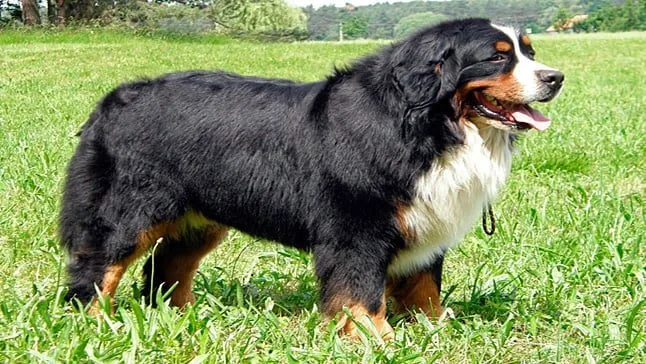
The Bernese Mountain Dog, also known as the Berner or Bouvier Bernois, has a sturdy, well-proportioned build that combines power with natural elegance. Under the official American Kennel Club standard, males stand between 64 and 70 cm at the withers and weigh 40 to 55 kg, while females fall between 58 and 66 cm and 35 to 45 kg. Beneath its thick coat lies compact muscle, built for working difficult terrain.
Its coat is the most distinctive trait: a long, straight, fine coat, jet black with tan markings on the cheeks, eyebrows, and legs, and pure white forming the emblematic Swiss cross on the chest. The triangular, high-set ears lie close to the head at rest, heightening its serene expression. The thick, well-covered tail rounds out a harmonious silhouette. This breed's life expectancy runs between 7 and 10 years, a figure that reflects how fragile these giants are and the importance of ethical breeding.
Alpine Roots of the Bernese Mountain Dog
The Bernese Mountain Dog has its origins in the pre-Alpine regions of the canton of Bern, Switzerland, where for centuries it was an all-purpose working dog. It was born from a cross between the ancient molossers brought over by the Romans and local herding dogs, producing an animal capable of herding livestock, watching farms, and pulling carts loaded with milk and cheese to market. Its strength and stamina made it a pillar of the Alpine rural economy.
In the late 19th century, farm mechanization and the arrival of foreign breeds nearly drove it to extinction. The decisive intervention of breeders like Albert Heim and Franz Schertenleib made it possible to revive the breed from the few purebred dogs remaining in the Dürrbach valley. The first breed club was founded in 1907, and in 1910 the Bernese Mountain Dog was officially recognized by the Swiss Kennel Club, cementing its revival.
The Temperament of a Gentle Giant
The Bernese Mountain Dog's temperament is the key to its success as a family dog. This is an affectionate, intelligent, extremely patient animal, especially with children, whom it tolerates with a gentleness that belies its massive size. Its calm nature makes it an ideal companion for domestic life, as long as its need for space and moderate activity is respected.
One notable quirk is its slow maturation: the Berner keeps a puppy-like mindset longer than other breeds of its size. This extended mental youth calls for consistency in training and strengthens the bond with family, but it also requires extra patience from owners during a longer learning stage. Its devotion to its people is absolute, which makes it poorly suited to prolonged solitude.
Details Only the Berner Has
Beyond its bearing, the Bernese Mountain Dog holds a few quirks that set it apart. The white Swiss cross on its chest isn't just decorative: it historically identified the dog as a working animal on Alpine farms, and today it's its most photogenic trademark. It's also the only long-coated Swiss mountain dog; its close relatives — the Appenzeller Sennenhund, the Entlebucher Mountain Dog, and the Greater Swiss Mountain Dog — all have short coats, making it an exception within its own family.
Its genetics also reveal some singularities. A scientific study from the Fred Hutchinson research center on linkage disequilibrium in domestic dogs showed that breeds like the Bernese Mountain Dog have exceptionally long haplotype blocks, which makes it easier to identify genes linked to hereditary diseases. This finding underscores the importance of selective breeding programs for preserving the breed's health.
Care and Health of the Bernese Mountain Dog
The Bernese Mountain Dog is a hardy breed, but it has a predisposition to certain health problems every owner should know about. Notable ones include hip and elbow dysplasia, bloat, and various forms of cancer, such as malignant histiocytosis, which disproportionately affect the breed and explain its short life expectancy. Regular vet check-ups and a controlled diet are essential for catching any signs early.
As for exercise, it needs moderate daily activity: long walks, controlled play, and, if possible, some light draft work or gentle hiking. It's especially sensitive to heat given its thick coat, so in summer it's best exercised early in the morning or in the evening. Its coat needs frequent brushing, at least two or three times a week, to prevent tangles and remove dead hair, along with professional grooming during seasonal shedding.
IMPORTANT: This article is for informational purposes only and does not constitute veterinary, nutritional or behavioural advice. Every dog is different, and only your trusted vet can advise you on its specific needs.