 Breeds
Bouvier des Flandres: Temperament, Care and Characteristics
The Bouvier des Flandres, a working dog created on Flemish farms, nearly went extinct during the two World Wars. This article traces his practical history, his sturdy build and his independent temperament, giving you the keys to understanding whether this firm-tempered breed is a good fit for you.
Origin and history of the Bouvier des Flandres
The Bouvier des Flandres originates from the farmland of Belgium and northern France, where farmers needed a dog capable of herding cattle, pulling carts and watching over the property. Nobody bred them with looks in mind. Selection was entirely functional, and the result was a rugged animal, built to work in any weather, with enough sense to make his own decisions when the farmer wasn't watching. That was essential. For decades there was no fixed standard, which explains why individuals of the era varied quite a bit from one another. It wasn't until well into the 20th century that breeders began unifying the type we know today.
The two World Wars left the breed on the brink of disappearing. The front lines opened right where these dogs were most numerous, and many didn't survive the bombing. Others were culled when food ran short, or simply died pulling carts and carrying messages at the front. Saving the breed depended on a handful of Belgian and French breeders who set about tracking down the survivors. It was a slow process. That genetic bottleneck is the source of some of the hereditary tendencies breeders watch closely today, as well as the relative uniformity the breed picked up from the 1950s onward, when the Bouvier des Flandres began crossing borders and settling into the rest of Europe and North America.
Today the breed has a fairly low profile compared to other herding or cattle-dog breeds, like the Bernese Mountain Dog, but the Bouvier des Flandres still carries in his genes everything that made him useful on Flemish farms. The guarding instinct is just as alive, and his ease of learning remains one of his defining traits. Understanding that background helps make sense of his behaviour. Generations of selection turned him into a dog who works alongside his owner but thinks for himself, without waiting for instructions on every single thing. Anyone coming to the breed with that in mind has an outstanding companion ahead of them. Treating him as mere decoration is a different story, and the dog ends up becoming a problem that's very hard to manage.
Physical characteristics of the Bouvier des Flandres breed
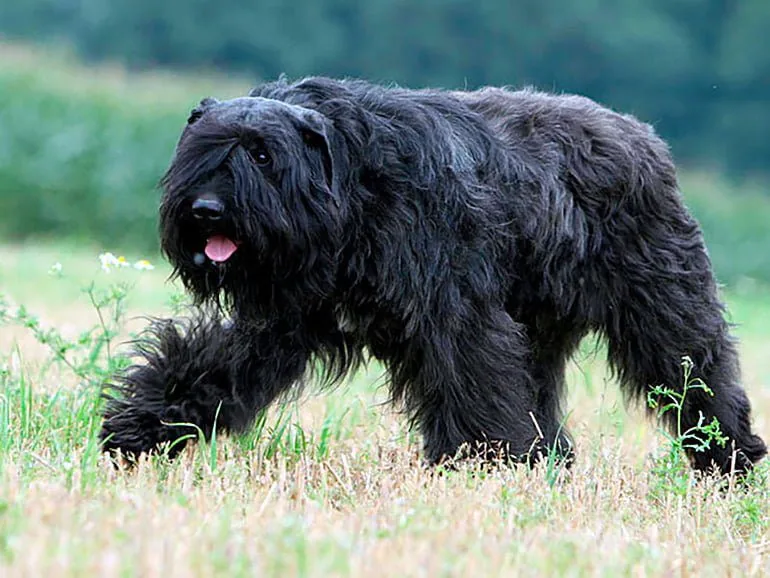
A dog of strong bones and compact muscle. That's the first impression the Bouvier des Flandres gives, an animal whose build recalls the Boerboel and makes clear at first glance what he was bred for. Males stand between 62 and 68 centimetres at the withers; females, between 59 and 65. As for weight, both sexes can reach 35-50 kilograms as adults. The overall look projects a square image: a broad, deep chest, powerful neck, and a solid head finished off with that characteristic moustache and beard that frame the muzzle and give him that instantly recognisable weathered-farmhand look. The tail, in countries where docking is still allowed, is traditionally shortened, though more and more individuals wear it natural, carried high without curling over the back.
The coat deserves separate attention. It has two layers: the outer one is rough to the touch, somewhat wiry, of medium length; the inner one, dense and woolly, insulates against the cold and rain of northern Europe. Watch out for this: that outer layer can't be soft or silky, because much of his protective function lies there. Colours range from fawn to brindle grey, also black or salt-and-pepper, with white patches on the chest in some individuals. All of this comes at a maintenance cost, and anyone who underestimates it is in for a surprise.
On the structural health front, hip dysplasia is the most recurring problem in the breed. Poor development of the hip joint that, if it goes unnoticed for too long, leads to arthritis and chronic pain. But there's another area that demands just as much watchfulness: the eyes. A study found that Bouviers des Flandres with normal eye pressure already had pectinate ligament dysplasia, and that in animals with glaucoma that dysplasia turned out to be severe ‘Dysplasia of the pectinate ligament and primary glaucoma in the Bouvier…’ (1987). When that ligament is poorly formed, drainage of the aqueous humour is compromised and the risk of glaucoma rises. Glaucoma is an emergency, and it can end in blindness if not addressed in time. Check-ups with a veterinary ophthalmology specialist should become part of the routine from a young age.
With the Bouvier des Flandres, the first word that comes to mind is judgement. Applied intelligence, solid loyalty and a highly developed protective instinct toward his own people. Don't expect effusiveness around a stranger, but you won't see fear or nervousness either. His natural stance is that of a dog who observes and assesses before moving. Centuries herding independently on Flemish farms gave him that ability to read situations, and he rarely acts without a clear reason. His physical presence already does much of the work before he opens his mouth. The bond with his owner is intense and lasts for years, but it needs to be reciprocal: this dog wants to know his opinion counts, within well-defined rules.
Anyone wondering what Bouvier des Flandres dogs are like is sometimes surprised to discover how demanding living with one can be. His intelligence, well above the canine average, becomes a problem if the owner isn't clear about what he wants. A bored or directionless Bouvier tends toward destructiveness, constant barking or a dominant attitude that's hard to correct once it sets in. The stubbornness attributed to the breed has another explanation: it's the reflection of an animal used to making decisions alone, who needs to understand the why behind each thing before doing it. Anyone adopting one should ideally have experience with working dogs or, failing that, lean from the start on a dog trainer who knows the breed well.
At home, once his physical and mental needs are covered, the Bouvier des Flandres is calm and balanced. He doesn't seek constant attention, but he doesn't handle a full day with nothing meaningful to do very well either. Things change if he's left without stimulation. His nose for the abnormal is sharp: he can perfectly distinguish everyday noises from something out of the ordinary, which makes him a very reliable alert dog. That quality, combined with his size and deep bark, generates a sense of security hard to replicate with other breeds. The flip side is that he needs socialisation from puppyhood so his natural wariness of strangers doesn't turn into reactivity.
Socialisation and life with children and other animals
Whether a Bouvier des Flandres fits well into a family with children depends almost entirely on when and how socialisation was worked on. If it starts from puppyhood and stays consistent, the result can be excellent. Watch out, though: his guarding instinct and the weight of an adult individual mean an adult should always be present whenever the dog interacts with young children. A well-meaning stumble from this dog can knock a small child to the ground. That's why the dog needs to be taught where his boundaries lie, and in parallel, children need to learn to read when the animal needs his space. Routine interactions, real supervision and a bond built with patience.
His relationship with other animals is shaped mostly during the sensitive socialisation period, which runs up to around sixteen weeks of age. A Bouvier raised alongside cats, other dogs or farm animals tends to adopt with them almost the same protective role he'd apply to livestock. Things change once sexual maturity hits, especially in unneutered males. With other males, dominance behaviours can surface, rooted in centuries of selection for handling unruly cattle. That's no surprise if you know the breed's history. Neutering — discussed with the vet — combined with obedience work sustained over time are the most effective tools for keeping those tendencies under control.
Space matters, a lot. A small flat isn't the right setting for this breed, just as it isn't for the Dogue de Bordeaux. Lack of square metres generates tension, and that tension ends up affecting life with the rest of the family, whether people or other animals. A well-fenced garden or yard gives the Bouvier a territory he recognises as his own and a corner to retreat to when the household bustle becomes too much. Without that outlet, the risk of chronic stress and behavioural problems rises considerably, and adding more daily walks doesn't make up for it.
Bouvier des Flandres training and education
A Bouvier des Flandres learns fast, yes, but only once he understands the point of what you're asking. If training turns into mechanical repetition, or if he senses inconsistency from the owner, he shuts down or simply does whatever he wants. What works are short, varied sessions with a bit of mental challenge. Punishment doesn't work with this breed. A Bouvier treated harshly can become stubborn, distrustful or, in the worst case, develop defensive aggression that's very hard to reverse afterward.
Socialisation comes first. As soon as the puppy arrives home, exposure needs to start, calmly and without forcing it, to different people, noises, surfaces and varied environments. The first weeks matter a great deal. If that genetic tendency to distrust the unfamiliar isn't worked on properly from the start, it can turn into fear or reactivity by adulthood. Puppy classes with qualified trainers help a lot here. The dog learns to move among other dogs in a controlled setting, and the owner starts understanding how to communicate with and handle him. With an animal of this physical power and guarding instinct, there's no room for gaps in his upbringing.
Before the dog reaches physical maturity, around eighteen months, basic obedience needs to be solidly in place. Commands like recall, stay or heel carry real weight in an animal this size. A recall that genuinely works can be the difference between an uneventful walk and a serious scare if the dog bolts after something. Dog sports — tracking, agility, recreational herding — give his intelligence an outlet, strengthen the bond with the owner and nip in the bud the behavioural problems that come from boredom. Anyone with no experience in working breeds would do well to find a professional trainer who knows the Bouvier des Flandres well. The money invested there more than pays for itself later.
Daily exercise
That the Bouvier des Flandres needs a lot of exercise is no secret. What surprises many first-time owners is the combination he demands: real physical movement and mental work, both at once. He comes from centuries of pulling carts, herding cattle and doing everything on the farm, and that background doesn't vanish just because he now lives in a flat. When that demand isn't met, the house pays the price: compulsive chewing, barking, constant restlessness. The reasonable minimum is two daily sessions that include a sustained trot and some scent or problem-solving game, not two laps around the block.
Watch out with puppies. The growth plates take a while to close, and forcing runs on asphalt or jumping sessions too early sharply raises the risk of joint damage in a breed that already carries some predisposition to hip dysplasia. Up to twelve or fourteen months, what works is long walks over varied terrain, scent games and training, which tires him out enormously without punishing the joints. From there intensity can go up, but always with the vet's go-ahead after checking how those joints are doing.
Having a garden helps, but it doesn't solve the problem. A Bouvier who spends hours alone in the yard arrives at the next outing with his nervous system on edge, which makes relaxing at home harder. The garden is good for moving around between sessions, exploring scents, unwinding a little in between. What genuinely regulates him is the activities he does with you: recreational herding if you have access, advanced obedience, anything that asks him to think and move at the same time. This dog is hungry for work, not just distance covered.
Coat care: brushing, bathing and stripping
Two or three times a week, at minimum. With the Bouvier des Flandres there's no room for skipping sessions, because his double coat — a rough outer layer over a dense, woolly undercoat — punishes neglect without warning. Dead hair doesn't fall out on its own. It tangles with the layer above and mats together until it forms felted clumps that pull on the skin, irritate it, and create the perfect environment for skin infections. During shedding periods the undercoat lets go more, and the pace needs to pick up. The basics for working this type of coat are a rotating metal-pin comb, an undercoat rake, and a tool that breaks up incipient tangles before they set in.
With bathing, less is more. Washing the dog too often strips the natural oils that waterproof the outer layer and maintain that rough, wiry texture that defines the breed. Every three or four months is usually enough, unless the dog comes home a mud disaster. Drying the coat thoroughly is as important as the bath itself — moisture trapped in that dense undercoat ends up causing dermatitis and bad odour. Shampoos formulated for wire coats help preserve the texture. Conditioners and softeners, out.
Stripping — manually pulling out dead hair — is the technique that best respects this coat's physiology. Cutting with scissors or clippers solves the problem visually, but the hair that grows back comes in softer, loses its coarseness and tangles more easily. Stripping removes old hairs at the root and makes way for new ones with the right texture. The process is repeated every few months and any owner can learn it with help from a breeder or a groomer who specialises in wire-coated breeds. For anyone not after a show finish, a hygienic trim around the eyes, ears and perianal area is still necessary for cleanliness and comfort.
Feeding the Bouvier des Flandres: kibble, homemade diet and supplements
A well-fed Bouvier des Flandres maintains muscle without accumulating fat. For a breed with this much body mass and a demanding activity level, that's easier said than done. Premium kibble for large breeds, with animal protein as the first ingredient and calcium and phosphorus at ratios suited to bone development, is the most practical starting point. It's best to split the ration into two meals a day. Deep-chested dogs are predisposed to gastric torsion, and that veterinary emergency is nothing to take lightly. The package guidelines serve as a rough guide, but the dog's actual body condition — plus a periodic check from the vet — matters more than any printed chart.
A homemade diet can also work, as long as a veterinary nutritionist is behind it ensuring nutrient balance. Adding omega-3 sources — oily fish, salmon oil — makes a lot of sense in this breed. It improves coat texture, supports the joints and helps maintain cognitive function. Joint supplements, glucosamine and chondroitin sulfate, are frequently prescribed in large breeds to keep cartilage in good condition. Here's the catch. Using them without a prior veterinary assessment isn't a good idea; being supplements doesn't make them harmless or necessary for every dog. Any diet change or new supplement should be discussed with the vet, especially if the dog has a sensitive stomach or is in the middle of a growth phase.
There's something owners of this breed should keep in mind. Dysphagia. The Bouvier des Flandres was overrepresented among dogs with swallowing problems; muscular dystrophy was identified as the cause in 10 dogs examined, and the affected animals descended from a specific group, as documented in the study ‘Dysphagia-associated muscular dystrophy: a familial trait in the bouvier des Flandres’ (1994). It doesn't affect the whole population, but it exists. If the dog regurgitates frequently, has trouble swallowing or loses weight for no apparent reason, see the vet without waiting. Raising the food bowl a few centimetres and choosing appropriately sized kibble can help in mild cases, but it's no substitute for a diagnosis.
Knowing in advance what this breed demands avoids a lot of headaches. For anyone already sure they want a Bouvier des Flandres at home, the next step is finding a serious breeder, one who health-tests their breeding stock and doesn't disappear once the puppy's handed over.
IMPORTANT: This article is for informational purposes only and does not constitute veterinary, nutritional or behavioural advice. Every dog is different, and only your trusted vet can advise you on its specific needs.