 Breeds
Cairn Terrier
Small, untamable, and with a gaze that radiates intelligence, the Cairn Terrier is far more than a companion dog: it's a born adventurer packed into a compact body. Its history as a hunter in the Scottish Highlands has shaped an independent temperament and an energy that defies any sedentary routine. Getting to know it well is the only way to enjoy its unreserved loyalty.
Anatomy of a Rock Hunter
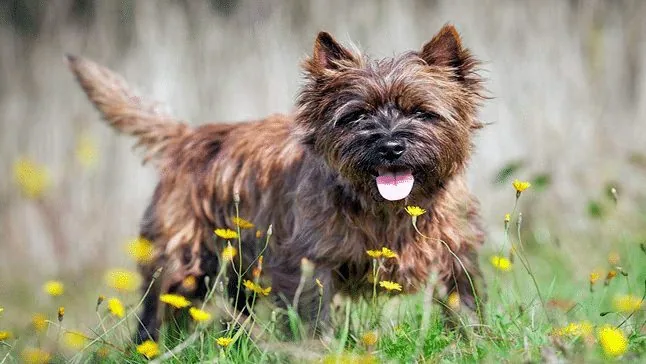
The Cairn Terrier fits the classic working terrier mold: small, sturdy, and surprisingly agile. Its height at the withers falls between 28 and 31 cm, while weight ranges from 6 to 7.5 kg, with no notable difference between males and females under the official American Kennel Club standard. The body is compact, with a deep chest and short but solid legs, built for digging and moving easily among rocks.
Its coat is a feat of natural engineering: a double layer made up of a coarse, hard outer coat and a soft, dense undercoat that insulates it against damp and cold. Accepted colors include cream, wheaten, red, gray, and brindle, often with dark masking on the muzzle and ears. The head is small but well proportioned, topped with pointed ears and lively dark eyes that give away its permanent state of alert. Its life expectancy is notably long, reaching 12 to 15 years with proper care.
The Scottish Origin of the Cairn Terrier
The Cairn Terrier has its roots in the Scottish Highlands and on the Isle of Skye, where for centuries it was the perfect ally for farmers and hunters. Its main job was flushing out otters, foxes, and badgers from the piles of stones — the cairns — that marked property lines or served as shelter for this prey. That's exactly where its name comes from, paying tribute to those rocky hideouts where the dog proved its bravery.
Considered one of the oldest Scottish terriers, the Cairn shares its origin with the Skye Terrier and the West Highland White Terrier. In fact, until the early 20th century, white-coated dogs were registered as Cairns, until breeders decided to split them into separate breeds. The Cairn kept its original rustic look, while the Westie was refined toward the uniform white coat we know today. Its primary role as an independent working dog explains many of the traits its temperament still carries today.
A Temperament Forged in the Burrow
The Cairn Terrier is cheerful, energetic, and perpetually alert. Its size is deceiving: it will confront animals much larger than itself without hesitation, and it explores every corner with insatiable curiosity. This breed hasn't lost its instinct to chase and dig, which translates into an independent streak that's often mistaken for disobedience. It's not that it ignores your call out of defiance — it's that its tracking drive can be stronger than any command in that moment.
With other dogs it tends to be sociable if raised alongside them, though it doesn't shy away from dominance. The real challenge comes with small pets like rabbits, ferrets, or cats: its hunting instinct triggers at quick movements, so living together is only safe under constant supervision. It's not naturally aggressive; what sometimes looks like aggression is actually explosive reactivity caused by excitement, fear, or poor socialization. Learning to read its signals — stiff ears, tense body, fixed stare — lets you anticipate and redirect its attention before it escalates.
Unique Traits of Little Toto
Few people know the Cairn Terrier achieved worldwide fame as Toto in The Wizard of Oz, but its personality goes well beyond the screen. Its tail, carried cheerfully upright but never curled over the back, is one of its trademarks and a perfect barometer of its mood. Unlike other terriers, its coarse coat has an almost self-cleaning quality: it repels dirt with surprising efficiency, an advantage inherited from its days hunting through mud and stone.
Another quirk is its relationship with the West Highland White Terrier: for decades they were considered varieties of the same breed, and Cairn litters could include white puppies later registered as Westies. This shared genetic history explains the physical similarities between the two, though the Cairn keeps a more natural, less uniform look. Its muzzle, shorter than other terriers', gives it a unique, almost fox-like facial expression that's unmistakable to fans of the breed.
Health and Care for the Tireless Cairn
The breed enjoys an enviable lifespan, but isn't free of hereditary issues. Among the most documented are patellar luxation, Legg-Calvé-Perthes disease, and hypothyroidism. A growing concern is ocular melanosis, a condition affecting the eyeball that can compromise vision. In fact, a scientific study published in the journal Veterinary Ophthalmology recently analyzed its prevalence in the adult Cairn Terrier population of the United Kingdom, underscoring the need for regular eye exams to catch it early.
Daily exercise is non-negotiable: it needs active walks and, above all, scent and tracking games that channel its hunting instinct. As for its coat, weekly brushing keeps the undercoat free of dead hair, but the real secret lies in hand-stripping — pulling out old hair with your fingers or a specific tool — to preserve the coarse texture of the outer coat. Using scissors or clippers ruins that weatherproof quality and should be avoided entirely.
IMPORTANT: This article is for informational purposes only and does not constitute veterinary, nutritional or behavioural advice. Every dog is different, and only your trusted vet can advise you on its specific needs.