 Care
Care
Canine Pheromones
In dogs, non-verbal communication plays a very important role, carried out through chemical messages known as pheromones. Pheromones are chemical substances dogs release through secretions such as urine, which trigger behavioral reactions in other dogs that pick up on them.
Since pheromones trigger specific behaviors in dogs, products are now sold containing certain synthetic pheromones aimed at encouraging certain behaviors or preventing unwanted ones.
Below, we'll give you more information about what natural and synthetic pheromones are and how they can help our dog. Shall we begin?
What Are Canine Pheromones?
Canine pheromones are chemical substances produced by the dog and released into the environment to communicate with other members of the same species or to trigger physiological or behavioral changes in the receiving dog.
These substances are released into the environment through urine, feces, vaginal secretions, or skin glands, and generally only act between members of the same species — meaning a dog pheromone would only change the behavior of other dogs.
Their purpose is to induce specific behavioral and emotional reactions, including sexual behaviors, aggression, fear-related behaviors, and avoidance reactions.
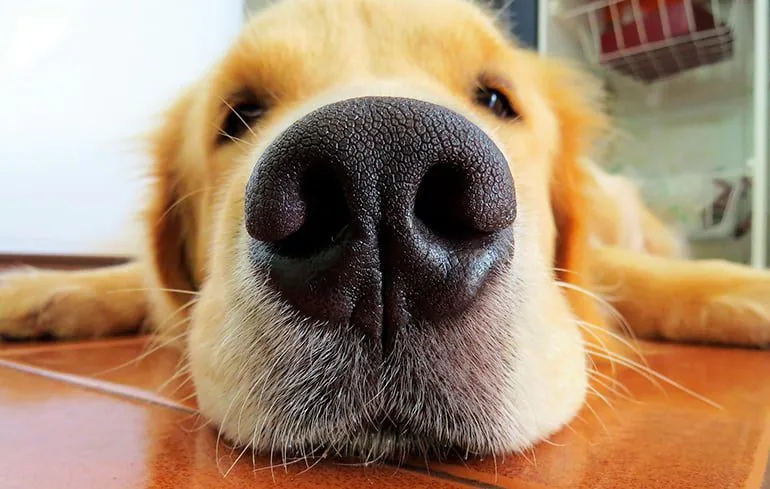
How Do Dogs Detect Pheromones?
Pheromones in the environment are detected by dogs through their sense of smell (olfactory mucosa) or the vomeronasal organ. The vast majority are detected through the vomeronasal organ, a structure located on the roof of the mouth.
This organ is made up of two ducts connecting to the oral cavity, and inside these ducts, there are receptors that detect pheromones and send "messages" to the brain (specifically to the amygdala), resulting in a behavioral response.
The amygdala is involved in controlling aggressive behavior, reproductive behavior, and the stress response, which explains the influence pheromones have on certain behaviors.
To make it easier to pick up on pheromones, especially sexual scents, many species perform a behavioral process called "Flehmen," in which they lift the upper lip and open their mouth to widen the ducts connecting the vomeronasal organ to the nasal cavity. In dogs specifically, it's not clear whether they perform Flehmen as such, but what they do is repeatedly stick their tongue in and out of the mouth to help detected pheromones pass through to the vomeronasal organ.
What Types of Pheromones Exist?
Generally, there are three types of pheromones based on their mechanism of action:
- Releaser pheromones: these are pheromones that, once perceived, immediately trigger a change in the receiving dog. Their effect is immediate.
- Primer pheromones: these don't produce an immediate behavioral change in the receiving dog, but instead trigger a series of physiological changes in its body (hormonal changes) that, after some days, will result in a behavioral change. They need several days to have their effect.
- Signaler pheromones: these are molecules that convey information about the characteristics of the dog that produced them.
The pheromones most interesting for managing canine behavioral problems, given their effect, are releaser pheromones.
What Are the Main Pheromones Dogs Produce?
Some of the pheromones dogs produce are of ethological interest, since they trigger changes in dogs' behavior that can be very useful for managing behavioral problems.
Appeasing Pheromone
This pheromone is produced by glands found near the mammary glands of nursing female dogs. The appeasing pheromone's function is to reduce anxiety in puppies while they're nursing — this substance produced by their mothers calms them down. It's been observed that adult dogs retain the ability to respond to this pheromone, which has an anxiety-reducing effect.
Sexual Pheromone
Females in heat (during the proestrus and estrus phases) secrete a sexual pheromone (methyl p-hydroxybenzoate) through their vagina, which lets males know which females are receptive for breeding. The scent of this substance can be detected by male dogs from great distances (up to 1 km) and triggers an immediate approach and mounting behavior toward the female.
How Can Synthetic Pheromone Products Help Dogs?
We can influence, or even stop, unwanted behaviors in dogs through the use of synthetic pheromones. Certain natural dog pheromones have been isolated and studied to create synthetic equivalents that can be used to treat behavioral problems.
There are synthetic pheromone products available on the market that help reduce nervousness or separation anxiety in dogs. These products contain synthetic equivalents of the canine appeasing pheromone. Synthetic pheromones designed to calm dogs mimic the soothing effect a mother dog's pheromones would have on her puppies.
We can use these pheromone products to help relieve anxiety in our dog caused by many different situations: general stress, separation anxiety, travel, and noise phobias such as those caused by storms or fireworks.
IMPORTANT: This article is for informational purposes only and does not constitute veterinary, nutritional or behavioural advice. Every dog is different, and only your trusted vet can advise you on its specific needs.