 Breeds
Everything About the Clumber Spaniel: Origin, Temperament and Care
The Clumber Spaniel, with his heavy build and melancholy expression, is the heavyweight of spaniels, bred to flush game through dense undergrowth. Discover his aristocratic origins, his unique personality and what living with this calm, determined breed involves.
Origin and history of the Clumber Spaniel
The Clumber Spaniel emerges as a distinctive breed within hunting spaniels, with an origin placed between France and England during the 18th century. The most accepted theory suggests the Duke of Noailles moved his dogs from France to the Duke of Newcastle's estate at Clumber Park, Nottinghamshire, to protect them during the French Revolution. It was on this English estate that the breed developed and was refined, gaining its definitive name.
These dogs were selectively bred for a very particular hunting job: tracking and flushing game birds in dense terrain and thick undergrowth. His powerful, low build, together with a heavy but steady pace, made him ideal for working close to the hunter, unlike other faster, wider-ranging spaniels. His fame grew until he caught the attention of royalty, including Prince Albert and King Edward VII, who kept them in their royal kennels.
The breed established itself as a status symbol among the British landed gentry, valued both for his hunting effectiveness and his calm, loyal temperament. Although never a hugely popular breed, his lineage has been carefully preserved, keeping those unique traits that make him unmistakable.
Physical characteristics of the Clumber Spaniel
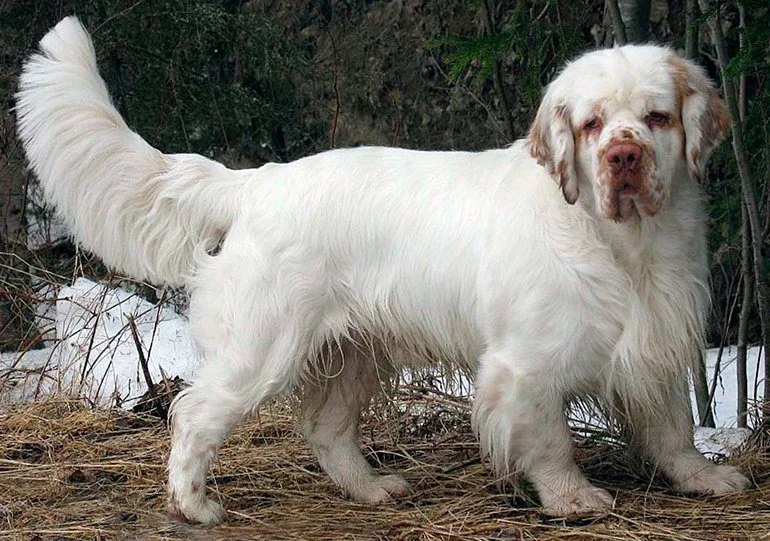
The Clumber Spaniel is the heaviest and most substantial of all spaniels, projecting an image of power and determination. Males reach an ideal weight of 25 to 38 kg and females 20 to 32 kg, with a height at the withers around 43-51 cm. His body is long, low and solid, resting on a sturdy bone structure giving him notable strength.
His head is large and square, with a marked stop, drop ears shaped like vine leaves, and a melancholy yet friendly expression that's characteristic of him. The eyes are dark amber, deep-set, with a gentle look. The coat is abundant, straight and dense, with a texture resistant to the elements. The predominant colour is pure white with lemon or orange markings, typically on the ears, around the eyes and sometimes at the base of the tail.
One of his most notable identifying traits is the presence of facial folds, especially under the deep-set eyes and around the wide muzzle. This build, together with well-developed upper lips, contributes to his tendency to drool, especially after drinking water or in moments of anticipation.
Personality and temperament
The Clumber Spaniel's temperament is a fascinating contrast: he's a hunting dog with an innate working drive, but at home he becomes a serene, affectionate and notably calm companion. He shows deep devotion to his family, seeking constant physical contact, often following members from room to room to lie at their feet.
His practical intelligence is notable, though it can be veiled by a certain independent stubbornness and a deliberate pace. He doesn't respond well to harsh or repetitive training methods; instead, he thrives with positive reinforcement, patience and short sessions that hold his interest. His tracking instinct remains very present, so in open, unfenced settings his recall can be compromised if he picks up an irresistible trail.
With children and other pets, he's usually a gentle, tolerant dog, preferring domestic calm to commotion. His nature isn't overly vocal, but he'll use his deep, resonant bark to alert to visitors, always more in an announcing posture than a confrontational one.
The Clumber Spaniel can be an exceptional pet for the right home, but his suitability depends heavily on meeting his specific needs. He's ideal for families or individuals who value calm company and an unhurried pace of life, and who have time for his meticulous grooming. His affable nature and attachment make him a dog well integrated into family dynamics.
He isn't the best option for anyone looking for a hyperactive companion for running or high-intensity sports. His heat tolerance is low given his dense coat and brachycephalic build, so he needs cool environments and exercise during the coolest hours of the day. He's also not suited to anyone reluctant to deal with regular drooling and maintaining his facial folds.
His adaptability to flat living is good as long as his daily walks of 30-45 minutes of moderate exercise are covered, but access to a fenced garden where he can sniff and move freely is a significant advantage for his wellbeing. Early socialisation is crucial to foster his natural confidence and ensure he stays the stable, balanced dog he is by character.
Brushing and coat maintenance
The Clumber Spaniel has a dense, water-repellent coat that, if not cared for regularly, ends up forming impossible tangles. The most problematic areas are behind the ears, the armpits and the inner thighs, where constant friction mats the hair quickly. Two or three weekly brushing sessions, with a metal-pin comb and a natural-bristle brush, are enough to keep the undercoat aired and free of build-up.
When shedding arrives, which happens twice a year, things change quite a bit. Hair comes out in quantity and you need to brush daily if you don't want the sofa, clothes and floor covered in white hair.
With bathing you need a light touch. Bathing him too much strips the natural oils protecting the skin and coat, so it's best kept for when the dog is visibly dirty or every two or three months at most. Always use a shampoo formulated for dogs that respects skin pH.
Drying needs to be thorough, without rushing. The legs and belly are the areas that retain the most moisture, and if left damp, irritation and dermatitis can appear. Trimming the hair between the pads and around the ears also helps stop dirt and moisture building up in those areas.
Cleaning facial folds and managing drooling
That characteristic Clumber Spaniel face comes at a price. The deep skin folds trap moisture, food residue and saliva, and all of that built up against the skin is the perfect breeding ground for dermatitis, irritation and fungal or bacterial infections.
Clean them every day. No exceptions. A gauze dampened with warm water or a product recommended by your vet works well; what can't stay is moisture. You need to dry fold by fold, carefully but without rushing, until the skin is completely dry. If you leave any trace of moisture, the problem comes back sooner than you'd think.
And then there's the drooling, which in this breed is simply how it is. It spikes when the dog gets excited, when he smells food or right after drinking. Having a towel on hand is more or less mandatory, and putting the food and water bowls on a washable mat saves a lot of headaches. Watch out for this too: that constant saliva speeds up tartar build-up, so oral hygiene deserves regular attention, not just once the problem is already visible.
Daily exercise and scent games
The Clumber doesn't need to run miles. With 30 to 45 minutes of moderate activity split across two or three daily walks, he has more than enough to stay physically and mentally healthy. That said, his heavy build and metabolic particularities mean keeping a calm pace, with no strain, and never taking him out during the hottest hours.
There are documented cases of exercise intolerance in the breed linked to metabolic deficits. Learning to read the signs while he walks is key: excessive panting, gradually slowing to a stop, or flatly refusing to continue are clear signs it's time to rest somewhere cool. No ifs or buts.
For the mental side, scent games work very well with this breed. Hiding treats around the house or garden, using a snuffle mat or creating food trails connects with that tracking instinct built into his genes, and the fatigue it generates can be as deep as a long walk. Sometimes more. In 2020 a case was published of a 6-month-old male Clumber Spaniel diagnosed with congenital erythropoietic protoporphyria and protoporphyric hepatopathy, with small stature, recurring dermatitis on the head and liver disease ‘Congenital erythropoietic protoporphyria and protoporphyric hepatopathy in a dog’ (2020). A specific case, but one that makes clear why regular vet check-ups can't be put off until there's already a problem.
How to control diet and prevent weight gain
This breed's metabolism is slow and his calm temperament means he burns few calories a day, so any excess in his ration builds up as fat at a rate that catches many owners off guard. And excess weight, in a dog like this, goes well beyond appearance. It worsens joint and heart conditions, complicates his metabolism, and completely undermines the little exercise tolerance he has.
The solution comes down to measuring. Every meal, weighed or dosed with a calibrated container, never trusting your eye or "a handful". Kibble formulated for animals prone to weight gain helps, but it's worth having the vet adjust it based on the animal's age, how much he moves and his body condition.
Weighing him at home once a month takes two minutes and gives a lot of information. If the scale starts climbing, it's not a good idea to cut rations or increase exercise on your own. First you need to see the vet. There can be medical causes behind weight gain, and the vet will know how to rule them out before suggesting any adjustment to diet or exercise routine.
IMPORTANT: This article is for informational purposes only and does not constitute veterinary, nutritional or behavioural advice. Every dog is different, and only your trusted vet can advise you on its specific needs.