 Breeds
Dingo
Thousands of years ago, some domestic dogs reached Australia and were never fully domesticated again: instead, they evolved in isolation for millennia into what we now know as the dingo. What's surprising is that even scientists can't agree on exactly what he is: an ancient dog, a wolf subspecies, or something in between that never quite settled into either?
Scientific classification and origin of the dingo
The dingo carries the scientific name Canis lupus dingo or Canis dingo, depending on the school of thought. This discrepancy reflects the open debate over his true nature: some experts consider him a subspecies of the grey wolf, while others see him as an independent species or even a domestic dog who never completed his domestication.
He reached Australia around 8,000 years ago, probably from New Guinea, brought by human populations sailing toward the continent. Australian Aboriginal peoples domesticated them and established a symbiotic relationship, using them for hunting. After millennia of geographic isolation, they evolved their own physical and behavioural traits setting them apart from both domestic dogs and wild wolves.
He's currently recognised as a native Australian animal and enjoys legal protection in some areas, though his status remains vulnerable due to hybridisation with domestic dogs, which has increased in recent decades.
Is the dingo a dog or a wolf?
Whether the dingo is really a dog or a wolf is a hard question to answer, and remains a matter of controversy today. The most accepted theory is that he's a very primitive, feral dog breed, though some scientists consider him a direct descendant of the grey wolf or Canis lupus.
In Australia there are farms where dingoes are bred with the goal of conserving this natural treasure and maintaining the breed's purity, though exporting them to other countries isn't allowed. Although in 1994 Australia recognised the dingo as an official dog breed, included within the hound group, the Fédération Cynologique Internationale still doesn't recognise it.
Physical appearance and distinctive traits
An adult dingo stands 50-59 cm at the withers and can weigh between 23 and 32 kg. Australian individuals are larger than their Southeast Asian relatives. As with almost all dog breeds, males are bigger and heavier than females.
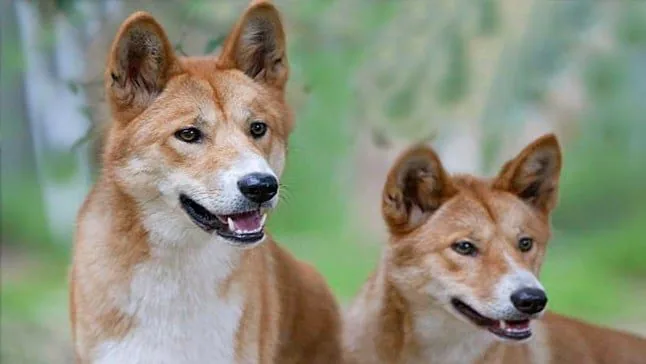
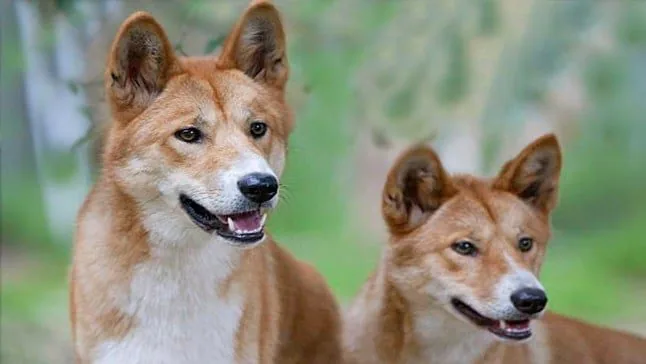
The body is lean and elongated, very athletic, with a thick neck and a long, furry tail. It's in the head where you find the traits that set him apart from other dog breeds: the long, fine muzzle, unmistakably wolf-like in appearance, along with the length of his incisors and canines, notably larger than those of similar domestic dogs.
His ears are large and pointed, while his eyes show a curious orange-yellow hue. A dingo's average lifespan sits around 10 years.
Coat and care
The dingo's coat is usually yellow, reddish or sandy, showing various shades depending on the region. A purebred individual will also have white markings on the chest, legs and tail tip.
Though rarer, there are also black dingoes with tan markings and completely white individuals. His coat, tough and hardy, needs no special care. Occasional brushing is enough to keep it in good shape.
Temperament and social behaviour
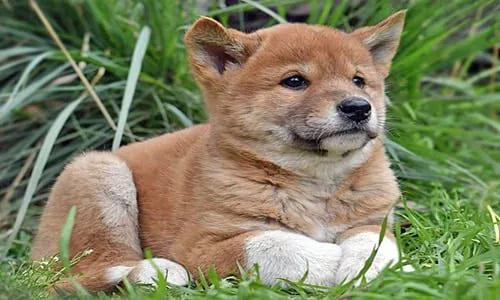
Experience shows that a domesticated dingo can be an intelligent, obedient and even affectionate companion, though his wild-animal nature can never be entirely erased. For instance: the dingo doesn't bark, but he does howl, and quite often, producing sounds very similar to a wolf's.
He can be very docile if in frequent contact with humans, behaving exactly like any domestic dog, showing no aggressive behaviour. In some cases he's even worked effectively as a herding dog.
In any case, all of this applies to a dingo adopted and trained from puppyhood. A wild dingo's temperament is completely different and incompatible with living alongside humans.
Ecological role and hunting behaviour
The dingo is an opportunistic carnivore whose diet includes large marsupials, reptiles, small mammals and carrion. As Australia's main land predator, he plays a key ecological role controlling populations of herbivores and invasive species like feral foxes and cats. His removal can cause serious ecosystem imbalances.
He feeds on more than 170 species in Australia, from insects to water buffalo. He hunts alone for small prey like rabbits, but in groups for large animals like kangaroos. He also attacks livestock when natural prey is scarce, which has caused historical conflict with Australian farmers.
The dingo is Australia's only native carnivorous mammal, and his absence would cause an ecological collapse on the continent.
He lives in packs of up to a dozen members with a hierarchy similar to wolves'. Reproduction is limited to the pack's dominant pair, who breed once a year with a gestation of 56-58 days. They can travel enormous distances, up to 250 km from their birthplace, letting them adapt to very diverse territories.
How do you train a dingo?
Being a wild dog only relatively recently domesticated, many specialists believe it's impossible to train this breed with any guarantee.
However, other experts are more optimistic and believe it is possible, though it requires patience, consistency and a deep understanding of his wild nature. The key is starting from puppyhood, setting clear boundaries and using positive reinforcement.
A dingo raised from a young age in a family environment can learn basic commands and behave predictably. What will never disappear is his predator instinct and his independence. Unlike a domestic dog, the dingo will always retain a degree of autonomy and won't blindly obey. This calls for an experienced, patient owner able to establish authority without violence.
Dingo danger and risks
Fatal dingo attacks on people are extremely rare. Before 2026, only two probable cases had been confirmed in almost five decades of records. That said, this doesn't mean they're completely harmless.
The main risk factor is habituation to human food. Tourists feeding them or poorly managed rubbish reduces their natural fear, increasing aggressive encounters. Adult dingoes caught on the street shouldn't be picked up, since they're wild canids who can become very aggressive when they feel cornered. Males become especially aggressive during mating season.
Although they have virtues like being independent and not smelling, they're never fully domesticated and need special care. Dingoes are protected under Australian legislation. Although many families keep them as pets, their 'domestication' isn't always easy given their wild DNA.
WILD DINGO: NEVER TRY TO TOUCH ONEA dingo living free isn't a potential pet. If you find one in the wild, keep your distance and don't feed it. Habituation to humans reduces their natural survival and increases conflict.
General care for a domesticated dingo
A domesticated dingo needs intense daily exercise, since his hunter nature demands constant activity. Without enough physical and mental stimulation, he can develop destructive behaviours or try to escape.
Diet should be carnivorous and high quality. Although he can eat commercial kibble, many owners opt for raw-meat-based diets to maintain his optimal health. Vaccinations and vet check-ups are mandatory, though finding a vet experienced with dingoes can be difficult outside Australia.
Early socialisation with other animals and humans is crucial to minimise aggressive behaviour.
Price and getting a dingo
In Australia, a dingo can be bought for between 500 and 1,000 Australian dollars (roughly €330-660). There are legal specialist breeders in Australian territory maintaining pure bloodlines.
However, exporting dingoes isn't allowed for people outside Australia. Taking the American dingo as a reference, with all paperwork included the purchase process would run between 300 and 500 US dollars (€200-400), though this is theoretical since export is banned.
Adopting rather than buying is strongly recommended, and you should never attempt to take a dingo out of the country, since he's considered a vulnerable species. Many sanctuaries and rescue organisations in Australia work with dingoes needing a home, offering an ethical alternative to buying from breeders.
History and evolution of the dingo in Australia
The dingo reached Australia around 8,000 years ago, probably from New Guinea, brought by human populations sailing toward the continent. For thousands of years he lived alongside Australian Aboriginal peoples, who domesticated him and used him for hunting, establishing a unique symbiotic relationship.
When Europeans arrived in the 18th century, the dingo was already an integral part of the Australian ecosystem. However, the introduction of livestock and competition for resources generated conflict.
For more than two centuries, dingoes have been hunted to protect livestock, which has significantly reduced their populations in some regions. Today, the dingo is recognised as a native Australian animal and enjoys legal protection in some areas. His conservation matters not just for his cultural value but for his irreplaceable ecological role. Hybridisation with domestic dogs remains a threat to the species' genetic purity.
Is it worth having a dingo as a pet?
The answer depends on your experience, patience and ability to accept the animal's wild nature. A dingo isn't a domestic dog that looks like a wolf: he's a fundamentally different animal requiring a deep understanding of his behaviour and needs.
If you live in Australia, have experience with wild animals and can dedicate time and resources to his care, a dingo domesticated from puppyhood can be a fascinating and relatively obedient companion. But if you're after a traditional dog who blindly obeys commands and is completely predictable, the dingo isn't for you.
The reality is that most people shouldn't have a dingo. His place is in the Australian wild, where he plays an ecological role no other animal can replace. If this species genuinely appeals to you, consider supporting conservation organisations or visiting sanctuaries where you can observe them in a more natural setting.
IMPORTANT: This article is for informational purposes only and does not constitute veterinary, nutritional or behavioural advice. Every dog is different, and only your trusted vet can advise you on its specific needs.