 Care
Care
Does Your Dog Have Symptoms of Colitis?
Colitis, literally, is inflammation of the colon, or large intestine. In dogs, we can identify this disease because it triggers diarrhea that shows up chronically or acutely.
Paradoxically, the symptoms can be confused with constipation, which can delay diagnosis. There are several causes of colitis in dogs, and in the more severe or chronic cases, seeing the vet becomes necessary.
What Is Colitis?
Colitis involves inflammation of the colon, the main section of the large intestine. Since it's responsible for absorbing water, when a disease affects it, this shows up in the characteristics of the stool.
This will be loose, shapeless, and with more water content than usual. In addition, for a dog to be considered to have diarrhea, both stool volume and how often it defecates need to increase.
Most Common Symptoms of Colitis in Dogs
The main problem when identifying colitis in our dog is that its symptoms can easily be confused with constipation. In addition, colitis can present acutely, when symptoms appear suddenly, or chronically, if they last more than 2-3 weeks or occur recurrently. These are the following:
- Pain when defecating.
- Prolonged straining while holding the typical squatting posture for defecation.
- Increased frequency or attempts to defecate.
- Gas.
- Small stools containing fresh blood and mucus.
- If diarrhea is severe, the dog can become dehydrated.
Main Causes of Acute Colitis in Dogs
There are several causes that can trigger acute colitis in our dog. This presentation is usually linked to a feeding problem. For example, overeating, a sudden change in diet composition, eating unsuitable or spoiled food, etc.
All the Causes of Chronic Colitis
With colitis that becomes chronic, the most common cause is one of the conditions grouped under inflammatory bowel disease. In this case, we may also notice vomiting and weight loss. There are several types, and a diagnosis can only be reached after an intestinal biopsy.
Internal parasites, whipworms or Trichuris vulpis, can also cause colitis. In dogs with an already weakened immune system due to another condition, colitis could have a fungal origin, although this makes up a smaller percentage of cases. Much less common, luckily, is colitis caused by the alga Prototheca.
This type of colitis is serious, affects the whole body, and hasn't been treated successfully so far. Finally, another better-known trigger of colitis is irritable bowel syndrome. It's characterized by a motility disorder that causes diarrhea and is associated with stress. Because of this, it's more commonly diagnosed in nervous dogs.
Diagnosis of Colitis in Dogs
Identifying that a dog has colitis can be relatively simple. But determining what triggered it is more complex. To find out, seeing the vet is necessary, since it's this professional who will be responsible for reaching a diagnosis. Getting this right matters especially in cases of chronic colitis.
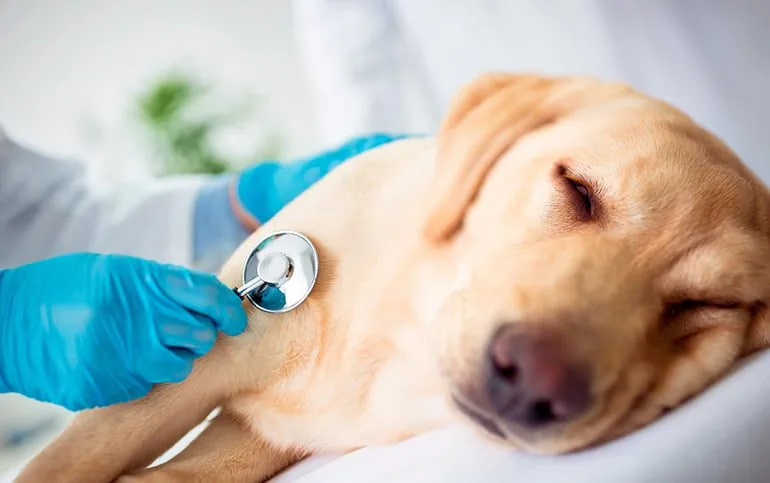
First, the vet will ask us questions about the dog's medical history. Then they'll perform a physical exam and suggest the tests needed to rule out causes one by one. For example, stool samples can be examined, or a culture done to look for both parasites and fungi.
It's also common to draw blood for bloodwork, which will give us information about the dog's overall condition. Ultrasounds and X-rays are other tests that may be ordered. In chronic colitis, colonoscopy and colon biopsy are recommended. The alternative is trying different treatments to see if any work.
Treatment for Colitis in Dogs
Logically, treatment will depend on what caused the colitis. Acute cases can resolve spontaneously within a short time. But if they don't resolve or become chronic, seeing the vet is essential. Treatment targets the specific cause, but is also prescribed to control symptoms.
In cases with noticeable dehydration, the dog will need to be hospitalized to replace fluids intravenously. A dog with mild symptoms can stay at home. Sometimes oral rehydration solution needs to be given and food withheld for about 24 hours.
Once feeding resumes, it's recommended to give the dog a high-fiber, highly digestible, low-fat diet, both in cases of chronic and acute colitis. In addition, chronic colitis may need antibiotics, immunosuppressants, probiotics, etc., depending on the cause.
When to See Your Vet for Colitis
If our dog has no prior underlying condition, a single episode of acute colitis can resolve on its own. But if this isn't the first time, symptoms don't go away, or it's a puppy or an older dog, we need to see the vet.
Also if the dog has some other already diagnosed disease, is dehydrated, or its condition worsens. Other warning signs are significant bleeding, general listlessness in the dog, or intense vomiting.
Bibliography Carlson and Giffin. 2002. Manual práctico de veterinaria canina. Madrid. Editorial el Drac.
IMPORTANT: This article is for informational purposes only and does not constitute veterinary, nutritional or behavioural advice. Every dog is different, and only your trusted vet can advise you on its specific needs.