 Care
Care
Ectropion in Dogs
Ectropion, in a nutshell, could be defined as eversion of the lower eyelid. It's due to different causes depending on whether it's a congenital defect caused by a genetic alteration or, on the contrary, an acquired problem.
Ectropion involves an anatomical change that can cause eye problems, since affected eyes are more exposed to any outside irritant. In the most severe cases, the vet will need to perform surgery. Let's take a detailed look at everything related to canine ectropion at Soyunperro.com.
What Is Ectropion?
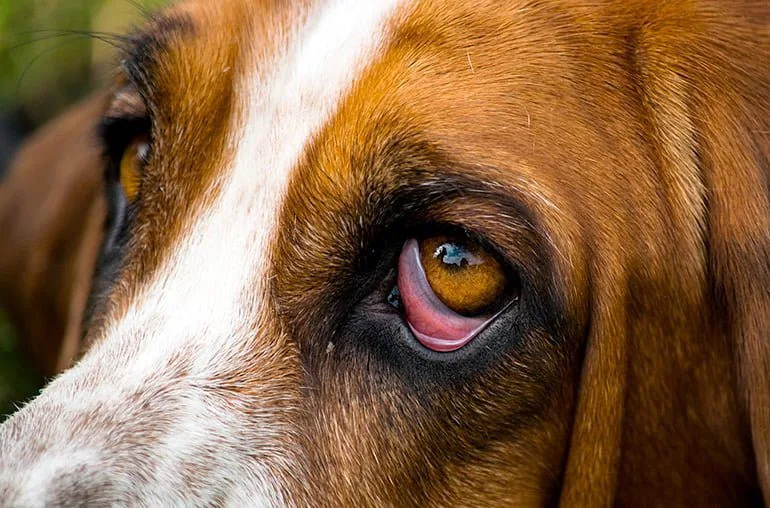
Ectropion is defined as the eversion of the eyelid margin and lower eyelid that can be identified in some dogs. Everting means turning outward or rolling. In other words, what happens is the lower eyelid rolls outward.
We can observe the formation of a kind of pocket that makes the eyelid droop, separating from the eye's surface and showing the eyeball, the conjunctiva, and the third eyelid, which stay hidden in the absence of ectropion. It normally occurs in the central part of the eyelid.
What Causes Ectropion in Dogs?
In some breeds, ectropion presents as a congenital defect due to alterations in certain genes. These genetic changes cause the eyelids to develop incorrectly. Its hereditary component seems certain, which is why it can appear in more than one dog in the same family.
For this reason, breeding dogs affected by ectropion isn't recommended. Besides genetics, sometimes ectropion appears as a result of another health problem, or simply due to old age.

Which Breeds Are More Prone to Ectropion?
This condition can appear in any dog, but it's more common in breeds with loose or drooping facial skin. For example, ectropion is notable in some hunting or water dogs, such as Hounds or Spaniels. But the very popular Saint Bernard also suffers from ectropion.
The Great Dane, Bullmastiff, or Newfoundland are other breeds more affected by this eye defect. In addition, older dogs lose tone in their facial skin and, as a result, can also show ectropion.
Side Effects of Ectropion in Dogs
The change ectropion produces at the eyelid level allows more exposure than usual of the ocular conjunctiva in the lower part of the eye. In other words, areas that should be fully covered by the lower eyelid, and therefore protected, become perfectly visible with ectropion.
This way, the eyes are exposed to irritating agents that can end up causing eye infections or corneal damage. In addition, since the defect persists, these become chronic. Notable ones include recurring conjunctivitis, but also corneal inflammation or keratitis. In the most severe cases, keratitis causes blindness.
The most common symptoms seen in eyes with ectropion are, besides conjunctivitis and corneal problems, constant tearing, also known as epiphora, and problems resulting from poor distribution of tears across the whole eye. One example of this last case is keratoconjunctivitis.
Treatment for Canine Ectropion
Faced with a dog with ectropion, we need to distinguish two situations. First, we have dogs with mild ectropion, characterized by not suffering any other symptom. These cases won't need treatment. At most, more thorough eye hygiene with saline solution is recommended to hydrate and clean the exposed area.
But in a higher percentage of cases, dogs with ectropion will show eye problems or too pronounced an eversion. That's why the defect will need to be repaired. The surgery, which of course the vet needs to perform, involves tightening the eyelids.
It's a simple procedure, but it always needs to be performed by a veterinary ophthalmologist or, at least, one experienced in ophthalmology. It involves removing a wedge of tissue from the lower eyelid and joining the resulting edges. This way, the eyelid's skin becomes tight again, correcting the defect.
Ectropion vs Entropion: What's the Difference?
Given how similar both terms are, and that they both refer to eye disorders, it's not unusual for confusion to arise between ectropion and entropion. But they're conditions that are easy to tell apart if we look at the definition. So, if ectropion was the eversion of the lower eyelid, entropion involves inward folding of the eyelid margin.
Inward folding here means the edge of the eyelids turns inward, which can damage the eyeball. It's a very common congenital defect in breeds like the Shar Pei or the Chow Chow and can affect both eyelids. It requires surgical correction.
Bibliography Carlson and Giffin. 2002. Manual práctico de veterinaria canina. Madrid. Editorial el Drac.
IMPORTANT: This article is for informational purposes only and does not constitute veterinary, nutritional or behavioural advice. Every dog is different, and only your trusted vet can advise you on its specific needs.