 Breeds
How Many Types of Doberman Are There? European vs. American
Dobermans are dogs that impress with their looks. But they're much more than imposing. Intelligent and active, though associated with property defense, they also make excellent companion dogs.
This much is well known, but what not every owner knows is that there's more than one type of Doberman. And we're not talking about the Pinscher, which some people associate with this breed, but the only two Doberman types that exist: the European and the American. Below, we'll go over the main differences between them.
The Doberman Breed
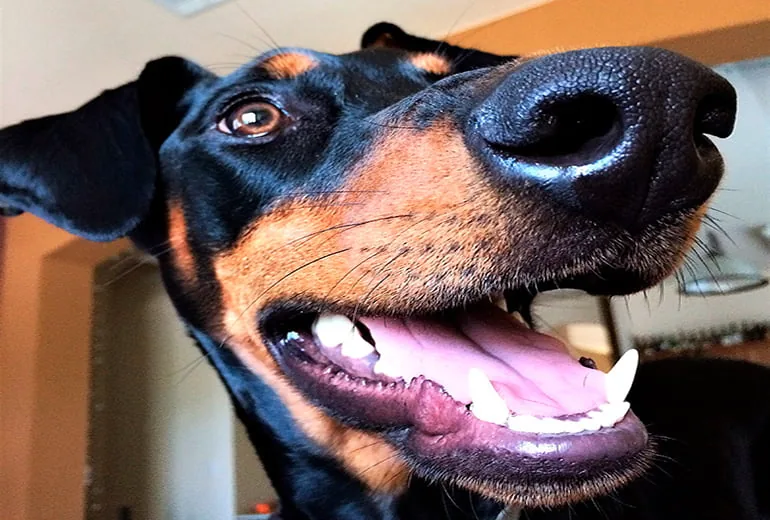
You've probably seen a Doberman before, even if just in a photo. It's a dog that makes an impression. It's medium-to-large in size, with a well-muscled, athletic body and a short, glossy coat that lies close to the body, in black and tan. Its imposing look has led to it being included on the list of potentially dangerous dogs, or PPP, in some countries — though not in Spain.
It has long carried out guard and defense duties, which has helped create an image of ferocity and danger that has little to do with reality. In fact, its excellent qualities have led it to serve in police work. They're very intelligent, active animals, and affectionate with their families.
This is the most common image of the Doberman, which is why many people will be surprised to learn that our idea of the breed is usually based on just one of the two Doberman types that exist. And the other one isn't the Mini Pinscher. Today, the Fédération Cynologique Internationale and the American Kennel Club each recognize a different Doberman type.
European Doberman
Characteristics of the European Doberman
The Doberman breed originated in Germany. Its breeding began with the goal of producing a dog for protection against intruders, without losing an affectionate temperament. And that goal was indeed achieved, since the Doberman shows excellent qualities, making it suitable for both work and companionship.
It's worth stressing its gentle character and attachment to its family, since the image branding it a dangerous dog is a powerful one. The reality is that, when well trained and with its basic needs met, it's far from aggressive. On the contrary, its gentleness will surprise you.
This breed is recognized by the FCI, which has established its standard. In it, it doesn't acknowledge that different Doberman types exist. It only talks about varieties whose sole difference is coat color. So, it accepts black or rust-brown individuals with tan markings in certain areas of the body, like the eyebrows, muzzle, or chest.
American Doberman (Photo with cropped ears and docked tail)
A Different Doberman: The American
So where does this other Doberman type come from? It's the American Doberman recognized by the AKC, which has set its standard. The differences found between the two are what lead to distinguishing a European type from an American one. The first distinction that can make telling them apart much easier is coat color.
The AKC accepts black, red, blue, and fawn colors, with rust markings on the eyes, muzzle, throat, legs, feet, chest, or under the tail. As a major difference, it also allows a small white patch on the chest, as long as it's limited in size. In the European Doberman, any white patch is disqualifying.
Differences Between the European and American Doberman
The first differences between the two types can be seen at a glance. Beyond the different colorings, you also need to look at the build. The European Doberman has a tougher look and less streamlined lines.
But looks aren't everything, since the most important differences relate to temperament. The European Doberman is a working dog, with a strong protective instinct and a powerful, though well-balanced, personality. It needs an experienced owner who can give it all the stimulation it requires.
The American type's breeding, on the other hand, is guided by looks and manageability. It has more streamlined lines and doesn't show the same drive for work as the European. But it'll make a good family dog and won't need as much stimulation, which makes it easier to manage.
Working Trials for Dogs
But why are the European and American Doberman's temperaments so different? The key is believed to lie in working trials. In Europe, these are mandatory for all breeding dogs. But this requirement doesn't exist in the United States, which only requires dogs to be registered with its association.
Working trials assess the dog's character, its aptitude for work, and its social skills. This matters if what you want is a Doberman that can compete in various dog trials.
Most Common Health Issues
Lastly, there are some differences in the most common health conditions in one Doberman type versus the other, due to the different breeding programs in Europe and the United States. In the European type, eye conditions stand out. In the American type, problems tend to affect the skin and coat more, and they also suffer more from Wobbler syndrome.
IMPORTANT: This article is for informational purposes only and does not constitute veterinary, nutritional or behavioural advice. Every dog is different, and only your trusted vet can advise you on its specific needs.