 Care
Care
Euthanasia in Dogs — When Should It Be Applied?
Euthanasia is a controversial topic on several levels. The word euthanasia, often used as a synonym for putting an animal down, refers to a clinical procedure that veterinary medicine can perform.
But the fact that a vet can euthanize a dog doesn't mean it's ethical to do so under any circumstance. That's why it's important to understand what euthanizing really means and in which cases it can be applied. Shall we begin?
Euthanasia vs. Killing
Etymologically, we can define the term euthanasia as "good death." The Royal Spanish Academy defines it, specifically, as hastening the death of an incurably ill patient with the goal of preventing suffering. Killing, on the other hand, simply means ending an animal's life.
In veterinary settings, it's not unusual to hear both words used as synonyms. But the distinction between them is very important if we want to understand the clinical procedure that euthanasia actually involves.
In fact, confusing euthanasia with killing leads some people to go to clinics asking the vet to euthanize completely healthy dogs. This could never be called euthanasia. It's killing, and the vet shouldn't agree to it.
When Is It Possible to Apply Euthanasia?
Going back to the definition of euthanasia, the first requirement to apply it is having a sick dog. But not just any illness will do, no matter how chronic it is, or how costly or complex its treatment or surgery might be. The disease affecting the dog must, first of all, be incurable. But that's not all.
For example, a dog with kidney disease has no treatment that can restore its kidneys' function. But it is possible to keep it living with a good quality of life for months or even years. That's why the other determining factor for euthanasia is that the condition causes suffering that can't be relieved by any other means.
No cure and in pain — this is when it's common for the vet themselves to bring up euthanasia. Given the conditions that can lead to death, statistically it's more common to need to euthanize an older dog. But serious accidents or infectious diseases are causes of euthanasia that can also affect young dogs.
When to Decide Whether to Euthanize My Dog?
The decision to euthanize our dog is the hardest one we'll ever have to make on its behalf. And the responsibility for that decision falls on us alone. Ideally, we should be guided by the same factors the vet considers — that is, incurable illness and suffering that can't be relieved. Outside of these circumstances, it's called killing. Let's not fool ourselves.
When our dog can no longer lead its normal life, we'll know the moment to say goodbye is approaching. Offering it its favorite food, taking it somewhere it especially loves, and, above all, staying by its side with affection and loving words is what we can do for our dog before euthanasia.
What Does the Euthanasia Process Involve?
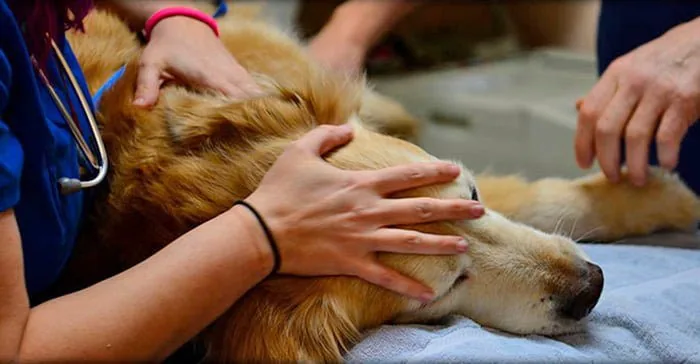
Once the decision has been made, the vet will sedate the dog. This way, it will fall into a deep sleep without feeling any pain. It's at that point that the euthanasia drug is administered, usually intravenously. For this, if it doesn't already have one, an IV line will be placed in a front leg.
Less commonly, euthanasia can be done through an intracardiac injection. Either way, the goal of the euthanasia drug is to stop the heart. Without suffering. After a few minutes, the vet will listen for a heartbeat to confirm there is none. The dog has passed.
What Happens After Euthanasia?
Depending on local regulations, we'll have different options after our dog's death. If we have a yard, in some cases we can bury it there or on any property we own.
Another option is cremation, which can be done collectively or individually. In the latter case, we can ask to receive our dog's ashes in an urn. This is a more expensive procedure.
Can a Dog Be Euthanized at Home?
The vet clinic can feel like too cold and public a place for a goodbye. Or maybe we'd rather not move our dog, it doesn't like the car, or we'd prefer the vet not to be its last memory.
That's why it's common for owners to consider euthanizing their dog at home. And the truth is, this is an option offered by many clinics. So, before making a decision, we can discuss this option with our trusted vet. The same procedure described above can be performed at home.
How Much Does It Cost to Euthanize a Dog?
Euthanizing a dog isn't free. It's not a simple injection. We've already seen how the whole process unfolds, and, of course, it can only be performed by a vet.
Although prices vary between clinics, the cost of the lethal injection, on average, ranges between 30 and 50 euros. But we need to keep in mind that costs will vary depending on the dog's weight. We also need to add the cost of cremation, if that applies to our case.
Should an Aggressive Dog Be Euthanized?
An unfortunately common example of killing disguised as euthanasia comes up in cases where people want it applied to an aggressive dog. Aggression is not a reason for euthanasia. On the contrary, the solution involves working on the dog's behavior.
For this, consulting an ethologist, a dog trainer, or a vet specialized in behavior is essential. Or, at the very least, we have a duty to contact a rescue organization that can take charge of finding a new home for a dog we're unable or unwilling to care for.
IMPORTANT: This article is for informational purposes only and does not constitute veterinary, nutritional or behavioural advice. Every dog is different, and only your trusted vet can advise you on its specific needs.