 Breeds
German Shorthaired Pointer: Complete Guide to This Hunting Breed
The German Shorthaired Pointer, designed as an all-round hunting aid in the 19th century through crosses with English Pointers, still carries a working instinct that shapes his everyday life; you might also be interested in the Weimaraner. Discover how his genetic heritage shapes his athletic build, his short-coat standard, his balanced temperament and his ability to fit into family life.
Origin and history of the German Shorthaired Pointer
The Deutsch Kurzhaar — as he's known in Germany — has nearly a century of very serious work behind him. 19th-century German hunters knew exactly what they wanted and built it methodically over several decades.
The problem was specific. Hunting dogs of the era tended to be good at one thing and average at everything else. One pointed well but wouldn't retrieve. Another tracked wounded game but got lost in water. For a hunter going out alone and needing to cover several types of terrain in a single day, that wasn't enough. Crossing old German bloodlines with English Pointers and some scent hounds, breeders sought an animal capable of pointing game, retrieving on land and in water, and tracking without losing his way. A dog for everything.
But breeders didn't stop at hunting aptitude alone. They also cared about temperament, because a dog who wrecked the house out of season had little future as a working breed. The standard they gradually fixed combined functional build — a deep chest, strong legs, a short, dense coat that protects without tangling in undergrowth — with docility and cooperative intelligence. The breed club was founded in Germany in the late 19th century, and the Fédération Cynologique Internationale classified him in Group 7, Section 1.1, as a continental pointing dog.
After the Second World War the breed left Europe and became firmly established in North America. In Spain he's been present for decades, both in hunting circles and among people looking for a genuine sporting companion. Knowing his origin helps make sense of much of his day-to-day behaviour. The German Shorthaired Pointer is an athlete with very strong instincts, and that doesn't go away just because he lives in a flat.
FCI standard: measurements, build and coat colours
Males stand between 62 and 66 cm at the withers. Females, 58 to 63 cm. Weight falls between 25 and 32 kg, always in proportion to the individual's height and muscular build. What the FCI standard aims for is an athletic dog without exaggeration: endurance and function above everything. A Pointer outside those measurements works worse, and pays for it in conformation shows too; but the real problem is that too bulky an individual loses ground in the field, while one below minimum weight can't keep up on long days.
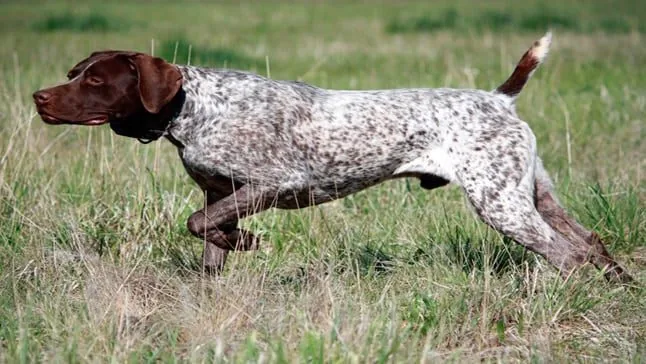
The short, dense, coarse-to-the-touch coat is there for purely practical reasons. It lies close to the body, repels water and withstands scraping against brambles without leaving the dog cut up. No woolly undercoat, no feathering. The standard allows brown in all its variants and black, both combined with white patches of free extent. There are solid-coloured individuals, others with white mottling over a dark base, and those showing a roan pattern, that intimate mix of coloured and white hairs producing a very recognisable speckled effect. Nose and eyelids pigment in harmony with the base coat. Whether a dog is dark brown, roan or black changes nothing about performance, though breeders have preferences based on which colour offers better contrast against the terrain during a hunt.
The head is well-proportioned, with a moderate stop and high-set ears that fall at the sides of the skull. The tail was originally partially docked for practical reasons in the field, a practice now banned or abandoned across most of Europe. The Pointer's expression conveys intelligence and liveliness, with no trace of shyness or aggression. Knowing the standard well helps tell apart breeders who work with health and function in mind from those chasing morphological fashions that only harm the animal.
To understand what German Shorthaired Pointer dogs are like, you have to start from his origin as an all-round hunter; if you're interested in German working dogs, you can also check out the German Shepherd profile. His temperament is a direct consequence of what this dog was selected for. Energetic, sharp, cooperative. He bonds with his family with an intensity that can catch the unprepared off guard, and he needs to be in the middle of whatever's going on. That energy, which serves him well tracking tirelessly in the field, turns at home into constant curiosity and a hunger for interaction that doesn't ease off easily. Left alone for hours with nothing to occupy him, the result is always the same: he wrecks things, barks, spirals.
With people he generally gets on well, children included, provided socialisation was properly handled from puppyhood. Watch out for this: his size and energy level can knock a small child over unintentionally, so encounters with little ones are worth supervising. With other dogs he's usually sociable, though intact males can get competitive. Living with cats, rabbits or birds is another story; the prey drive is present, and if clear inhibition isn't worked on from puppyhood, the Pointer will act accordingly.
He's an emotionally sensitive dog. He picks up on the tone of his surroundings, and if the rules change from day to day or the household is chaotic, he notices immediately and responds with instability. Coercive methods don't work on him. What he needs is calm, predictability and positive reinforcement, leadership that channels his willingness to cooperate without crushing it. Real exercise, plus daily mental challenges. This isn't a suitable breed for someone with little time or little physical activity.
Early socialisation and developing the hunting instinct
The critical window runs from three to fourteen weeks. During that period the puppy's nervous system is especially receptive, and whatever he experiences then — who he meets, what he smells, how the world reacts around him — leaves a mark that's very hard to erase. With the German Shorthaired Pointer there's an extra layer, since the predatory sequence is written into his genes. Locate, stalk, chase, catch, bite. It's going to emerge as the dog matures, with or without help. But if during that sensitive period he's gradually exposed to hunting scents, taught to inhibit the chase on a signal, and rewarded for staying calm around triggering stimuli, that expression can be shaped. Socialisation needs to continue throughout the whole first year, not just the first few weeks.
Trying to suppress the hunting instinct is a dead end. The dog gets frustrated, that frustration builds up, and sooner or later it comes out as compulsive behaviours — obsessive chasing, non-stop barking at birds, trouble concentrating. It's far better to redirect it toward something meaningful — fetch or tug games, searching for objects hidden around the garden or house, and, if the owner is up for it, starting hunting training with someone who knows what they're doing. With cats or poultry, always go on lead and take it slow, pairing their presence with something positive for the dog. Done well, the dog ends up building an emotional response that simply doesn't line up with giving chase.
Between six and eighteen months comes adolescence, and with it the real test. The instinct intensifies, boundaries that seemed well established start to wobble, and a dog who used to respond perfectly to recall can start ignoring it the moment he picks up an interesting scent. Here consistency in recall and release commands makes the difference, along with never letting the dog run off after something unsupervised, because if he does it once and it pays off, he'll want to do it again. A well-trained "stay" and "come" are the two tools that will give this dog the most freedom in natural settings. Without them, freedom in open country has a very clear ceiling.
How to train a German Shorthaired Pointer
The German Shorthaired Pointer learns fast. Too fast, in some cases, because that same mental agility leads him to anticipate routines and lose interest once exercises become repetitive. He grasps what's being asked of him right away, and that's an advantage as long as whoever's training him knows how to make the most of it with short, varied sessions that offer something new to solve each time. He comes with built-in motivation to work with people, but that doesn't mean training runs itself. Positive reinforcement — treats, play, well-timed praise — is what works best with this breed, because it connects directly with what he already carries inside. Fear-based or physically punitive methods end up producing a dog who avoids, who tenses up, who over time stops trusting the person who should be guiding him.
Of everything to work on, emergency recall comes first. The Pointer has a hunting instinct, and once he picks up a trail he can get a long way off before he even notices. Getting him to associate "come" with something he genuinely cares about — a top-tier treat, not just any kibble — can prevent more than one scare. Start at home, no distractions, and gradually add difficulty until the dog responds even with a rabbit twenty metres away. "Drop it" or "leave it" goes hand in hand with this, and the most effective way to train it is through toy exchanges: the dog learns that letting go of something is followed by something better, and conflicts over objects disappear. With those two commands solid, most tricky situations during a walk have a solution. A clicker or any verbal marker helps capture the exact moment the dog does the right thing, and speeds up the process considerably.
Learning to sit or stay is fine, but the Pointer needs more. Scent games — hiding treats around the house, laying trails in the garden — give him real work he's genetically built for. Agility circuits work too, and complex tricks keep his mind occupied when there's nothing else going on. For anyone not hunting with him, mantrailing or barn hunt are alternatives that fit his abilities perfectly. And here's the trick a lot of people overlook. Training isn't something you do as a puppy and then consider done. This dog needs stable rules and daily mental work for the rest of his life, because what his body asks for doesn't change with age.
German Shorthaired Pointer health and hereditary diseases
A well-cared-for German Shorthaired Pointer can reach 12 or 14 years in great shape. For that to happen, it's worth knowing from the start which hereditary diseases circle the breed and choosing puppies from breeders who run genetic tests.
Cone degeneration is one of the eye conditions with the most weight in these dogs. It's documented in the study ‘Canine CNGB3 mutations establish cone degeneration as orthologous to the human…’ (2002). Symptoms show up very early: within a few weeks of life, the puppy already has trouble moving around in bright light, though he manages much better in low light. There's no cure for the disease, so the only real path is genetic testing in breeding stock before mating.
Type 2 von Willebrand disease is another hereditary condition with a notable presence in the breed. It affects clotting: a wound or routine surgery can turn into prolonged bleeding that would be minor in another dog. Watch out for this — an affected dog can live a completely normal life, but any surgical procedure needs the vet informed from the start. There's now a genetic test that identifies an animal's status in advance, useful both for breeders planning litters and for owners about to neuter their dog.
Exfoliative cutaneous lupus erythematosus, ECLE, rounds out the three most relevant hereditary conditions in the breed. It's an autoimmune skin disease presenting with flaking, hair loss and crusting, mainly on the face, ears and genital area. At any skin lesion that doesn't clear up in a few days, see the vet without waiting: the sooner immunomodulatory treatment starts, the better the outcome usually is. Beyond these three, hip dysplasia, gastric torsion and recurring ear infections also show up in the breed and are covered in the routine care section.
Ear hygiene and preventing ear infections
The German Shorthaired Pointer's ear shape — floppy, high-set, with a flap that covers the ear canal — creates a warm, damp microclimate that favours yeast and bacterial growth. This anatomical predisposition worsens if the dog bathes often, swims in stagnant water or hunts in areas with dense vegetation, where foreign bodies like grass awns can get in. External ear infections aren't a minor issue: beyond the pain and discomfort they cause, becoming chronic can lead to middle ear infection and, in severe cases, hearing loss. That's why ear hygiene shouldn't be a reaction to symptoms, but a preventive weekly routine.
The correct procedure starts with a visual check of the flap and canal. If redness, a bad smell, dark discharge or persistent head-shaking shows up, see the vet before handling the ear, since improper cleaning on an inflamed eardrum can make the injury worse. Under normal conditions, a dog-specific ear cleaner is used — never cotton swabs, which push dirt further in. A small amount of solution is poured into the canal, the base of the ear is gently massaged for a few seconds so the liquid dissolves the wax, and the dog is allowed to shake his head. Excess product and visible dirt are then removed with a clean gauze pad, without going in any deeper than a finger can reach.
In dogs who swim or work in wet areas, it's worth thoroughly drying the ear flaps after every session, paying special attention to the inner face of the ear. Some owners choose to apply drying solutions with boric acid or propolis on veterinary advice, especially during hot weather. Keeping the ear canal ventilated is tricky given the breed's anatomy, but it can be helped by trimming the hair growing at the ear entrance, always with round-tipped scissors and plenty of care. Consistency in this routine drastically reduces the incidence of ear infections and stops the dog from associating ear handling with a painful experience.
How to properly care for a German Shorthaired Pointer
The German Shorthaired Pointer is a dog who needs far more than two walks a day. We're talking about one to two hours of intense exercise at minimum, and that's on normal days. Puppies and individuals from very active hunting lines can ask for quite a bit more. The right mix is long off-lead runs in open areas, retrieving sessions and, whenever possible, swimming. Water suits him especially well because it works the whole musculature without punishing the joints. A Pointer who doesn't burn off energy ends up wrecking the sofa, barking non-stop or stuck in a constant state of alert that wears everyone out.
The short, dense coat of this breed is deceiving. It looks like it takes no work, and largely that's true, but it's not something to ignore either. A rubber grooming glove or a natural-bristle brush once a week is enough to remove dead hair and keep that characteristic shine. Baths only when genuinely needed, with a gentle shampoo that won't disrupt the coat. Nails, every three or four weeks if the dog doesn't wear them down enough on hard surfaces. And the teeth too. Regular brushing or dental-specific treats stop tartar from settling in, something that goes unnoticed more than it should. For food, high-end kibble for active breeds split into two daily meals helps prevent gastric torsion, though it also matters not to let him do intense exercise right before or after eating.
A flat can work, but with conditions. Without frequent, long outings outdoors, this dog doesn't thrive. The ideal setting is a house with a fenced garden where he can move around freely between sessions. Watch the fence, though. This dog jumps very well, and if something catches his eye on the other side, he won't think twice. Heat also calls for caution. The combination of short coat and high metabolism makes him vulnerable to heatstroke, so in summer walks should be reserved for early morning and evening, always with water and shade available, and never left inside a parked car.
Anyone wanting to live with a German Shorthaired Pointer is taking on a real commitment. Every outing, every ear check, every training session builds the relationship and keeps the dog in balance. Before taking the step, it's worth finding a breeder who provides genetic tests for the parents and doesn't disappear the moment the puppy leaves their home.
IMPORTANT: This article is for informational purposes only and does not constitute veterinary, nutritional or behavioural advice. Every dog is different, and only your trusted vet can advise you on its specific needs.