 Breeds
Grand Bleu de Gascogne
The dignified expression and majestic bearing of the Grand Bleu de Gascogne make an impression from the very first moment. Developed in the French countryside to accompany royalty on their hunting expeditions, these dogs are perfect for families with an active lifestyle and a fondness for outdoor walks.
At home they're affectionate, faithful, and devoted to their people, with a highly sociable personality, especially toward other animals sharing the household. But that's not all. Let's take a look at every detail of this impressive dog breed.
Physical Characteristics of the Grand Bleu de Gascogne
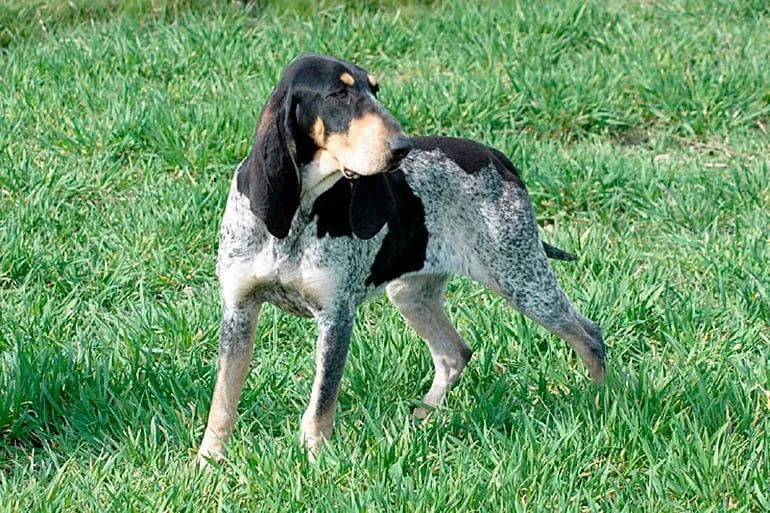
This breed stands out for its noble appearance and intimidating size. Its build is lean and elongated, with large bones and well-developed musculature. It has strong-boned legs with plenty of stamina. The front legs are notably thick and straight, while the hind legs stand out for their athleticism and power. The tail is saber-shaped.
The Grand Bleu de Gascogne also has a dome-shaped skull and a medium-length muzzle with drooping lips and cheeks. The eyes are round and dark-colored, with an expression of calm and composure. The ears, long and dropped, are set on either side of the head.
Its most distinctive trait is its blue-ticked coat, created by the visual effect of black spots scattered over the white base coat on its back. It's also common for them to show an oval spot atop the head and tan markings above the eyes and on the cheeks.
 Height between 65 and 72 cm in males and between 62 and 68 cm in females
 Weight between 35 and 55 kg in both males and females
 Short, coarse, very dense coat over the whole body
 Affectionate, docile temperament, good with other dogs
 Strong health, though prone to dysplasia
 Estimated life expectancy of 10 years
What Is the Grand Bleu de Gascogne's Temperament Like?
Despite their imposing looks, these dogs tend to be extremely affectionate and very docile with the people they share their lives with. They get along wonderfully with children, though given their large size you should closely supervise play sessions. They form positive relationships with other animals in the household, since they feel most comfortable as part of a pack.
They're not especially well suited to city life, and even less so to small apartments. These dogs are simply too large to feel comfortable in tight spaces, and on top of that, they have a very deep, intense howl that's likely to bother both owners and neighbors alike.
A Grand Bleu de Gascogne will be happy in the countryside, whether on a farm or in a house on the outskirts of town with enough space to move around. People who enjoy rural excursions or hiking will find these dogs to be an ideal companion.
Its hunting instinct stays close to the surface, so you should always walk it on leash, especially if your route might cross paths with small animals like cats, rabbits, or birds, which it will chase as prey. In some places these dogs are still used to hunt deer and wild boar.
Recommended Care for the Breed
Grand Bleu de Gascogne dogs need at least 2 hours of daily physical activity. It's recommended that these outings take place in open spaces, so they can move freely. Mock hunting exercises are also a good option, since they help keep the dog mentally balanced.
Dogs of this breed take a while to fully mature, so they'll keep acting like puppies until they're about two years old. For that reason, you shouldn't strain their muscles or joints until they've finished growing. In the meantime, avoid letting them climb too many stairs or jump onto furniture while young.
Coat care is simple, and no more than one brushing a week is needed. Baths are necessary about once a month, unless they come back very dirty from an outing. Likewise, after every outing you should check their paws to make sure no thorns have gotten stuck in them.
Their ears also need frequent checking, since given their shape they tend to trap moisture, which can lead to fungal infections. Finally, it's a good idea to check their thighs and belly for parasites or ticks after they've been through areas with dense vegetation.
History of the Grand Bleu de Gascogne
The Grand Bleu de Gascogne is believed to trace its origins back to the Middle Ages, emerging from a cross between a dog of the Bloodhound breed and native varieties in what is now the Gascony region of France. For centuries they were favorites of the aristocratic classes, helping nobles hunt wolves, bears, and wild boar.
Unfortunately, this association meant that after the French Revolution, breeding declined and their numbers dropped drastically in France. The breed would find a suitable home in North America to continue developing. In fact, there's a very popular hound breed in the U.S., the Bluetick Coonhound, which descends directly from these dogs. Blueticks are excellent trackers and raccoon hunters, and have inherited the sharp sense of smell of their European ancestors.
Fun Facts About the Grand Bleu de Gascogne
Some fans of the breed claim that packs of Grand Bleu de Gascogne had such stamina and such a sensitive nose that they could follow their prey's trail for weeks. Since they worked in groups of five or more, they were capable of taking down a bear without trouble, or holding it at bay until the hunter arrived.
Paradoxically, these dogs, once a symbol of absolute monarchy in France, became a symbol of the fight for freedom in the English colonies of North America. Legend has it that it was the Marquis de Lafayette, a French aristocrat, who brought the first Grand Bleu dogs to North America.
This nobleman joined the American fight for independence, and in 1785, upon meeting George Washington, gifted him seven magnificent hounds, which accompanied the founding father throughout his campaign for independence. According to many accounts, the Grand Bleu de Gascogne and Washington became inseparable.
IMPORTANT: This article is for informational purposes only and does not constitute veterinary, nutritional or behavioural advice. Every dog is different, and only your trusted vet can advise you on its specific needs.