 Breeds
Bloodhound: The Hound with the Best Nose in the World
The Bloodhound isn't a historical relic, but a living breed with the most powerful nose in the canine world: he has around 300 million scent receptors. In this article you'll discover his fascinating monastic origin, how his tracking ability has even been admitted in courts, and the keys to his stubborn but affectionate temperament.
History and origin of the Bloodhound
It all starts in Belgium, at the monastery of Saint Hubert. The Benedictine monks of that abbey had spent centuries selecting scent hounds with one very specific obsession: dogs able to follow a trail for miles and miles without losing it. When the Normans crossed the Channel and took over England, they brought these dogs with them, and it was there that the breed was refined into the standard the Fédération Cynologique Internationale recognises today under Group 6, Section 1.1 (large-sized scent hounds).
The name Bloodhound throws a lot of people off, but it has nothing to do with blood. It comes from "blooded hound", an expression denoting purity of lineage; back then, a "blooded" dog was one of selected, documented pedigree. For generations they were used to track missing people and fugitives, and police forces around half the world still call on them today. The French Revolution nearly finished them off: dissolving the monasteries lost many individuals and left the breed on the brink. It was British breeders who rescued the genetic stock and kept the line alive; you might also be interested in the Basset Hound.
Some people mistake the Bloodhound for some extinct ancestor or a discontinued variety. None of that. He's a fully current breed, with an official standard and individuals bred right now, though outside professional hunting and search circles the population isn't huge. Males run around 64-72 cm in height and 46-54 kg in weight; females, between 58-66 cm and 40-48 kg. Life expectancy sits around 10-12 years.
Exceptional sense of smell and legal recognition
Three hundred million scent receptors. That's what the Bloodhound packs into that long muzzle, with wide nostrils and an enormous surface area of olfactory mucosa. His precision at telling smells apart beats most technical analysis instruments, as recorded in the study ‘Canine Olfaction: Physiology, Behavior, and Possibilities for Practical Applications’ (2021). Canine smell already beats human smell by a landslide, but the Bloodhound takes that advantage to another dimension.
In many countries he has official recognition as a tracking dog, and in some US and European courts his findings have been admitted as evidence. He can follow a specific person's trail for days, over long distances, without confusing it with anyone else's. That sets him apart from drug- or explosive-detection dogs: here the target is the individual human scent, which makes him a fairly unique forensic tool. If you want to compare him with other hunting and tracking breeds, there's a full rundown of the best scent hound breeds.
Behind that legal recognition lie decades of real field work. Security forces use them to search for missing people, locate bodies or find leads at crime scenes. Every solved case has built that reputation, case by case, until by now nobody disputes it.
The Bloodhound's temperament, in two words: charming and stubborn
Some breeds are exactly what they seem. The Bloodhound is sweet, enormously affectionate with his own people, and gets on well with kids and other animals. But put his nose on a trail and forget he exists. He disappears. His whole nervous system switches on for one single thing, and no command in the world is going to interrupt it. That's instinct, not disobedience, and no trainer is going to get it out of him.
If the dog doesn't get enough scent work, that energy comes out some other way. Chewed furniture, tipped-over bins, ransacked cupboards. It isn't malice. It's a dog who needs to use his nose and can't.
These are sensitive animals. Shouting or physical correction doesn't work with them; on the contrary, it can build distrust and make things worse. Positive reinforcement gets better results, though the breed's stubbornness means progress is slow. Watch out for this — it isn't a breed for beginners. Channelling his impulsiveness without losing your patience takes experience and plenty of it. At home, though, they're calm, provided they've had the chance to sniff, move and tire themselves out during the day.
Socialisation from puppyhood makes all the difference. A well-socialised individual accepts strangers without issue, though he can seem a bit reserved at first. His voice is deep and powerful, and when following an exciting trail they tend to howl. They aren't built to guard or protect; that's not where his strengths lie. His historic function is tracking, and that's what he does, indoors too, where his nose ends up in every corner, every drawer, every bin he comes across.
Physical characteristics of the Bloodhound
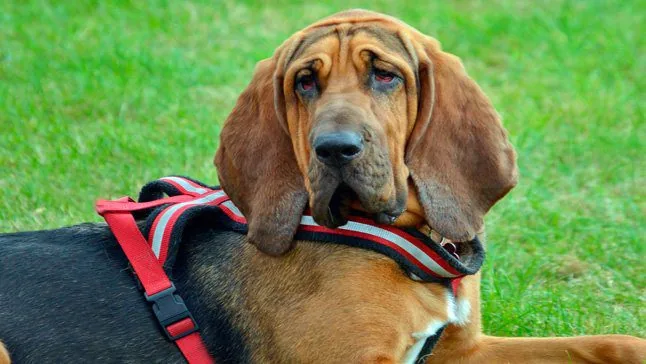
A Bloodhound in the flesh makes an impact. The head is huge and angular, the forehead crossed with deep wrinkles and the eyes framed by well-marked folds. The long, almost silky-textured ears hang down, and the facial folds are so characteristic they identify the breed at a glance. A generous dewlap hangs from the neck, a result of that loose skin.
The body matches. Heavy bones, well-built muscle, a deep chest with the lung capacity for long stretches. The coat, short and rough to the touch, comes in three variants: black and tan, red and tan, and plain red. A Bloodhound carrying extra kilos shows it in the joints sooner than expected, precisely because of how heavy that bone structure is.
His way of moving gives him away before he even reaches a trail. Head down, an even, methodical trot. Alert, the tail rises. The dewlap picks up scent particles every time the muzzle brushes the ground, and the ears do their part too, raking the surface and stirring up scent molecules toward the nose. A couple of traits that are no accident in a breed bred for tracking.
Training and education: managing the tracking instinct
Training a Bloodhound calls for a radically different approach than with other breeds. It isn't about teaching him not to track, but about channelling that instinct into controlled activities. The treat-search game is an excellent tool: hiding treats around the garden or the house and letting him find them with his nose satisfies his natural need. Basic obedience training should happen in short, varied sessions, since he gets bored easily. Constant-repetition methods don't work well.
Controlling the tracking instinct matters especially during walks. A Bloodhound can catch an interesting scent and take off without looking back, ignoring any command. The practical solution is a safety harness and a long line letting the dog explore without risk of escape. He should never be let off in unfenced areas. Recall training needs to be especially solid, but even with the best training, his instinct can override conditioning in moments of excitement.
A concrete guideline for owners: dedicate at least 20-30 minutes daily to structured scent games. Trails can be created with food or scented toys. Dog sports like tracking or mantrailing also exist, where the Bloodhound can compete and develop his talent in a structured way. Positive reinforcement with petting and a cheerful tone of voice works better than any correction. Patience is essential: this breed matures slowly and can keep behaving like a puppy until age three.
Gastric dilatation-volvulus syndrome is one of the most feared emergencies in large breeds. The stomach fills with gas and twists on itself, cutting off blood supply within minutes. Without urgent veterinary intervention, it can be fatal within hours. The Bloodhound, with that deep chest and body volume, ranks among the highest-risk breeds according to the study ‘Canine gastric dilatation-volvulus’ (1990).
Anti-torsion diet and preventing gastric dilatation
The first measure, and the simplest to apply, is splitting the daily food into two or three meals. One big daily ration is exactly the scenario you want to avoid. The bowl goes on the floor, not raised: although raised feeders are recommended in other situations, in breeds prone to torsion they can make the dog swallow more air than needed. Letting him eat calmly, without rushing, already helps a lot.
After eating, no running or wild play. At least an hour of rest. Water shouldn't be given in large amounts right after finishing either. And watch out for this: sudden diet changes generate gas, so any transition to a new food should happen gradually, mixing it in bit by bit over several days.
As for bowl material, stainless steel or ceramic are the best options. Plastic, especially if the dog tends to chew it, can release particles that have no place in the digestive system. Some owners add natural probiotics to help gut flora, but it's worth discussing with the vet first.
If the dog shows a swollen abdomen, tries to vomit without success, drools more than usual or won't stop pacing restlessly, get to the vet as an emergency without waiting. Gastric torsion allows no room to manoeuvre and has no home solution.
How to clean a Bloodhound's ears and prevent ear infections
The Bloodhound's ears have an anatomy working against them. Long, heavy and drooping almost to the ground, they create a dark, damp environment inside the ear canal where air barely circulates. Bacteria, yeast and mites thrive on that. Ear infections are one of the most common conditions in the breed, and the only realistic way to reduce them is cleaning the ears weekly with a solution specific to dogs. No hydrogen peroxide or alcohol, which irritate the mucosa and do more harm than good.
The process has no great mystery to it. Pour the liquid into the canal, gently massage the base of the ear for a few seconds and let the dog shake his head so residue comes out; gauze only comes in afterward, to pick up whatever's left on the visible part. Cotton swabs, best avoided. Instead of cleaning, they usually push dirt further into the canal, and in the worst case end up damaging the eardrum.
Watch out for walks through damp areas or dense vegetation. Every outing on that kind of terrain deserves an ear check and thorough drying if they've picked up moisture. When heat arrives, or the air turns especially humid, the routine needs stepping up. Some vets recommend gentle drying products to reduce residual moisture, always on their advice and without self-medicating.
Many Bloodhound owners have also adopted the habit of gently holding the ears back while the dog rests, for a few minutes a day, to let the canal air out a bit. It takes nothing special. Just some consistency.
There are signs not worth ignoring. Bad smell, redness, dark or yellowish discharge, or the dog constantly scratching at the area — any of that deserves a vet visit without waiting. The sooner an ear infection is caught, the easier it is to resolve.
Facial fold hygiene against infections
The Bloodhound's folds are what make him unmistakable, but also what needs the most attention. Heat, moisture, food residue, saliva — all of that gets in there and creates the perfect environment for dermatitis, fungi and bacteria. They need daily cleaning, with a damp gauze or a soft cloth with warm water — or a specific cleaning solution for canine folds — worked well into each crease and then dried thoroughly with a dry gauze or clean towel.
Drying thoroughly matters more than it seems. Residual moisture left inside causes more problems than the dirt itself. If you see redness, notice a bad smell or discharge appears, see the vet without waiting: it could be pyoderma. Some cases end up needing protective creams or topical antibiotics. Vinegar, baking soda and similar remedies are best avoided without professional guidance; they alter the skin's pH and can worsen irritation instead of relieving it.
The most practical routine is cleaning after every meal, since that's when the folds accumulate the most residue. In dogs with especially deep folds, a specific dog wet wipe followed by drying with a microfibre cloth works well. In warm climates or during summer, a daily check is non-negotiable. It helps a lot to set a specific moment of the day — before the dog's dinner, for example — so it isn't something that always gets put off. With that consistency, most infections are avoided and the dog is spared chronic itching and odour.
An inflamed fold hurts. The dog notices and rubs against the wall or scratches, which makes the lesion worse. It isn't just a cosmetic issue. Daily cleaning is what cuts that cycle of recurring dermatitis short and avoids ending up at the vet's every couple of months for the same thing.
IMPORTANT: This article is for informational purposes only and does not constitute veterinary, nutritional or behavioural advice. Every dog is different, and only your trusted vet can advise you on its specific needs.