 Training
How to Get Children and Dogs Living Together
Every day we see children on the street approaching to stroke dogs they don't know, with far too much confidence. Something that can not only scare the dog, but also be dangerous for the child.
The same happens in homes with dogs where a child arrives, or in homes with children where a new dog arrives. Both dogs and children need training, since it's vital both know how to respect each other and live well together.
How to Train a Child to Interact With Dogs?
The first thing we need to know is that training a child to behave around a dog we have at home, that is, one who's part of our family, is different from, say, a dog they might come across on the street who they don't know at all.
When we say "child", we obviously mean boys and girls under fourteen or fifteen years old, especially under ten, since they're still naturally unaware and could do something that harms the dog.
How a Child Should Act Around an Unfamiliar Dog- It's not advisable to approach an unfamiliar dog, touch them, talk to them or stare directly into their eyes. We need to make sure our child learns this properly.
- Before trying to stroke a dog, they should ask their owner first. If their owner isn't there, they should never approach the dog.
- If the owner agrees to let our child stroke the dog, since as the owner they know their character and know it won't pose a danger, our child should bring their hand close very gently and hold it still, so the dog can sniff them.
- Once the child's hand has been sniffed, they can stroke the dog very gently along their back and the sides of their neck. They should never stroke their head, muzzle or other areas that could bother the dog.
- Don't run towards the dog, shout, or make sudden movements that could scare them.
When the dog isn't a stranger but a family dog, or our own dog, our child should follow the rules above and also add some new ones:
- The dog isn't a toy — don't ride them or play tricks on them such as pulling their tail or ears.
- Never bother the dog while they're sleeping or eating.
- Never scare the dog, never hit them, and of course, respect them as another family member.
- Never put your face right up against the dog's face, against their muzzle.
- Don't hug them as if they were a person (that overwhelms plenty of dogs).
- Never take anything out of their mouth (neither toys nor food).
- Don't play tug-of-war games with toys with them.
Actually, making a dog happy is very simple — you just need to follow certain guidelines to avoid bothering them, so the whole family can live together perfectly.
Can a Dog Attack a Child?
Not only can they, they will — a scared dog can snap a bite to defend themselves. A watchful dog will attack if someone unfamiliar approaches. Dogs aren't bad, let's be clear — we also act the same way, just on a different scale.
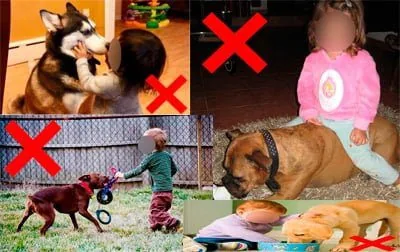
It's simply that children need training so they know how to respect dogs as they deserve, as another family member, and not as a pastime/toy.
Under no circumstances should you ever leave a small child alone with a dog — the child could innocently hurt or provoke the dog, and they won't know how to read the dog's signals when they show danger, and could get hurt.
From around twelve or fourteen years old, children start gaining some responsibility and knowledge about how to interpret these signals. Even so, both the child and the dog are always an adult's responsibility.
Dogs are affectionate, noble, loyal and highly family-oriented, as long as they're well trained and children respect them. If your child doesn't respect the rules, simply don't let them approach dogs.
How to Train a Dog to Interact With Children?
Dogs are highly intelligent creatures, but obviously have a limit, and there are things they can't assess. For example, why a child is pulling their tail and ears and nobody's doing anything about it.
It's our responsibility, and ours alone, to properly train our dog or puppy to prevent them picking up unsuitable behaviours. A well-trained dog isn't just a safeguard against potential problems with children, but also a safeguard for ourselves.
If our dog has the bad habit of biting while playing or being a bit rough, we need to teach them to bite their toys instead so they don't bite children or adults (playfully, of course): How to teach a puppy not to bite.
How Should I Introduce My Dog to My Baby?
Ideally, while the child is in hospital during the first few days, we should bring the dog a used nappy or clothing worn by the baby so our dog recognises their scent.
When our child leaves hospital and arrives home for the first time, we should follow a very simple ritual to introduce them to the dog:
- The dog should have just come back from a long walk, where they've run and burned off their energy. The more tired and relaxed they are, the better.
- We should greet the dog as usual, giving them affection and strokes but without getting them too excited.
- We should let the dog approach and sniff the child. This is entirely normal and necessary, since dogs recognise other dogs and people through their scent. Our dog should have the chance to sniff or even lick them. We should NEVER let this happen unsupervised — a responsible adult should be in charge of the child and another adult in charge of the dog, letting them sniff and get to know them, but with caution.
- Dogs pick up on our nervousness, so we need to stay calm and cheerful, talk to the dog and so on…
- Common sense is our main asset — if our dog is aggressive, we should skip these steps entirely. And whether or not the dog is aggressive, remember never to leave children and dogs alone.
IMPORTANT: This article is for informational purposes only and does not constitute veterinary, nutritional or behavioural advice. Every dog is different, and only your trusted vet can advise you on its specific needs.