 Training
How to Help a Dog and Cat Respect Each Other
Although there's a myth that dogs and cats are irreconcilable species, the truth is both can live together perfectly well in our homes. Here at SoyUnPerro we'll give advice to make life together satisfying for everyone.
Always remembering we need to follow specific guidelines for them to get along, since by their very nature they could have trouble living together.
You'll also enjoy reading: How to get a dog used to staying home alone
Do Dogs and Cats Always Get Along Badly?
The first thing to bear in mind is that between kittens and puppies problems don't usually arise, and it's most common that, if we introduce them young, they'll live together with no special measures needed on our part.
Likewise, we should know there are cats who won't tolerate dogs, and dogs who, as a rule, chase and attack cats.
If we've found our pet acts this way, it's not wise to bring in another pet, and if we have to, we should directly get support from a professional.
These are extreme cases; generally it's possible to get dogs and cats living together, as we'll see.
Preparing the Home
Although we might be lucky enough to have a particularly sociable cat or dog who accepts other animals with no special introduction needed, the truth is, especially when it comes to cats, it'll be more common that we need a gradual adaptation.
To do this, we can make use of pheromones, substances found on the market in various forms that have a calming effect.
These exist for both dogs and cats. Before bringing in a new animal, we can start using them, especially if we already have a cat at home, since cats tend to get stressed with changes.
We also need to prepare a room to initially set up the newcomer in, so meetings happen gradually.

The First Contact
The most important advice when introducing a dog and a cat is that we stay entirely calm.
Both animals can sense if we're nervous, which will unsettle them too and could lead to conflict. Of course, we should always be present, since if the reaction is bad, the animals could hurt each other.
In fact, until the relationship between the two is settled, we shouldn't leave them together unsupervised. It's also key that the first contact isn't forced.
If we have a cat and come home with a dog, we can show the dog their space, but shouldn't go looking for the cat — instead wait for them to approach on their own. Generally, they'll prefer to approach when the dog is still.
Getting to Know Each Other
They'll sniff each other and, quite likely, hiss and walk off. This can be a good start, and we can consider the first meeting concluded. If, on the other hand, we have a dog and are bringing in a cat, it's best to set them up directly in their own room, where we can include a blanket or towel used by the dog so the cat gradually gets used to their scent.
Afterwards we can come in with the dog, ideally on the lead, with the cat up at a certain height and with a way to escape, since cats feel safer if they can watch from up high.
Just as in the previous case, it's normal for both animals to sniff each other and for the cat to hiss, which usually has no major consequences.
Getting to Know Each Other Better
If the first contact went well, we can repeat it. It's normal for the cat's hissing to continue, or for the dog to try sniffing the cat a bit clumsily. They also need to get to know each other and set their own limits.
We'll always stay close in case we need to separate them. Meetings can gradually become more frequent until we let both animals roam freely around the house.
At that point, it's advisable for the cat to have furniture they can move around on if they don't want to be within the dog's reach. We should also leave their food up high to stop the dog eating it.
Likewise, the dog shouldn't have access to the litter tray, to avoid coprophagia and bothering the cat, which could lead to toileting problems in unsuitable spots.
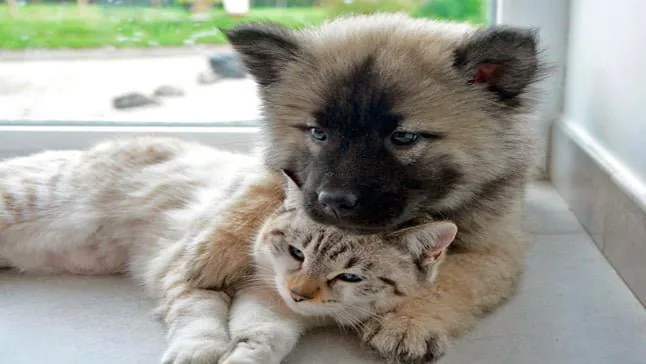
If the cat was there first, these changes to their setup should be gradual. At first, we should keep them separated again when we go out. Hopefully soon we'll see them sleeping together, licking each other, rubbing against each other and even playing.

Warning Signs
We've said a cat's hiss is to be expected, but if we see them take on a threatening posture, with ears back, mouth open and fur standing on end, it's time to take the dog out of their sight.
Likewise, a dog staring fixedly at the cat while staying still and starting to growl and bare their teeth is warning us they're close to attacking.
These are extreme, minority cases, but if every meeting we try ends with this reaction, we should consult a professional specialising in animal behaviour, and above all, never force contact or leave the animals together, since the risk of attack is very high.
Bibliography: Señordongato.com: https://xn--seordongato-2db.com/
IMPORTANT: This article is for informational purposes only and does not constitute veterinary, nutritional or behavioural advice. Every dog is different, and only your trusted vet can advise you on its specific needs.