 Care
Care
How to Know a Dog’s Age
If we adopt a dog, or find a stray and decide to give it a home, we'll need to know its age to provide the care best suited to its life stage. Puppies need very different care from a middle-aged or elderly dog.
With these simple tips, you'll easily be able to know your dog's age, regardless of its size or breed. This way, you'll be able to care for it as it deserves, giving it a diet and attention suited to its age.
How to Calculate Age in Puppies and Young Dogs
Teeth are, without a doubt, the best way to know a dog's approximate age without a vet's help, since vets actually use these same techniques to pin down a dog's age.
If our dog is a puppy and still has no teeth in its mouth, it means its age is somewhere between one day and fifteen days old. During this stage, they have no teeth, since they're still forming.
From fifteen days to a month old, puppies develop their incisors and canines. Incisors are the small teeth that form between the upper and lower canine teeth. If the puppy only has these teeth, we know its age doesn't exceed a month.
From the first month to the third month of life, our puppy will develop all its baby teeth. These are characterized by being very thin and weak, since they're rootless teeth. Colloquially, they're known as needle teeth, since due to how thin and sharp they are, they can prick our hands like little needles (when playing with our dog).
From three to eight months old, our dog will start losing its baby teeth, replacing them with its permanent teeth. These are sturdier, bigger, and harder, and their color will be much whiter and shinier.
From eight months to twelve months old, the dog will have fully completed the transition from baby to permanent teeth, showing a perfect, unworn set of teeth.
- 2 to 3 weeks: No teeth yet
- 4 to 5 weeks: Temporary canines start coming in (baby teeth)
- 5 to 6 weeks: Temporary incisors and premolars start coming in (baby teeth)
- 7 to 8 weeks: Has all temporary teeth (twenty-eight) and there won't be changes until four months
- 4 to 5 months: Temporary teeth start falling out and permanent teeth come in
- 6 to 8 months: Already has all permanent teeth (forty-two), very white and shiny
As you can see, calculating a young dog or puppy's age is very simple if we look at its teeth. It's impossible to determine an exact age, but we can get quite close.
How to Know If Our Dog Is an Adult or Elderly
Determining an adult dog's age is trickier than with a young dog or puppy, but we can get a good idea by also looking at its teeth, their wear, and other physical aspects of the dog.
Dogs between one and three years old show a perfect set of teeth, but with slight wear on their incisors (the incisors are the teeth found between the canines). Their incisors will gradually wear down until taking on a smoother shape, looking less sharp.
From three to six years old, wear on the incisors becomes much more noticeable, taking on a more square shape. The canines also start wearing down, becoming more rounded and less sharp, though this doesn't mean they're weaker.
From six years old onward, its teeth will wear down considerably, losing some teeth or showing tartar buildup if the dog is fed with kibble (commercial food, kibble pieces). We'll also notice spots on its nose, and clear signs of aging.
- 2 to 4 years: Teeth start turning a bit yellow and some tartar appears
- 5 to 9 years: Tartar presence is more evident and teeth are more yellowed
- 10 to 15 years: Tartar presence is pronounced and teeth may be missing, with a darker color
Other Signs That Can Help Us Calculate a Dog's Age
Not every dog has the same life expectancy, since small breeds have an average lifespan of fifteen years, while large breeds have a life expectancy of barely eleven years. This doesn't mean they can't live longer — there are known cases of large dog breeds reaching even twenty years old.
That said, it does mean large-breed dogs age faster than small breeds. So, the following symptoms will always be more noticeable in large-breed dogs than in small-breed dogs, even at the same age.
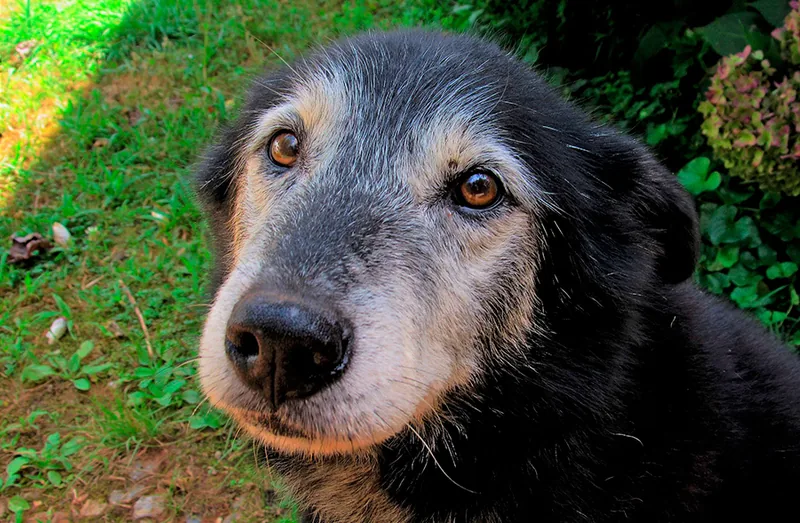
- Gray hair appearing: dogs over six years old start showing gray hair around their muzzle, turning their fur white over the years. That said, small breeds start showing gray hair later, usually from around eight years old.
- Coat shine gradually fades over the years, which also comes with gray hairs appearing on the rest of the head and body.
- The dog's energy gradually decreases over the years — while puppies and young dogs are very energetic and playful, once they become adults and enter old age, they prefer calm walks and less hustle.
- The appearance of conditions like arthritis in dogs usually occurs in elderly dogs, whose joints have aged along with them.
- Calmness — generally, and barring rare exceptions, elderly dogs rarely seek out trouble. They take on a calm, respectful attitude, since they know they're vulnerable.
With all this information, you'll be able to get a clear idea of your dog's age, so you can give it all the attention and care it deserves.
IMPORTANT: This article is for informational purposes only and does not constitute veterinary, nutritional or behavioural advice. Every dog is different, and only your trusted vet can advise you on its specific needs.