 Care
Care
How to Protect a Dog From Leishmaniasis
The odds of our dog getting infected with Leishmania are rising due to the significant climate change we're experiencing. Sand flies are spreading with increasing ease thanks to higher temperatures, and they're the main carriers of the disease. Let's take a detailed look at the best way to protect our dog from leishmaniasis.
What Exactly Is Leishmaniasis?
This is a disease caused by a protozoan that can infect dogs through the bite of the sand fly insect. If a dog is infected with leishmaniasis, it will carry this disease chronically for life. It causes a wide range of systemic symptoms and disorders in dogs, such as kidney, liver, and skin problems, among many others.
Symptoms of Leishmaniasis in Infected Dogs
Depending on the antibody titer and parasite load, symptoms can range from none at all to severe clinical presentations. Symptoms can be systemic/general or cutaneous.
- Systemic or general: weight loss, muscle wasting, pale mucous membranes, epistaxis (nosebleeds), anemia.
- Kidney disorders: glomerulonephritis, kidney failure, elevated urea and creatinine, proteinuria (protein in urine).
- Liver disorders: granulomatous hepatitis, elevated transaminases (liver enzymes).
- Digestive disorders: ascites, granulomatous ulcerative colitis, large-bowel diarrhea with or without blood.
- Musculoskeletal disorders: intermittent lameness, polyarthritis from the deposition of Leishmania immune complexes…
- Eye disorders: conjunctivitis, keratitis, blepharitis, uveitis…
- Skin: a lesion at the bite site possibly appearing around twenty days after the bite, typically in hairless areas. Nasal or paw-pad hyperkeratosis (dry skin) can occur.
We may see wounds and ulcers that become painfully chronic at the edges of the ears, between the toes (pads), etc. Single or multiple nodules may also appear.
How Is Leishmania Transmitted?
Sand flies, tiny insects barely three millimeters long, are responsible for transmitting Leishmania to dogs (genus Phlebotomus in Eurasia and Africa, and Lutzomyia in the Americas). Female sand flies feed on dogs' blood through a discreet bite, through which they can also transmit the disease.
They look like a small, furry, long-legged mosquito, and they reproduce very easily in warm climates. In the past, they were mostly found in coastal areas with warm climates or places with water (reservoirs, rivers, etc.). But nowadays they've spread across practically the entire country, so the risk of infection is far higher.
These insects are mainly active at dusk, as the sun starts to set. Although in practice they can be active at any time of day or night.
Why Are There More Leishmaniasis Infections Now?
Climate change is one of the main reasons sand flies are spreading into areas where they didn't used to live. Rising temperatures make it much easier for these insects to reproduce, since they thrive at temperatures above eighteen degrees Celsius.
That's why it's important to protect our dogs with preventive measures, to avoid infection and the many health problems it can cause.
How to Protect a Dog Against Leishmaniasis
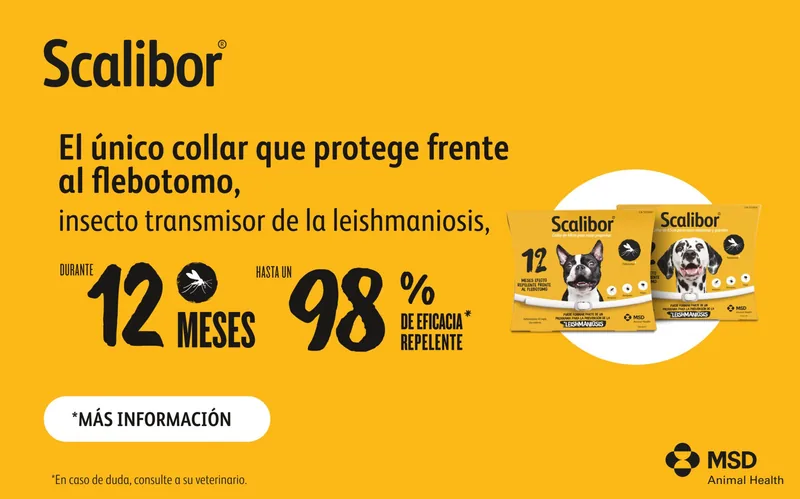
Prevention is the best medicine we can offer our dog — preventing infection is our main goal, and for that we can use anti-parasite collars that cover sand flies, such as the well-known Scalibor.
We can also vaccinate our dog annually against leishmaniasis, since a leishmaniasis vaccine exists, although this vaccine doesn't offer 100% protection against infection.
That's why prevention is the best tool we have to protect our dog. Let's look in detail at how the Scalibor collar works and what it does to protect our dog against leishmaniasis.
Scalibor Collar
The Scalibor collar is known as one of the most effective options for protecting dogs against parasites. It's very simple to use — we just need to fit it around our dog's neck and let it do its job. It offers effective protection against fleas, ticks, and the sand flies responsible for spreading leishmaniasis. Here are some of its benefits:
- Continuous, persistent protection for 12 months against sand flies*
- Effective protection against fleas and ticks.
- Can get wet.
- Suitable for puppies from seven weeks of age.
- Suitable for pregnant and/or nursing females.
- Developed by MSD Animal Health.
*Samara Paulin, Régis Frénais, Emmanuel Thomas Email author and Paul M. Laboratory assessment of the anti-feeding effect for up to 12 months of a slow release deltamethrin collar (Scalibor®) against the sand fly Phlebotomus perniciosus in dogs. Baldwin. Parasites & Vectors 2018 11:529.
Opinion
We all know climate change is real — just look at the numerous heat waves we've experienced over the past year to realize the climate is shifting dramatically.
This is making many insects feel right at home in places that used to have cold climates and are now becoming tropical or warm. Among them is the dreaded sand fly, responsible for spreading Leishmania.
Protecting our dog is the best solution, since if it becomes infected, there's no treatment that cures the disease — it will carry leishmaniasis chronically for the rest of its life, along with the health problems and veterinary costs that come with it. Our recommendation is to protect dogs with a highly effective anti-parasite collar against sand flies, such as Scalibor.
IMPORTANT: This article is for informational purposes only and does not constitute veterinary, nutritional or behavioural advice. Every dog is different, and only your trusted vet can advise you on its specific needs.