 Care
Care
How to Travel With a Dog by Car According to the Law
Without a doubt, if you have a family trip planned and will be bringing your dog along, choosing the car, whether your own or rented, is an excellent choice. Not only will you be free to manage stops based on your needs, but it's also more comfortable and lacks the restrictions on number of animals and weight that public transport has.
To make things easier, in this post we summarize what the General Directorate of Traffic (DGT) states about transporting pets in private vehicles, and what the RACE and DGT recommend for safely traveling with a dog by car in Spain. If you're in Mexico, you'll also find answers here.
Traveling With a Dog by Car: What Does Spanish Law Say?
In Spain, the DGT's Traffic and Safety Code is the regulation governing drivers' obligations. So, whoever drives is required to preserve their own safety and that of the vehicle's other occupants. To achieve this, they need to ensure proper visibility, freedom of movement, and adopt the correct driving position.
Similarly, the placement of objects and animals, if any, must serve the same goal: not interfering with vision, not distracting the driver, not affecting the vehicle's stability, and not giving anyone other than the driver access to mechanical controls (gear shift, pedals, and so on). All this to prevent an accident.
So, if you travel with your dog by car, you'll need to secure it using one or more restraint systems approved under European standards (ECE R17 or DIN 75410-2). Letting it stick its head out the window isn't safe, since there's a risk of falling. Dogs traveling lying on the rear shelf aren't safe either — they could be thrown from the vehicle.
Particularities of Restraint Systems
The restraint systems recommended by the DGT are the double-anchor harness, the dividing grille, and the carrier, which should be suited to the dog's size. We look at each separately below.
Double-Anchor Harness
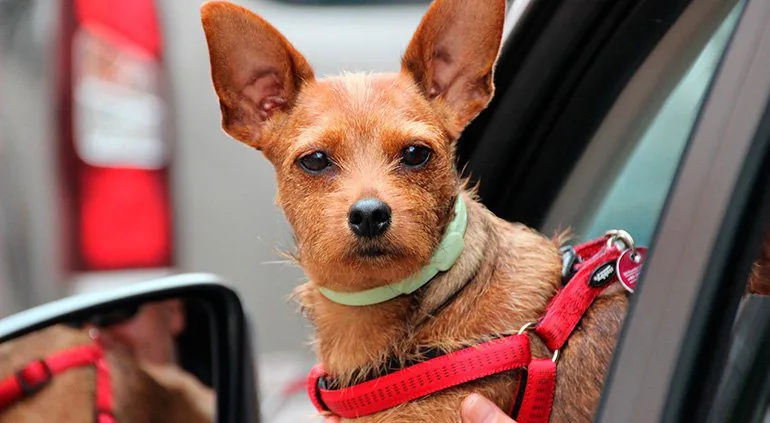
Regardless of the dog's size, the DGT and RACE recommend keeping it in the back seat secured with a double-anchor harness. This is a harness that distributes its body weight evenly to avoid hurting its neck, and that attaches to the seatbelt or ISOFIX, as well as to both of the harness's anchor points.
The leash should be short to prevent the animal from hitting the front seats in case of a collision and suffering serious injury. It's also not advisable for the leash to attach to the collar — it won't hold the dog back and could seriously hurt it or even be fatal.
Dividing Grille
This is a grille placed between the trunk and the back seats, recommended for large dogs, especially if the car is a family vehicle or has a rear hatch. It gives the animal room to move, but in case of an accident, on its own it's not enough to protect its safety.
According to the DGT, the safest setup has this grille running from the car's roof down to the trunk floor, keeping this space well contained and following European standard DIN 75410-2. That said, if your dog is medium or large, you'll need to combine this measure with a carrier suited to its size.
Carrier
This is perhaps the device we're most familiar with. The dog carrier should match the dog's size for it to travel comfortably and safely. So, if it's small, you should place it on the floor of the back seats, and if it's large, in the trunk as close to the seatback as possible and perpendicular to the direction of travel.
Drop the idea of placing the carrier on the seat and securing it with the seatbelt. In case of an accident, the carrier is very likely to break and your small pet could be thrown from it. RACE has run several 50 km/h collision simulations with a 22 kg dog dummy and found the animal's weight multiplies by 35.
Traveling With a Dog by Car in Mexico: What Does the Law Say?
Unlike Spain, in Mexico, the rules on how to travel by car with a dog differ from state to state. That said, municipal traffic regulations share the premise that it's advisable to use one of the restraint mechanisms available for this purpose.
So, if you're in Mexico and travel with a dog over 10 kg, you'll need to secure it to the back seat with a harness, buckled to the seatbelt. Although the double-anchor type is safer, it's not mandatory to avoid a fine. The carrier and dividing grille are the other alternatives to choose from.
What is penalized under the Mexico City Traffic Regulation is holding, carrying, or placing on your lap, or carrying in your arms, people or animals. Not following this rule and not ensuring safe driving, putting the vehicle's occupants' lives at risk, is fined 2,500 dollars.
Our Recommendations
Beyond what the law requires, which is mandatory, it doesn't hurt to keep certain tips in mind for a more pleasant trip. In this sense, you should space out mealtime and the start of the trip. Otherwise, it could get carsick and vomit. Let it drink water periodically and schedule stops so it can relieve itself.
Be extra careful if you've unleashed it before opening the door — it could get hit by a car if you're not alert — and, of course, don't leave it alone with the windows closed, especially if temperatures are high. We hope everything we've shared has been useful, and that you can put it into practice. Happy travels!
IMPORTANT: This article is for informational purposes only and does not constitute veterinary, nutritional or behavioural advice. Every dog is different, and only your trusted vet can advise you on its specific needs.