 Breeds
Hungarian Puli: Characteristics, Temperament and Origin
The Hungarian Puli is a herding dog of ancient origin, famous for his corded coat and analytical intelligence. Forged on the plains of the Puszta, he combines a strong working instinct with deep loyalty to his family, making him a demanding but extraordinary companion.
Origin of the Hungarian Puli: a dog with a thousand-year history
The Hungarian Puli is one of the oldest herding breeds in Europe, with a lineage going back more than a thousand years. His history begins on the Asian steppes, where the Magyars, nomadic peoples, bred working dogs to watch over and guide their flocks. These dogs travelled with the Magyars during their migration west until they settled in the Carpathian Basin, in present-day Hungary.
Once in Hungarian territory, the Puli established himself as the herding dog of the Puszta plains, specialised in keeping the flock together, directing it with agility and protecting it from predators. Shepherds rigorously selected the individuals with the strongest herding instinct and best physical stamina, which kept the breed practically pure for centuries thanks to geographic isolation.
Medieval chroniclers were already describing dogs with long, curly coats working alongside Hungarian shepherds. That characteristic coat wasn't an aesthetic whim: it protected the dog from harsh weather and from animal bites during long days out in open country.
This history as a working animal explains much of his current temperament: intelligent, reactive, and with an energy that only fully unfolds when he has a task to complete.
Physical characteristics of the Puli: much more than dreadlocks
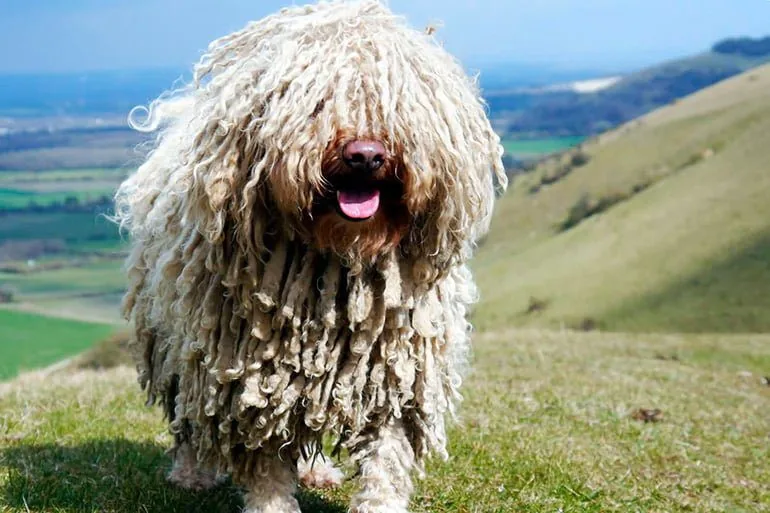
The Puli's most distinctive trait is his coat, which forms natural dreadlocks or cords spontaneously. This waterproof coat, woolly and dense in texture, protected these herding dogs for centuries on the harsh Hungarian plains. The cords can reach the ground in adult individuals and need no manual braiding: they form on their own as the coat matures.
As for size, the Puli has a compact, muscular build. Height at the withers ranges between 36 and 45 centimetres, with a weight of 10 to 15 kilograms and a life expectancy of 12 to 16 years. Females are usually slightly smaller than males, but both keep an agile, sturdy structure, ideal for herding.
The breed standard allows four main colours: black, white, grey and fawn. Black is the most common and the one that best camouflages field dirt. Pure white is less frequent, while grey and fawn show shades ranging from silver to light brown. All should be uniform, with no patches or markings.
The head is proportionate to the body, with drop ears in a V shape hidden beneath the coat. His eyes are dark and lively, with an alert expression reflecting his intelligence. The tail, curved over the back, is also covered in cords, contributing to his rounded, characteristic silhouette.
Hungarian Puli temperament and character
The Puli processes information quickly, which translates into an extremely alert dog, attentive to any change in his surroundings. This mental reactivity comes directly from his function as a herder: a dog who had to anticipate the flock's movement before it happened.
He has a highly developed protective instinct, geared toward watching over the safety of his family unit. This deep loyalty means he forms exclusive bonds with his owners, acting as a watchful but balanced guardian, without the unjustified aggression of some guardian breeds.
Socially he shows a reserved attitude toward strangers until he feels secure. His behaviour is selective: he prioritises earned trust over impulsive interaction with strangers, which can be misread as shyness when it's actually calculated caution.
With children he's generally patient and affectionate, provided his space is respected. His liveliness makes him an active playmate, though his herding instinct can lead him to try to “organise” the youngest members of the household, something worth redirecting from the start.
Why does the Puli headbutt? The herding instinct that throws people off
If you live with a Puli, you've probably felt his head pressing against your leg, a child's, or even another dog's. This gesture isn't a nervous tic or a whim. It responds to a behaviour inherited directly from his function as a herder on the Hungarian plains.
In his original job, the Puli used his head and chest to push and guide the flock of sheep. Not being large, he needed to apply pressure with his body to redirect the livestock's movement. That same impulse carries over today into his domestic environment: when he wants something or someone to move in a specific direction, he resorts to the headbutt.
The Puli doesn't just push to herd, but also to get attention or request an action. If he's lying down and wants you to open a door for him, he'll likely rest his head on your hand or leg. It's his way of saying "I need you to move" without barking or circling. This controlled push is a direct communication signal, not a sign of aggression.
The moment this instinct shows up most is during play or when children are running around. The Puli reads fast, erratic movements as if they were scattering sheep, and his natural reaction is to group them by pushing with his head. He doesn't do it to annoy: his herding brain tells him he needs to keep the family "flock" in order.
If the headbutt is directed at another dog, it's usually an invitation to play or a way of establishing hierarchy without reaching conflict. The Puli applies the same measured pressure he used with the sheep: firm but harmless. Understanding this origin avoids misreading his behaviour as stubbornness or dominance when it's actually pure working instinct.
Exercise and daily activity needs
The Hungarian Puli is a working dog with a herding heritage that demands moderate-to-high daily physical activity. He isn't a sofa dog; he needs to burn energy to stay balanced both physically and mentally.
A healthy adult needs at least an hour of exercise split across two walks, combined with moments of free play. Activities like agility, hiking or scent games channel his instinct and prevent boredom, making the most of his ability to learn complex tasks.
Lack of activity triggers behavioural problems: excessive barking, destructive chewing or hyperactivity. A Puli with no stimulation becomes anxious and can develop obsessive behaviours, like chasing his tail or spinning non-stop.
Beyond physical exercise, this dog needs daily mental work. Short scent-search sessions, memory games or improvised agility circuits at home satisfy his need to solve problems and reduce tension built up during rest hours.
Training and education: keys to a balanced Puli
Being a herding dog, the Puli tends to weigh whether a command is useful to him before executing it, which can come across as stubbornness. In reality, he's a dog who thinks before acting, a valuable trait in the field but one that at home calls for consistent training from puppyhood.
Training should be built on positive reinforcement. Rewarding the desired behaviour immediately ensures the dog associates the mental effort with a tangible reward. Punishment or physical correction builds distrust and blocks his willingness to cooperate.
Early socialisation is a critical pillar to stop his protective instinct turning into reactivity. Exposing him to different environments, noises and people during the first months modulates his alert threshold and teaches him to tell a real threat apart from an everyday stimulus.
Sessions should be short and varied. The Puli gets bored with mechanical repetition, so changing practice settings and alternating physical and mental exercises keeps his motivation high and consolidates learning more durably.
Coat care: how to maintain perfect dreadlocks
The Puli's dreadlocks form when dead hair gets trapped in the outer layer, creating natural wool cords. For this process to stay uniform, conventional brushing needs to be avoided, since it would break down the cord's structure from the base.
Maintenance involves manually separating the cords every two or three weeks. You need to run your hand along the cord to undo any cross-tangle joining two separate cords, making sure each grows independently and cylindrically.
Baths should happen every six to eight weeks so as not to strip the natural oils protecting the skin. When washing the coat, it's recommended to use lukewarm water and a neutral shampoo, avoiding harsh rubbing that could disrupt the hair strand's structure.
Drying is the most critical phase of the process. Water trapped inside the cord's core can generate persistent moisture, favouring fungi or skin irritation. The dog needs drying with air or a hairdryer on medium heat, stretching the cords vertically until they're completely dry on the inside.
To prevent unwanted tangles, it's worth checking the high-friction areas every five to seven days, like the armpits and legs. Hair tends to mat in these spots, requiring more frequent manual separation to stop compact clumps forming that are later hard to undo without damaging the cord.
Winter care: when does a woolly dog need a coat?
The Puli has very high natural cold resistance thanks to his dense, woolly coat. This structure acts as an air chamber insulating the body and preventing heat loss, so in dry cold conditions he rarely needs extra protection.
However, a coat becomes necessary in situations of extreme humidity or persistent snow. If the dreadlocks get soaked, the hair loses its insulating capacity and cold water stays in direct contact with the skin, raising the risk of hypothermia. A light raincoat cuts that problem off at the root.
In cold, rainy climates, drying the coat thoroughly after every walk makes a difference. Using a waterproof coat is the most effective measure to stop water penetrating the coat's inner layer, especially in dogs whose dreadlocks aren't yet fully formed.
Special attention needs to go to the areas where the coat is shorter, like the muzzle and pads. Using protective wax on the paws stops road salt or ice from causing skin cracks, a frequent problem in cities where anti-ice products are applied to pavements and roads.
IMPORTANT: This article is for informational purposes only and does not constitute veterinary, nutritional or behavioural advice. Every dog is different, and only your trusted vet can advise you on its specific needs.