 Breeds
Japanese Terrier: Temperament, Care and Fun Facts
The Japanese Terrier was born in the ports of Yokohama during the Edo period, the result of crossing fox terriers brought by Dutch sailors with native dogs, but unlike other terriers he was specifically selected as a lapdog companion.
History of the Japanese Terrier breed
This article from our editorial team reveals his history, the balanced temperament that makes him suitable for flats, and the keys to getting a healthy individual in Spain.
The Nihon Teria, as he's called in Japan, has his roots in the port cities of the Edo period. Yokohama and Kobe were the setting: Dutch sailors disembarked with their smooth-coated fox terriers, those dogs crossed with local breeds, and that's where it all began. The idea was to get a compact animal, with the terrier's spark, but built for living in small spaces.
The Taishō era (1912-1926) was what finished defining him. The official standard was fixed, and his role became clear: companion dog, a lapdog if you like. Other terriers were bred to go into burrows and hunt rodents; this one was selected for cohabitation, and it shows. Smaller than most of his terrier cousins, with a temperament that suits family life better than the countryside.
The Fédération Cynologique Internationale recognised him in 1964, placing him in Group 2, Pinscher and Schnauzer type — Molossoid breeds — Swiss Mountain and Cattle Dogs, Section 1: Bull type terriers. Outside Japan he remains a breed few people know, but he's increasingly attracting those who want an active dog without that being a problem in a flat.
Japanese Terrier characteristics
Compact, well put together, looking like he's never broken a plate in his life. The Japanese Terrier stands 30 to 33 cm at the withers and rarely exceeds 6 kg, though some individuals run around 4. That small body hides a genuinely terrier architecture — a chest not overly wide but well let down, a firm back and fine legs holding up more than they appear to. Agility shows in every line.
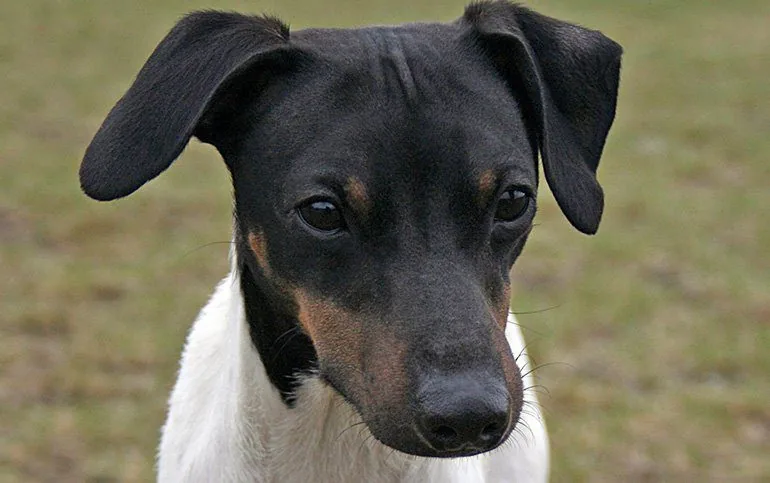
The coat is uncomplicated. Short, smooth, dense and with a texture that invites petting. The base is white with black and tan patches, that reddish-brown so characteristic of the breed; the patches don't follow a fixed pattern, but the standard calls for a harmonious distribution. A weekly brush is enough. As for the tail, the current standard favours leaving it as it grows, though in some countries it's still docked where legislation allows.
The head has a well-marked stop, oval eyes full of life and ears that can stay semi-erect or fall slightly forward. Nothing out of the ordinary for a terrier, but the overall look comes out elegant. Watch out for this — being a small dog he has some predisposition to orthopaedic problems, especially patellar luxation. Regular check-ups let you catch these things early; the study ‘Canine patellar luxation’ (1993) remains a reference for early diagnosis of this condition.
Lively, alert, always on the ball. The Japanese Terrier has that terrier nerve that can't be hidden, but he isn't a dog who spends the day bouncing off the walls. At home he switches off easily, and that makes him considerably more manageable than other working breeds of similar size.
With his family he's very clingy, the type who seeks out contact and appreciates any training session with a bit of play to it. He learns fast. Positive reinforcement suits him wonderfully, though if sessions get repetitive he starts slacking off — you need variety to keep his attention. Socialisation from puppyhood is essential so that alert instinct doesn't fire at every new thing; a poorly socialised dog can become reactive, and with these the margin for error is small.
With people he doesn't know he's usually cautious, rarely aggressive. He does announce visitors, but without going overboard.
Finding a Japanese Terrier in Spain isn't easy, and the price reflects that. A puppy from a responsible breeder runs between 1,200 and 1,800 euros, depending on the line, how closely the individual matches the standard, and the socialisation work the breeder has done. That price usually includes a microchip, first vaccinations and health guarantees against congenital diseases. If the pedigree is exceptional or the dog comes directly from Japan, the figure goes up.
The breed's rarity in Europe means you need to be very careful choosing a breeder. Only from breeders registered with recognised dog clubs — never pet shops or unverified platforms. You should be able to meet both parents and confirm specific health tests are run for hereditary problems. Waiting lists tend to be long, a sign the breeder isn't producing on demand.
Adopting one from a Spanish shelter is practically impossible. The breed's presence in the country is so scarce that individuals don't reach rescue organisations.
No dog is fully hypoallergenic. Allergic reactions come from proteins present in saliva, urine and dander — not the hair itself — so the idea that a short-haired breed is automatically safe for allergy sufferers oversimplifies things quite a bit. That said, the Japanese Terrier disperses fewer allergens than a long or dense-coated breed, and day to day that shows.
A weekly brush removes dead hair and skin flakes before they float around the floor. A monthly bath with the right products reduces dried-saliva residue on the coat. These are simple habits that help, but anyone with severe allergies needs to spend real time with the breed and see how their body reacts before making any decision.
Things change quite a bit if you also add HEPA-filter air purifiers, restrict the dog's access to the bedroom and clean surfaces frequently. These combined measures reduce symptoms more than breed choice alone. And, before taking the step, talk to an allergist.
Exercise and mental stimulation for a Japanese Terrier
The Japanese Terrier needs around 45-60 minutes of daily activity split between walks, interactive play and training sessions. Although his energy level is moderate-to-high, his small size means much of his needs can be covered indoors through scent games or chasing balls. Walks should combine calm routes with sniffaris allowing mentally stimulating exploration.
Mental stimulation is as crucial as physical exercise. They're ideal candidates for adapted dog sports like mini agility, obedience or rally-o, where his intelligence and willingness to work shine. At home, food puzzles, short trick-training sessions and hide-and-seek games keep his mind engaged and prevent boredom.
Overstimulation is as problematic as understimulation: watching for signs of tiredness lets you adjust activity intensity. The combination of structured physical exercise, scent freedom and cognitive challenges creates a balanced, satisfied dog.
Caring for a Japanese Terrier
Coat maintenance is simple: a weekly brush with a rubber grooming glove or soft-bristle brush removes dead hair and spreads natural oils. Being short, it doesn't tangle, but its fine texture offers little protection against extreme cold or abrasive surfaces, making a coat advisable in winter and sun protection in summer for areas of pink skin.
Diet, a topic we cover in Is raw meat good for dogs? Pros and cons, needs to be formulated for small, high-energy breeds, with kibble sized for his jaw and quality protein content. His fast metabolism benefits from two or three daily meals rather than a single ration to maintain glucose stability. Weight control is essential, since a few extra kilos overload his delicate joint structure.
Dental hygiene needs specialised attention: daily brushing with enzymatic toothpaste and dental chews help combat his predisposition to tartar build-up. Six-monthly vet check-ups let you monitor oral health, along with preventive eye and joint check-ups given his susceptibility to patellar luxation.
With children and other animals at home
With school-age children who already handle dogs with care, the Japanese Terrier works very well. He's playful, tolerant and holds up fairly well against the household's movement. With children under 6, things change. An adult needs to be nearby at all times. The dog isn't aggressive, but he's lightweight, and rough handling can hurt him or leave him stressed, so it's best not to risk it.
With other animals it depends a lot on how he was raised. Alongside dogs he's grown up with from puppyhood, he usually manages without problems. More care is needed with rodents and small birds. The terrier instinct is there and can wake up when you least expect it. With cats it usually works out if he's used to them from a young age, but introductions need to be unhurried, with every step controlled.
Being small puts him at a disadvantage when playing with large breeds. It isn't enough to leave them alone; you need to keep an eye out so play doesn't get out of hand. In households with several animals, it helps to give him some elevated corner he can retreat to, a bed on a piece of furniture or something similar. From there he watches everything without anyone bothering him, and that helps him a lot.
According to SoyUnPerro | Dog Experts, the Japanese Terrier condenses everything terrier into a compact body, which makes him a good option for anyone wanting genuine energy in an adaptable dog. Caring for him properly means understanding what he needs in terms of health and stimulation, and doing so throughout the 12-15 years he can be by your side.
Living with a Japanese Terrier is fairly manageable if you give him what he needs. His mind never stops, and when that mental energy has no outlet, quirks and repetitive behaviours start showing up. Scent games, short tracking routes or interactive toys hit the right note and channel that hunting instinct he carries. You don't need to devote hours to it, but you do need to be consistent. Walks where he can explore new smells do the rest.
IMPORTANT: This article is for informational purposes only and does not constitute veterinary, nutritional or behavioural advice. Every dog is different, and only your trusted vet can advise you on its specific needs.