 Breeds
Kuvasz: The Majestic Hungarian Guardian Dog
Discover the Kuvasz, the legendary white-coated Hungarian guardian who protected flocks and property with absolute autonomy.
The Kuvasz: history of a guardian born among Hungarian nobility
When the Magyar tribes crossed the Carpathians and settled in the basin that is now Hungary, they already had these large white dogs with them. The Kuvasz is one of the oldest guardian breeds on the continent. For centuries he was the preserve of Hungarian aristocracy, and under the reign of Matthias Corvinus he reached his highest point of standing: legend has it the king distrusted his own personal guards, but opened his doors to his Kuvasz dogs without a second thought; if this kind of large-format guardian breed appeals to you, you might also enjoy reading about the Great Dane. His job was never to drive flocks from one point to another. His was something else: patrolling estates, driving off wolves, standing up to any intruder who got too close. Centuries of that selection produced an animal with an almost total independence of judgement, able to cover large areas alone and make decisions without waiting for orders.
The Second World War very nearly finished off the breed. Occupying troops shot many individuals; those who escaped that fate were abandoned when their owners fled. Once things calmed down, the number of dogs available for breeding was estimated at fewer than thirty. A group of Hungarian breeders spent years working to rebuild the population from that low point, recovering the working lines that had defined the original standard. That genetic narrowness still has visible consequences today: certain hereditary conditions show up more often in the Kuvasz than in breeds with a broader genetic base, which makes responsible breeding more than just a recommendation. The Fédération Cynologique Internationale places him in Group 1 — Sheepdogs and Cattle Dogs, except Swiss Cattle Dogs — though if a more precise label were needed, it would be livestock guardian dog, not herding dog.
Outside Hungary, the Kuvasz took a long time to find his place. Not until well into the 20th century did he start arriving steadily in other European countries and in the Americas, and today he remains an uncommon breed. That scarcity, paradoxically, has served him well: by not going through the mass popularity that distorts so many breeds, he retains much of his original character. Watch out for this, because anyone bringing a Kuvasz home encounters, from day one, a territorial guardian carved by generations for protection, and managing that instinct takes a lot more than good intentions.
Kuvasz morphology and breed standard
We're talking about a genuinely large dog. Males run between 71 and 76 cm at the withers, weighing 48 to 62 kg; females fall clearly below that, at 66-70 cm and 34-48 kg. That sex difference is more pronounced than usual in other breeds and has direct consequences for breeding. A female that's too tall can complicate whelping, which is why it's one of those details serious breeders don't overlook. His build is muscular and sturdy, without reaching the heaviness typical of a molosser. As for longevity, the usual range runs around 10-12 years, provided vet care stays consistent and the dog lives the kind of life the breed needs.
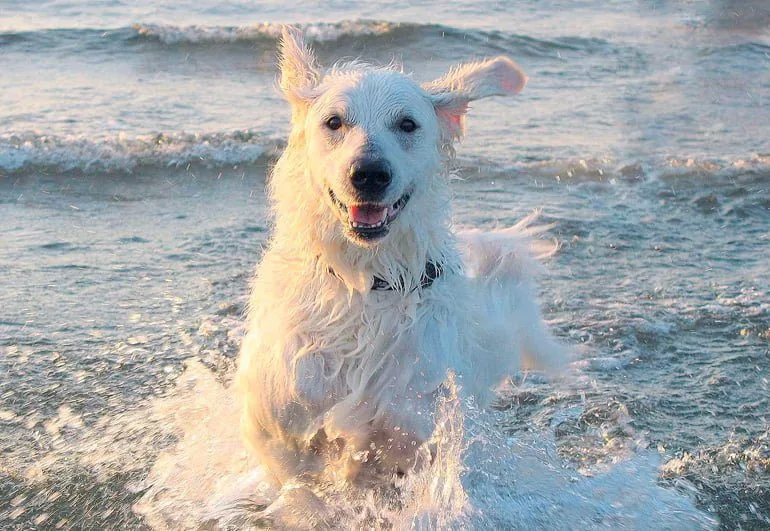
White — or ivory, which is what most individuals actually show — is practically this dog's signature. The outer coat is wavy, with a bit of curl, and coarse to the touch; underneath is a dense, woolly undercoat that insulates in both directions, holding up against winter cold and summer heat alike. That texture has another advantage too: mud and moisture don't stick to it the way they do to finer coats. The head is proportionate and noble-looking, with a moderate stop, a black nose and dark brown almond-shaped eyes that give off the sense of a dog constantly sizing you up. The ears fall in a V close to the cheeks. The tail, set low, hangs when the animal rests and rises when he's active, but without curling over the back.
The FCI standard doesn't just measure height and weight. Overall harmony and the absence of exaggerated traits carry a lot of weight in the evaluation, and temperament figures fully into the equation: watch out for this, because both shyness and unprovoked aggression are penalised as serious faults. That says a lot about what's expected of this dog. The trot should be broad and springy, covering ground with an efficiency that never looks forced or laboured. It makes complete sense once you consider the Kuvasz spent long days covering flocks; a dog who tired quickly simply wasn't up to that job.
Kuvasz, Komondor and other white breeds: what really sets them apart
At first glance, mixing them up is understandable. The Kuvasz, the Komondor, the Maremma Sheepdog and the Pyrenean Mountain Dog all share a light coat and a guarding vocation, though that's where the major similarities end; if large-format protection breeds appeal to you, it's also worth looking into the Caucasian Shepherd. The Komondor has those felted cords of hair that make him unmistakable, something like a giant living mop. The Kuvasz has a wavy coat, a lighter build, a narrower head and that lively look that gives him away from a distance. The Maremma goes a different route: a wider skull, considerably smoother hair and a wariness of strangers that makes him harder to read.
The Kuvasz's temperament has a quirk not always mentioned. While the Komondor tends to manage his territory with a certain emotional coolness — the space matters to him more than who's in it — the Kuvasz actively seeks out his family when there's nothing to watch over. That attachment is real. That said, loyalty doesn't mean docility: he makes his own decisions, and anyone expecting automatic obedience is in for a surprise. You need to understand how he thinks before trying to direct him. With children at home he's usually patient and switches into protective mode, but the animal's size and his tolerance for rough play make it essential that an adult is always nearby.
In practical terms, the coat changes everything. The Komondor's cords demand very specific maintenance that becomes especially cumbersome in humid climates. The Kuvasz, with his self-cleaning coat, handles urban day-to-day life considerably better, provided he gets the exercise and mental stimulation he needs. Neither breed is for a beginner; watch out for this. But the Kuvasz, with well-worked socialisation from puppyhood and consistent handling, can fit into an active family without losing what he is.
Kuvasz temperament and character: an independent guardian
The Kuvasz is, above all, a guard dog with a strong territorial instinct and an innate ability to assess threatening situations without needing orders. This autonomy, forged over centuries of solitary work on the Hungarian plains, makes him a companion who doesn't just react, but anticipates and prevents. His bond with the family is intense but not clingy: he'd rather stay close and keep watch than demand constant petting. Around strangers he's reserved and watchful; he doesn't usually look for conflict, but won't hesitate to step in if he perceives real danger.
As for vocalisation, Kuvasz dogs do bark, and it's part of their guarding repertoire. He's not a compulsive or noisy-for-no-reason barker, but uses barking strategically to deter and alert. A Kuvasz who barks excessively is usually showing boredom, a lack of exercise or poor socialisation that leads him to read everyday stimuli as threats. When his physical and mental needs are covered and he's been gradually exposed to different environments, barking drops to whatever's strictly necessary for his watchdog role. Studies on livestock guardian dogs have shown that their deterrent presence alone significantly reduces predation ‘A DECADE OF USE OF LIVESTOCK GUARDING DOGS’ (1988), which illustrates how effective this kind of behaviour is without direct aggression.
Living with other animals is possible if the Kuvasz has grown up with them, but his protective instinct can lead him to correct other dogs who invade what he considers his space. With cats or other household pets he's usually tolerant, provided clear rules were established from the start. The biggest mistake in handling a Kuvasz is treating him like a docile companion dog: he needs calm, consistent leadership that respects his intelligence and doesn't try to override his decision-making ability, but channel it.
Daily life together: space, exercise and family life
For the Kuvasz, space isn't a luxury, it's a necessity. A small flat or a sedentary life doesn't suit him. He needs a fenced plot where he can move freely and patrol the perimeter, which is exactly what his instinct asks of him several times a day. The fence needs to be tall and well anchored to the ground, because the Kuvasz jumps easily and, if he senses something threatening on the other side, digs too. Between 45 and 60 minutes a day is usually enough exercise, whether that's lead walks, controlled play or letting him explore somewhere safe. What harms him most is irregularity. A Kuvasz with no routine gets bored, and out of that boredom comes destruction or a hypervigilance that ends up exhausting.
At home, the Kuvasz always seeks out the spot from which he can see everything coming and going. Hallways or the front door tend to be his favourite places. If he's grown up with the family's children, he can be an extraordinary dog for them, but his size and strength mean an adult should always be nearby. Rough play makes him uncomfortable, and an unfamiliar child invading his space can end badly. When children from outside the family visit, close supervision is needed, and both sides need to be shown where the boundaries lie.
Living in a city with a Kuvasz is possible, but only under certain minimum conditions. The home needs a garden, the owner should already have experience with working dogs, and socialisation needs to start very early, taking him from puppyhood to places with traffic, bikes, noise and crowds. Even with all that, don't expect him to turn into a sociable park dog or enjoy strangers approaching him without his say-so. This dog is happy with a well-defined territory, familiar people around him, and as few alerts as possible putting him on guard.
Socialising a Kuvasz puppy in the city: a practical phase-by-phase guide
You have about twelve weeks to get this right. Before the Kuvasz reaches 16 weeks of age, his brain is in maximum-absorption mode, and whatever he experiences — for better or worse — is going to stick. People of different appearances, children, stable dogs, buses, escalators, pavements that sound strange. All of that needs to enter his life before the breed's innate wariness sets in, and it needs to come paired with a treat or a game, so the emotional memory being built is a good one.
This works best structured in phases. First quiet streets, no chaos. Then areas with moderate traffic, markets, busy squares, and finally areas with higher crowd density. The order matters because each step prepares the puppy for the next. Watch out for this: if signs of stress show up — closed mouth, pinned-back ears, tucked tail — pull back without drama. Something going wrong at this stage can leave phobias that later take months to reverse, or don't reverse at all. For introductions to other dogs, stick to calm adults. Crowded dog parks are a bad starting point; the Kuvasz can feel cornered and learn to respond disproportionately, which is exactly the opposite of what we want.
Exposure to stimuli is only part of the work. The puppy also needs to learn that things don't always go his way, and to handle that without the world falling apart. Waiting lying down while there's movement around him, letting go of something before being asked, staying still before going through a door. These are simple exercises that, practised daily, gradually build real self-control. And once he reaches 16 weeks with the work done, the task isn't over. A Kuvasz who stops practising social skills during his youth tends to become more territorial and reactive. That needs to stay active, even once it no longer feels urgent.
Feeding the Kuvasz: preventing bloat and choosing between BARF and kibble
Gastric dilatation-volvulus can kill within hours, and in breeds like the Kuvasz, with that deep, voluminous chest, the risk is always present. The most effective way to reduce it is splitting the daily ration into two or three meals instead of one. No intense activity in the hour before eating or the two hours after. Water offered slowly after a walk, no big gulps all at once. Raised feeders have been debated for years, but the studies don't give them clear support, so what really makes the difference is splitting meals properly and keeping a close eye on the dog.
The two main options, quality kibble and a BARF diet, both have a place if planned properly. With BARF you decide exactly what goes in the bowl, which helps a lot when the dog has intolerances. The problem is the margin for error is small. A poorly designed diet can leave the animal short on calcium, phosphorus or fat-soluble vitamins, which is especially risky in puppies. A Kuvasz growing up on an unbalanced BARF diet can develop bone and joint problems that are very hard to reverse afterward. Kibble simplifies things considerably, as long as the product is designed for large breeds and has energy and calcium in the right proportions.
Any diet change calls for one to two weeks of gradual transition so the digestive system adapts without upset. If appetite drops, the coat loses its shine or stools change appearance, it's time to call the vet. The Kuvasz's weight needs close monitoring. Extra kilos aren't just a cosmetic issue. They put pressure on the joints and bring on dysplasia sooner. Exactly how much to feed depends on the individual, how much he moves and the time of year. Package guidelines give an initial reference, but from there real monitoring of the animal is needed to fine-tune the amount.
Kuvasz health: hereditary conditions and data from Spain
Hip dysplasia shows up fairly regularly in the breed, with an estimated rate of 15-20%. It has a multifactorial origin. Genetic load plays a role, along with growth rate, diet during the first months and how much exercise the puppy does before his joints are mature. Something similar happens with elbow dysplasia and osteochondrosis, which surface in some lines; that's why responsible breeders X-ray their breeding stock and share those results with whoever is taking home a puppy. Beyond that, it's worth keeping autoimmune hypothyroidism on the radar, which can go unnoticed for months because its signs — lethargy, unexplained weight gain, coat changes — are easily mistaken for the simple passage of years.
In 2005, a study documented degenerative encephalomyelopathy in seven Kuvasz puppies with progressive weakness and ataxia, with documented damage to the caudate nucleus, cerebellar nuclei and spinal cord ‘A degenerative encephalomyelopathy in 7 Kuvasz puppies’ (2005). The cases were closely related to one another, pointing directly to inbred crosses as a risk factor and making clear that checking a puppy's genetic history before buying matters more than many people give it credit for. In Spain the breed is uncommon and the available epidemiological data is limited, but information from breed clubs and specialist vets suggests the incidence of this specific condition is low.
Orthopaedic check-ups should be a constant, and from around five or six years it's worth adding thyroid function bloodwork. Paying attention to any change in gait also makes sense, since joint pain in large breeds often shows up in subtle ways at first. When dysplasia is caught early, it responds well to conservative management. Controlled weight, physiotherapy, prescribed joint supplements. That kind of approach is usually enough to avoid surgery. If any symptom shows up that doesn't add up, seeing the vet is the right call.
Anyone considering a Kuvasz does well to visit several adult individuals before deciding. Seeing how they move, how they react, how much space they take up in a family's daily life. And then looking for breeders who provide health tests for their breeding stock and speak openly about the litter's history. Early socialisation and consistent handling from puppyhood make all the difference in a breed with such a deeply rooted guardian instinct.
IMPORTANT: This article is for informational purposes only and does not constitute veterinary, nutritional or behavioural advice. Every dog is different, and only your trusted vet can advise you on its specific needs.