 Breeds
Great Dane
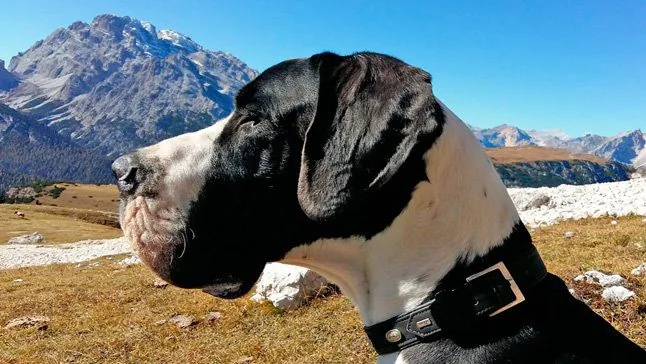
For some, the Great Dane represents the world's biggest lapdog. Don't let his majestic bearing fool you. This canine is big in size but also in sweetness.
If you want to find out why, as well as what his most common diseases are, his care and other quirks, keep reading this complete guide to the Great Dane.
Great Dane breed fact sheet
 Height between 80 and 90 cm in males and between 72 and 84 cm in females
 Weight between 75 and 100 kg for males and between 50 and 90 kg for females
 Coat very short, soft and smooth. Black, white or spotted
 Temperament cheerful, playful, affectionate and very loyal
 Health good but prone to dysplasia and/or heart problems
 Life expectancy estimated at 7 to 10 years
A bit of history about the Great Dane breed
His origin lies in Germany, so it isn't exactly clear why he's called the "Great Dane". He descends from the Bullenbeisser, a now-extinct German breed, halfway between the Greyhound and the English Mastiff.
According to the timeline of his history, it's known that Alan warriors were driven out of Asia and, on reaching Europe, crossed their huge fighting dogs with German and French dog breeds.
As a result of these confluences, the Great Dane was born in 1870, a breed historically much appreciated by kings, nobles and artists.
Did you know the poet Alexander Pope kept an individual of this breed as a pet? His elegance, intelligence, loyalty and calm temperament are his most outstanding traits.
In fact, he's considered the Apollo of all breeds, since he combines an imposing bearing with a gentle, affectionate personality, making him a faithful life companion.
However, in his origins he didn't have such an affable character. Quite the opposite, his instinct was that of a hunter, always combative.
For that reason, he was a regular in wild boar hunts. Successive breeding and training programmes have managed to tame him until turning him into the affectionate, family-oriented dog he is today.
He goes by other names like German Mastiff, German Boarhound or German Alaunt, and his life expectancy ranges between 7 and 10 years. His proportions are grandiose, as we'll see next.
Physical characteristics of the Great Dane
Did you know that standing on his hind legs he can reach 2.10 metres in height? Quite the giant when it comes to dogs.
Generally speaking, females reach 72-84 cm in height and 50-90 kg in weight, while males stand around 80-90 cm tall and weigh 75-100 kg.
This is, therefore, a large breed but balanced and well proportioned. Qualities that have led this breed to hold the Guinness World Record for tallest and heaviest dog in the world across several editions.
According to the Fédération Cynologique Internationale, the FCI, breed purity is certified if his length equals his height at the withers, not exceeding 5% in males and 10% in females.
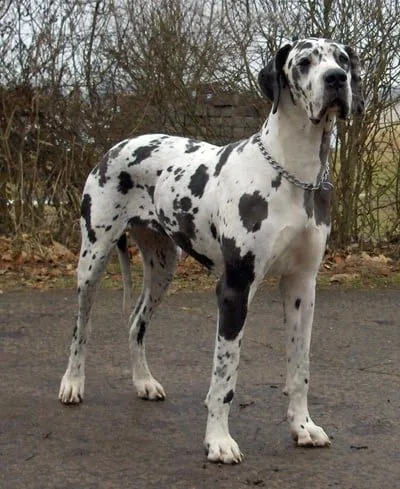
He must also meet these standards:
- His neck should be long, strong and slightly arched forward. The skin shouldn't hang in the form of a dewlap.
- His back should draw a short, straight line with a subtle slope toward the rear.
- His tail should be high and wide, tapering toward the tip. At rest it should form a natural curve, while in motion it should be carried sabre-shaped.
- The lips should have well-defined edges and the jaw should have powerful jawbones, with a healthy bite.
- The legs should look parallel and the nasal bridge narrow.
- The cheek muscles shouldn't protrude.
- His head should be elongated and lean, but never pointed.
- His ears are medium-sized, high-set and drooping. In the past it was customary to crop them to increase his solemnity, something thankfully no longer practised today.
- His coat is short, flat, glossy and smooth.
There are different shades for his coat:
- Fawn. Characterised by a golden tone, soft or intense, accompanied by a black mask on the muzzle.
- Brindle. Here the gold shows black stripes across the rib area. A dark mask on the muzzle is also present.
- Harlequin. There are different variants, from pure white to white with black speckling or irregular jet-black patches distributed randomly across the body.
- Black. Jet black combined with white markings on the chest, muzzle, neck, belly, legs or tail tip.
- Blue. Dark steel blue complemented with white markings on the chest and lower legs.
As a curious fact, worth noting that in the blue and harlequin shades, the nose is anthracite or diluted black in colour. In the harlequin it can also be pink.
The German Mastiff's eyes are almond-shaped, dark in colour, and shouldn't be excessively far apart. In the blue and harlequin shades they can be lighter, with harlequins prone to heterochromia (one eye of each colour).
Temperament of the Great Dane dog breed
To his noted elegance and regal bearing, we should add a deep sense of loyalty to his owner; he needs his company and can become destructive if bored or left alone for too long. He enjoys living alongside other dogs, other pets and children.
He's an intelligent dog, since if something bothers him he'd rather withdraw than fall into provocation.
Given his large size he demands ample space, but doesn't adapt well to living entirely outdoors. He prefers being indoors and exercising with his owner.
Recommended care
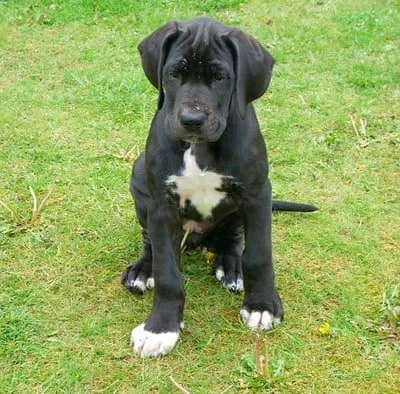
As for care, the Great Dane needs generous feeding, especially as a puppy, a stage in which you'll need to give him 3 meals a day, since he'll reach 14 kilos in barely 2 months.
As an adult, 2 daily meals of dry kibble specific to large breeds will be enough, along with supplements to protect his joints and mitigate the impact of his considerable weight.
You'll need to brush him 2 or 3 times a week to remove dead hair and dirt. This frequency could increase during shedding season (spring and autumn). Don't overdo baths, since you could cause irritation, allergy or dry skin. Once a month is enough.
Given his tendency to build up tartar and bacteria, responsible for gum diseases and bad breath, you'll need to brush his teeth several times a day.
As an extra measure, dental snacks and rawhide strips don't hurt. While he enjoys chewing, your pet will strengthen his jaw thanks to their high vitamin and mineral content and remove any build-up of tartar.
The Great Dane needs moderate daily exercise, around 30 to 60 minutes. Puppies need somewhat more activity, around 90 minutes a day. It helps them exercise and learn while exploring.
Keep his vet visit schedule up to date and protect him from parasites with the deworming tablets, spot-ons and collars your vet recommends.
Training: Basic notions
Given his tendency to keep his distance from strangers, a trait that makes him an excellent guard dog breed, if you bring an individual of this breed into your life it's worth socialising him from puppyhood so he gets used to humans.
Crate training is appropriate so he internalises from puppyhood what confinement means. In that sense, you should provide him with a large basket so he understands it's where he should sleep.
Positive reinforcement through praise and rewards is ideal for training this breed. You can also practise it when he goes to the vet so this experience feels pleasant to him and he isn't afraid.
Remember that up to age 2 his bone structure isn't fully set, so it isn't advisable to go running with him.
Possible diseases of the Great Dane
This breed shows a certain genetic predisposition to:
- Hip dysplasia.
- Gastric torsion. This is a common condition in large dogs and involves the strangulation of the stomach. To prevent it, avoid large meals; it's better to split them throughout the day. Give him the rest he needs after eating and don't offer water or food right before or after physical exercise.
- Cardiomyopathy.
- Osteosarcoma or bone cancer.
- Wobbler syndrome. This neurological disease is hereditary and causes the dog to stagger when walking as a result of narrowing of the spinal cord.
- Cataracts.
- Entropion and ectropion. These are two eye conditions causing irritation to the dog's eyeball due to a poorly positioned eyelid.
- Hypothyroidism.
- Juvenile spots.
In all of them, surgery and/or drug treatment carry a good prognosis. Either way, it's worth remembering that at any abnormality or odd change you should go to the vet.
Now you know that the breed Scooby-Doo or Astro from The Jetsons belong to has the ideal qualities for you to choose him as your new pet. He'll enjoy your company and your family's, will avoid bothering you at all costs, and will show you time and again just how much he loves you.
IMPORTANT: This article is for informational purposes only and does not constitute veterinary, nutritional or behavioural advice. Every dog is different, and only your trusted vet can advise you on its specific needs.