 Breeds
Leonberger: Elegance and Giant Size in One Dog
Eight dogs. That's what the Leonberger was rebuilt from after the Second World War, when the breed came within a hair of disappearing forever. That genetic bottleneck weighs on his history as much as his origin as a symbol of the city of Leonberg or his morphological standard as a fawn giant with a black mask.
History of the Leonberger: the dog born to embody the Leonberg lion
And then there's the temperament, which is what throws off anyone meeting him for the first time most: behind that imposing bearing lies a balanced dog, considerably easier to live with than he looks.
In the mid-19th century, a German councilman named Heinrich Essig set out with a fairly specific idea: he wanted a dog that would recall the lion on his city's coat of arms, Leonberg. He crossed a Newfoundland female with a Saint Bernard male, and later brought Pyrenean Mountain Dog blood into the mix. What came out of it was a breed with an imposing bearing, a fawn coat and a presence that doesn't go unnoticed. European aristocracy soon took notice: Empress Elisabeth of Austria and the Prince of Wales were among his earliest admirers. By the 1850s the breed was already established in Germany, and today several thousand individuals are found around the world.
The two World Wars nearly wiped the Leonberger off the map. After the First, only a handful of dogs remained. The Second was even worse: by the end, only eight individuals were fit for breeding. That the breed survived that has real merit, and we owe it to German breeders who worked steadily, without rushing, to rebuild it from those eight survivors, staying true to the original standard. That severe genetic bottleneck is what explains the Leonberger's current predisposition to certain hereditary conditions; with so little genetic diversity to start from, it was hard for it to be otherwise. Even so, the breed gained ground across Europe and North America during the second half of the 20th century, and anyone who discovered his mix of physical power and gentle temperament almost always fell in love.
Leonberg hasn't forgotten the dog that bears its name. In the town hall square stands a statue in his honour, and every year the city hosts an international gathering of breeders and enthusiasts that keeps that link between the breed and his place of origin alive. The FCI recognised him in 1955, placing him in Group 2, Section 2: Mountain-type molossers, the same classification he shares with other giant working and guardian breeds like the Great Dane.
Leonberger morphology, coat and mask: the FCI standard in detail
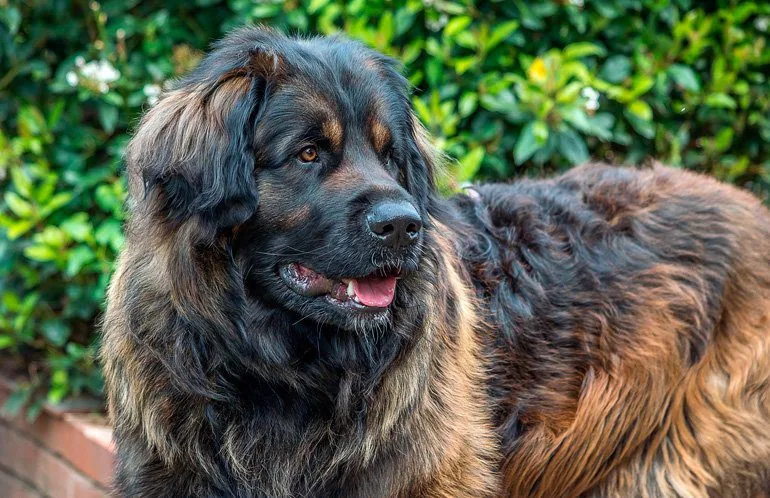
Males stand between 72 and 80 cm at the withers; females, between 65 and 75 cm. In adults, weight ranges from 50 to 70 kg for males and 45 to 60 kg for females, as set out in the FCI standard. The silhouette is rectangular and the bone structure powerful without tipping into the coarseness seen in some heavy working breeds. The musculature shows well under taut, fold-free skin. The head is in proportion to the body, the skull gently arched, and the muzzle long and wide, without the tapered finish that would take him out of type. The black mask covers the muzzle and runs up to the eyes; without it, the animal simply doesn't meet the standard. That serious yet calm expression everyone recognises comes, in large part, from there.
The coat deserves separate attention. The hair comes in two layers, a dense woolly inner one and an outer one of straight, long hair lying close to the body. On the neck and chest grows that characteristic ruff, considerably more pronounced in males than in females. Colour ranges from pale sand to deep reddish tones, always with the mask present. Small white patches on the chest or between the toes are tolerated, but nowhere else on the body. The ears, high-set, triangular and drooping, suit that expressive head well. The tail, long and thickly coated, hangs straight at rest and rises slightly in motion, without ever curling over the back. Anyone wondering what the Leonberger looks like has here the combination that defines him: substantial size, a fawn coat with a dark mask and a calm presence that rarely goes unnoticed.
Movement is also evaluated in shows, and in quite some detail. The stride needs to be broad and fluid, with good reach in the front legs and real drive from the rear. Limb angulation is built for traction over difficult terrain, connecting directly to the snow and water rescue dogs the breed descends from. On deviations from the standard, the FCI leaves no room: if the build becomes so heavy it compromises agility, or if the mask appears faded or absent, that's a serious fault. The Leonberger needs to be able to work, and his build reflects that.
Leonberger temperament and character
This dog has a very level head. He moves confidently through all kinds of social situations, doesn't need to bark to earn respect — his presence alone says enough — and has a way of reading his surroundings that's remarkable in such a large breed. He was bred to live close to people, and it shows: he seeks out physical contact without hesitation, leans in on the sofa, follows you around the house. The bond he forms with the family is very intense, and if you leave him alone for hours every day, he'll sooner or later start showing it. With children he's patient and affectionate, and he spreads that loyalty across everyone living at home, without fixating on just one person.
Being a sociable dog doesn't mean he lacks a protective instinct. A Leonberger well socialised as a puppy grows into an adult who's friendly with strangers and calm with other dogs, but he keeps a certain assessing quality that never fully disappears. If he senses a real threat to his own people, he reacts, and he does so with judgement. That combination — social openness and independent judgement — is exactly what anyone who knows the breed well appreciates, because the extremes (the dog who growls at everything or the one who doesn't react to anything) turn out to be far less reliable.
With young children he can be an extraordinary companion, on a par with the Labrador Retriever, but you need to keep his size firmly in mind. An unintentional tail swipe or a quick turn can knock a small child down without the dog even noticing. Watch out for this. From puppyhood, the training priority needs to be self-control: learning to manage himself in tight spaces, to check his own impulses, to respond when asked. He's intelligent, eager to please and sensitive to tone of voice in a way few breeds match, so positive training works very well. Pressure-based methods or harsh correction do exactly the opposite: they build distrust, shutdown, a dog who stops communicating. And with a breed this attuned to his handler's emotional state, that's a serious problem.
Leonberger hereditary diseases: hip dysplasia, LPN polyneuropathy and others
As with most giant breeds, the Leonberger shows a predisposition to hip dysplasia, a malformation of the hip joint presenting with joint laxity, progressive cartilage wear and, in advanced cases, disabling arthritis. The mechanism has a strong polygenic hereditary component, but environmental management — especially diet and exercise during the growth phase — significantly modulates the disease's clinical expression. Selecting breeding stock with official hip X-rays free of dysplasia is the main tool for reducing incidence in litters, and any responsible breeder should provide both parents' certificates.
Leonberger polyneuropathy (LPN) is a hereditary neurological disease affecting the peripheral nerves, causing progressive muscle weakness, atrophy and loss of reflexes, generally showing up between the first and third year of life. It's inherited in an autosomal recessive pattern, meaning a dog can be an asymptomatic carrier and pass the mutation on to his offspring. Genetic tests exist that identify carriers and allow matings to be planned that avoid producing affected puppies. Another serious neurodegenerative condition described in the breed is leukoencephalomyelopathy (LEMP), a juvenile central nervous system disorder linked to a genetic variant located on chromosome 4 ‘Canine NAPEPLD-associated models of human myelin disorders’ (2018). Clinical signs include ataxia, weakness and gait abnormalities that appear in very young puppies and progress rapidly.
On the cardiac front, Leonbergers are predisposed to dilated cardiomyopathy, a heart muscle disease that reduces pumping capacity and can lead to congestive heart failure. Breed-specific echocardiographic reference intervals have been proposed based on 42 clinically healthy dogs ‘Reference intervals and echocardiographic findings in Leonberger dogs’ (2020), letting veterinary cardiologists catch subtle changes before clinical symptoms appear. Other conditions with some prevalence in the breed include entropion, ectropion, osteochondritis dissecans and, in older individuals, various types of cancer such as osteosarcoma. This modest longevity reflects the biological toll paid by large breeds and calls for maximising quality at every life stage through prevention and regular vet check-ups.
Leonberger breeders in Spain and puppy prices: what to know before buying
Finding a Leonberger breeder takes time, and doing it properly is worth every minute. The first thing worth checking is whether they're affiliated with the Spanish Leonberger Club or Spain's Real Sociedad Canina, and whether they work to the FCI standard. That already filters out quite a bit. A good breeder's breeding stock goes through hip and elbow X-rays, genetic tests for LPN and LEMP, and echocardiography to catch dilated cardiomyopathy. None of this is optional. Beyond the paperwork — a contract with health guarantees, a proper pedigree — they should also commit to following up on the puppy long term. And visiting the breeder is non-negotiable. Seeing where the dog grew up, meeting the mother, confirming the puppies have spent weeks in a home environment rather than shut in a cage. That time spent at the breeder's says more than any advert.
A Leonberger puppy with pedigree and all the tests in order costs between €1,500 and €2,500 in Spain. The range depends on the breeder, the parents' history, any titles they hold — conformation or working — and whether the price already includes the first vaccinations, deworming and microchip. When you see a price well below that range, watch out. There's almost always something behind it. Breeding with no veterinary oversight, genetic tests nobody ran, or breeders churning out litter after litter without the animals' welfare costing them any sleep.
The purchase price is just the first chapter. An adult Leonberger eats between 500 and 700 grams of quality kibble a day, and on top of that come vet check-ups, liability insurance — mandatory in most Spanish regions for dogs over 20 kg — and everything that comes with having a dog this size. A sturdy harness, an orthopaedic bed, a suitable crate. If the budget is tight, some specialist rescue associations have adult Leonbergers up for adoption. The numbers change quite a bit that way, and on top of that you give a second chance to a dog who ended up abandoned precisely because someone didn't fully understand what this breed involves.
Feeding the Leonberger: nourishing a giant through growth
From 500 grams at birth to over 50 kilos before turning a year and a half. The Leonberger grows at a pace that tests his skeletal system from day one, and diet has a lot to say in that process. Excess energy or calcium during the first months is one of the main environmental factors behind hip dysplasia, osteochondrosis and other bone development disorders. That's why the puppy needs kibble specifically designed for giant breeds, with a moderate protein level and calcium adjusted to WSAVA guidelines, and a calcium-phosphorus ratio allowing gradual ossification without forcing an early closure of the growth cartilage.
During the first year, rations are split into three or four meals a day. The stomach of a deep-chested dog like the Leonberger doesn't handle being filled all at once well, and gastric dilatation-volvulus — an emergency that can kill within hours — has more chance of showing up if the dog eats a lot in one sitting or exercises right after. The rule is waiting at least an hour after each meal before letting him move around. Water should always be available, though sensibly: a long drink right after eating doesn't help. As important as what he eats is how much. Weighing him regularly and checking his body condition every month — ribs palpable but not visible, waist noticeable from above — lets you adjust the ration in time, before excess weight starts loading joints still in formation.
Once the dog reaches adulthood the diet changes, though it still revolves around the same principles. Two meals a day, good-quality protein to sustain muscle mass, and calorie control that avoids obesity, which wrecks the joints of breeds this size over the years. Here's the trick with kibble: it's worth looking for formulas that include natural joint supplements like glucosamine and chondroitin, which help keep cartilage in good condition. Omega-3 supplementation from fish oil can also contribute to skin, coat and joint inflammation health, but any addition to the diet needs veterinary supervision so as not to disrupt the base kibble's nutritional balance.
Living with, training and caring for a Leonberger day to day
Having a Leonberger at home changes the daily logistics. He's not a dog who needs two hours of running, but he doesn't settle for a ten-minute walk either. Long outings where he can sniff at his own pace, the occasional swimming session — which unloads the joints without impact — and search or tracking games cover his needs. What does need watching during the first year and a half is not overloading him. No jumping, no running on asphalt, and stairs kept to the essential minimum. Giant breeds' growth cartilage closes late and suffers a lot if rushed.
The coat is another chapter. Twice a year, shedding hits hard, and if you don't commit to daily brushing during those weeks you end up with entrenched tangles in the armpits, groin and behind the ears, plus fur everywhere. An undercoat rake and a long-pin comb are the basic tools. Outside those periods, two or three thorough weekly sessions keep the coat healthy, spread the skin's natural oils and let you spot anything unusual before it worsens. Bathing, only when genuinely needed, and always with a specific shampoo so as not to strip the oily layer that protects the coat.
With training, positive reinforcement works very well with this breed. They learn fast. That comes with a catch, because if you repeat the same exercises mechanically they switch off. Short, varied sessions with something that genuinely motivates them get far better results than long, monotonous ones. At home, routines help more than you'd think. Fixed times for walks, meals and rest give structure to a dog who appreciates knowing what comes next. An orthopaedic bed matters too, because the weight a giant carries eventually takes its toll if he sleeps on a hard floor. Getting a Leonberger properly settled into the family is years of work, but the result is a dog with a loyalty and calm few breeds match.
If, after weighing all this — the space, the time, the cost — you find it fits your situation, the logical next step is contacting the Spanish Leonberger Club. They have the list of federated breeders, and you can request a visit to observe the adults in their real environment before committing to anything.
IMPORTANT: This article is for informational purposes only and does not constitute veterinary, nutritional or behavioural advice. Every dog is different, and only your trusted vet can advise you on its specific needs.