 Breeds
Differences Between the Mastiff and the Saint Bernard
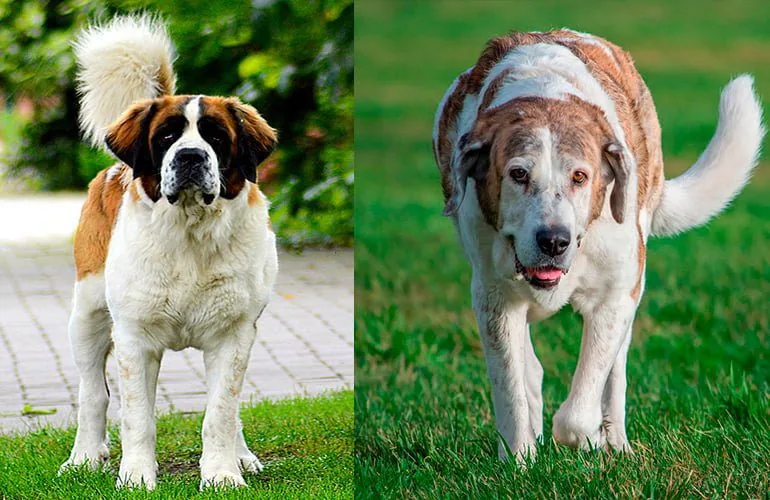
Telling the Mastiff and the Saint Bernard apart isn't easy at a glance. Both are large dogs with a heavy build, drooping jowls, and a gentle expression; on top of that, there are several types of Mastiff, each with different physical traits. Even so, there are a few tricks that will help you know which dog you're looking at.
Coat, head shape, and height are key pieces for spotting the differences between the Mastiff and the Saint Bernard. Let's look in detail at how to tell these two breeds apart at a single glance.
Characteristics of the Spanish Mastiff
There are several types of Mastiff, but the one that most resembles the Saint Bernard is the Spanish Mastiff. This dog is native to Spain and has a sturdy build in both sexes: males stand between 77 and 81 centimeters at the withers, while females reach 72 to 75 centimeters.
The Spanish Mastiff's head is wide and strong. It has a large, black nose, a color shared by the mucous membrane of the lips. The muzzle is straight and somewhat rectangular in appearance, but never pointed. The jaw has a scissor bite. The eyes are small, almond-shaped, and dark, framed by black eyelids that droop when the dog is resting. The ears are also triangular and drooping.
The Spanish Mastiff's coat is thick, dense, and medium-length. The strands tend to grow longer around the neck, back, tail, and legs, where the texture is also coarser to the touch. The coat is white, with a dark mask on the face and irregular patches scattered over the body.
This breed has a protective personality and is very wary of strangers. With its own family, though, this dog is gentle and calm, making it a perfect fit as a member of a family with children.
Characteristics of the Saint Bernard
The Saint Bernard is native to Switzerland, where it was bred on the Grand Mont St. Bernhard, which is where its name comes from. It's a large breed: males stand between 70 and 90 centimeters at the withers, while females reach between 65 and 80 centimeters.
The Saint Bernard's head is imposing and majestic, with a square, black nose. The breed's muzzle is wide, with black mucous-membrane lips and well-developed, slightly drooping jowls. The bite can be either scissor or level. The eyes are medium-sized and set deep, with well-pigmented black eyelids and an iris ranging from brown to hazel. The ears are wide and set high, hanging down to the cheeks.
The breed's coat can be short or long, but is double-layered in both cases. The coat has a white base, with red markings on the face, back, and flanks. Though less common, some Saint Bernards also have a solid reddish coat or a brindle combination.
The Saint Bernard is a friendly, affectionate dog that gets along well with its family and other pets. It also does an excellent job as a home guardian, thanks to its protective personality. It commonly stays alert around unfamiliar people, but rarely attacks unless provoked.
Differences Between the Mastiff and the Saint Bernard
As you can see, these breeds share plenty of physical and character similarities. Have you come across one but couldn't tell which was which? Don't worry! The following list of traits will help you find the differences between the Spanish Mastiff and the Saint Bernard:
- Country of origin: the Mastiff and the Saint Bernard are both mountain dogs; however, one comes from Spain and the other from Switzerland.
- Size: although both dogs are imposing and considered large breeds, the Saint Bernard is up to 10 centimeters taller than the Mastiff.
- Bite type: the bite is a scissor bite in the Mastiff, but can be scissor or level in the Saint Bernard.
- Coat color: both dogs have a white base coat; however, the patch pattern differs, and these patches are black or golden in the Mastiff and red in the Saint Bernard.
- Eye shape: the eyes are almond-shaped in the Mastiff, but rounder in the Saint Bernard.
- Skull shape: viewed in profile, the Mastiff's skull is slightly convex, while the Saint Bernard's skull looks more rounded.
- Stop shape: the naso-frontal stop is subtle in the Mastiff, but more pronounced in the Saint Bernard.
IMPORTANT: This article is for informational purposes only and does not constitute veterinary, nutritional or behavioural advice. Every dog is different, and only your trusted vet can advise you on its specific needs.