 Breeds
Spanish Mastiff
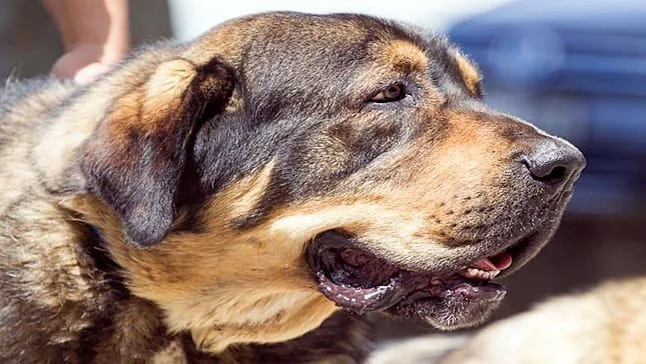
The Spanish Mastiff has an unmatched temperament, which is probably why it's become one of the most sought-after breeds. An excellent companion dog and a great guardian, this breed's traits make it a truly impressive dog.
And although its size is nearly monumental, its heart is even bigger, since it's very affectionate and loving with its family, even from puppyhood.
If you want to know all the details, here at SoyUnPerro we'll show you what its behavior is like, its strengths, and the care it needs to be a healthy, strong, happy dog.
Behavior of the Spanish Mastiff
Among the many strengths of the Spanish Mastiff's temperament, its nobility and loyalty stand out above all. It's not prone to excessive displays of affection, but when the moment calls for it, it won't hesitate to sacrifice its own life to protect you and your family.
It's not a barky dog, but it snores and drools constantly. An exemplary guardian and companion, it enjoys playing with children and learning new tricks. That said, keep in mind that given how large and strong they are, they can unintentionally hurt a small child if we're not careful.
It's strong, brave, and independent, highly self-assured with a well-balanced temperament. Also, being a highly intelligent dog, it's capable of making its own decisions and solving problems on its own. The downside is that it can sometimes be disobedient and stubborn, especially when its owner is too soft and permissive.
Although the Spanish Mastiff can seem lazy at times, it's actually always watchful and alert to everything happening around it. When the moment calls for it, it can be surprisingly fast and agile despite its huge size.
Physical Characteristics of the Breed
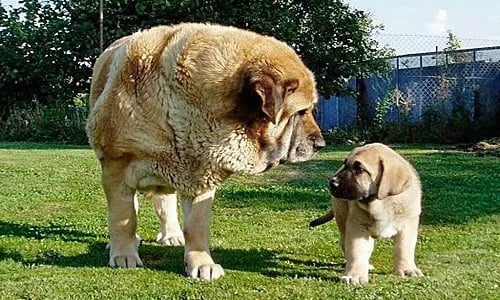
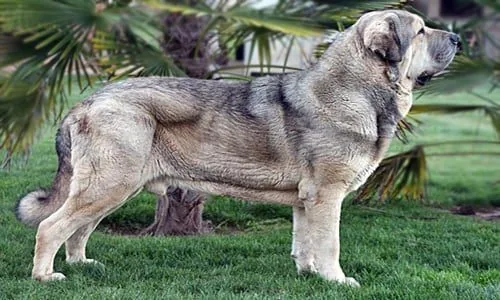
The Spanish Mastiff breed is a large, powerfully built dog, with a well-proportioned figure and strong legs. Females usually weigh between 40 and 60 kg, and males between 50 and 70 kg. Height at the withers runs around 70 cm, somewhat less in females.
There are two varieties of Spanish Mastiff: the "heavy" type, more common in the north of the country, and the "light" type, more agile, lean, and athletic.
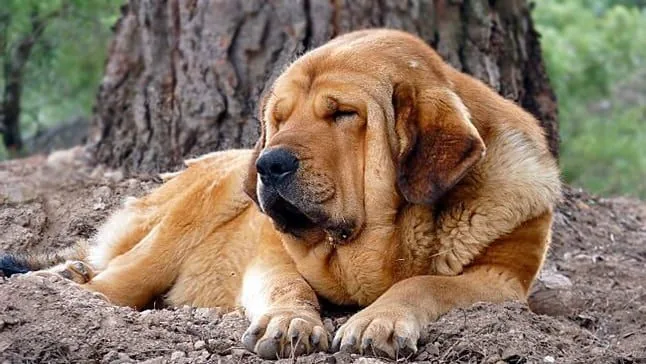
Its head is large, with a deep muzzle and strong jaws, fleshy lips, and a very characteristic dewlap under the neck. The Spanish Mastiff has double dewclaws on the hind legs, a trait this breed shares with others like the Great Pyrenees.
The eyes are small, almost always giving off a deceptively relaxed, carefree look (in reality, this dog is always alert). Its ears are pointed and hang on either side of the face.
The Mastiff's coat is short, straight, and fine. Beneath the outer coat is a woolly undercoat that it sheds in summer. Coat color can be reddish, fawn, gray, yellow, or black, often with black or brindle markings:
Training Tips
Training the Spanish Mastiff's obedience can sometimes be a challenging task, since it's a stubborn dog by nature with a tendency toward "selective deafness." That's why it's essential to set boundaries and make clear who's in charge from the very start, which is naturally easier if training begins while your Mastiff is still a puppy.
But once you get past that initial hurdle, training the Spanish Mastiff is very rewarding for anyone, since it's a dog with well-developed intelligence and a strong learning ability. As is always the case with the smartest breeds, it's best to avoid repeating the same commands too often during training sessions. Doing so risks your dog getting bored and losing interest.
Gradual training and socialization from an early age are very important for getting your Spanish Mastiff used to different situations, people, places, and dogs. With positive, reward-based training, you'll get the best out of it.
Recommended Care for the Spanish Mastiff
The Spanish Mastiff's activity level is fairly low, so it only needs a relatively moderate amount of exercise to feel good. Three or four walks a day, without forcing it, are enough.
But no matter how calm it is, given its huge size, it's not a suitable dog for a small house or an apartment with no yard or garden. There's no problem keeping it outdoors, since its thick coat protects it from cold and damp, while centuries of adapting to the harsh climate of Spain's central plateau have made it handle summer heat quite well, as long as it has water and a shaded spot within reach.
The Spanish Mastiff's coat needs regular brushing, especially during shedding season, in fall and summer.
As for health, this dog is prone to hip dysplasia and heart problems. It can also develop weight problems in its more mature years, so its diet needs to be watched closely.
The Spanish Mastiff's average lifespan is 10-11 years, though with good care it can live considerably longer.
IMPORTANT: This article is for informational purposes only and does not constitute veterinary, nutritional or behavioural advice. Every dog is different, and only your trusted vet can advise you on its specific needs.