 Care
Care
My Dog Has Green Eye Discharge — Is It Sick?
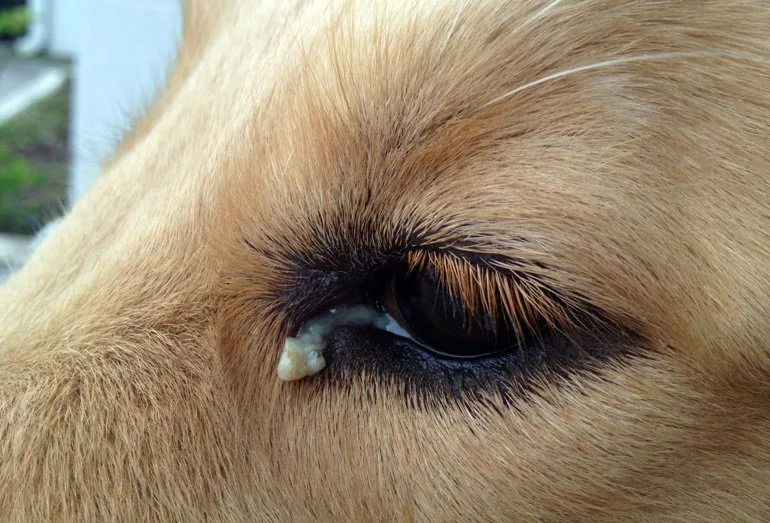
Just like humans, dogs also produce discharge in their eyes. Sometimes it's whitish or almost clear in color, and other times it has intense or mild green discharge, even yellowish.
The truth is the color of the discharge tells us whether our dog has some eye condition, since depending on its color, as well as its amount, it could mean one thing or another. Let's take a look below.
Types of Eye Discharge in Dogs
Producing tears is a natural, physiological process in many animals. Discharge itself is too, since it forms thanks to the eye's tearing. As tears dry, spill over the eyelid, and come into contact with the fur, they dry out, producing what's called discharge.
There are several types of discharge, with whitish-clear discharge being completely normal, as is more brownish-toned discharge in dogs with fur of that color, which is also normal and physiological.
However, excessive tearing, even if it's one of the colors mentioned as normal, can have some cause behind it, so it wouldn't hurt to check it out. However, if it forms green or yellowish discharge, we need to see a vet, since it could be a secondary symptom of an eye condition.
It's common at vet clinics during spring-summer to see dogs with a foxtail in the eye, presenting with the eye more closed than normal and excessive, constant tearing, so we need to stay alert.
Green or Yellowish Discharge in a Dog's Eye
As mentioned, this color can appear as a symptom of a condition. Normally, the presence of green or yellow discharge is a sign of conjunctivitis. This translates to inflammation of the transparent membrane (conjunctiva) covering the eyelid and the white part of the eyeball.
Conjunctivitis is normally accompanied by redness of the sclera (the white part of the eye) due to irritation and dilation of the blood vessels. Conjunctivitis can have many causes; below, we'll look at the ones most commonly seen at vet clinics and relevant to daily life.
Conjunctivitis: Corneal Ulcer
We all know how dogs are — always sniffing and sticking their snout into bushes and plants, running through fields of grass… These are situations in which they can unknowingly damage the cornea (the most superficial layer of their eyes), from simple contact with a leaf, branch, or stem.
Even when playing, they're sometimes a bit rough, especially when playing chase and bite with other dogs without any real harm intended. All these situations can result in another dog accidentally scratching our dog's eye and creating a small cut on the cornea, causing an ulcer.
Small cuts or ulcers in a dog's eye aren't visible to the human eye — a vet needs to diagnose them. This is done using a special dye called fluorescein followed by saline solution. Fluorescein stains deeper parts of the cornea (the stroma), showing that the superficial layer (cornea) is damaged.
Treatment for corneal ulcers is normally based on antibiotics every 8 hours for as many days as the vet recommends, based on its severity. Only a vet can prescribe these medications, since there are many different types of infections and they're not all treated the same way.
Conjunctivitis: Infections
There's also the possibility our dog catches a bacterial or viral infection (for example, distemper). These can be caught from dog to dog, or spread from one eye to the other by mistake, by touching the affected eye first and then the healthy one.
You can find in-depth information here: Eye diseases in dogs. This type of infection is also a cause of conjunctivitis, so depending on its origin, treatment will vary widely. Generally, treatment consists of eye drops prescribed by the vet, with a specific antibiotic or even a corticosteroid, depending on the cause.
Conjunctivitis: Irritating Substances
Aerosols and gases released from certain chemical products can also cause conjunctivitis in your dog if they come into contact with its eyes. The same goes for smoke from cigarettes or car exhaust pipes, especially older ones due to how much they emit.
Soap can also irritate and cause conjunctivitis during the baths we give our pet, so we need to be careful when applying it to our furry friend. All this will cause excess tearing and discharge.
Treatment will likewise be a specific eye drop. Don't hesitate to see or call the vet so they can diagnose the eye condition and prescribe the right one. Trying to give the eye drop we think is right at home will only end up prolonging the conjunctivitis.
IMPORTANT: This article is for informational purposes only and does not constitute veterinary, nutritional or behavioural advice. Every dog is different, and only your trusted vet can advise you on its specific needs.