 Breeds
Neapolitan Mastiff
Although it might look a bit slow-moving given its giant size, the Neapolitan Mastiff is actually an agile, fast dog, capable of catching up to anyone in a matter of moments.
Affectionate, protective, and highly intelligent, this molosser-type mastiff knows exactly when it needs to act to defend its family and when it should simply watch. Want to know more about this breed? We'll tell you all about it :)
History of the Neapolitan Mastiff
The Neapolitan Mastiff is a breed with a long history, descending from the ancient Tibetan Mastiff. In ancient Rome, this dog was used in circus spectacles, fighting both gladiators and other animals, and also as a defense dog to protect homes against bandit attacks.
The breed nearly went extinct in the mid-20th century, but survived thanks to the efforts of several breeders in southern Italy, which is why it was given the name we know it by today.
What Is a Neapolitan Mastiff's Temperament Like?
Looks can be deceiving: this large, majestic dog might seem heavy and clumsy at first glance, but it's actually very agile and has a powerful stride.
With its family it's affectionate, respectful, and protective. It's a calm dog at every level, though that doesn't mean it isn't alert, being the excellent watchdog it is.
It's always alert and watchful, even when it seems relaxed and distant. It'll only bark if it has good reason to.
This powerful, imposing guardian effectively deters intruders: it will never let anyone uninvited set foot in the house.
That said, it will accept guests without any trouble with just a simple gesture from us, though it will remain distant. The Neapolitan Mastiff reserves its shows of affection for its family and no one else.
Physical Characteristics of the Neapolitan Mastiff
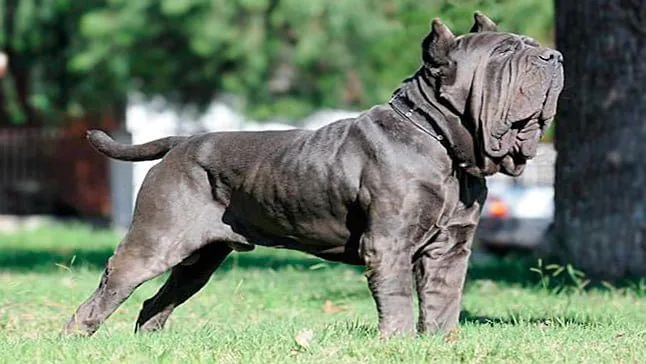
The Neapolitan Mastiff is a huge dog, standing 50 to 70 cm at the withers, with a weight that can easily exceed 70 kg. Females are somewhat smaller.
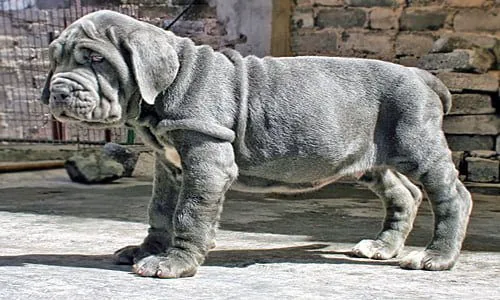
Its body is muscular and sturdy, with abundant loose skin. Its head has numerous wrinkles and folds. Below it hangs a large dewlap.
Its face is defined by expressive, piercing eyes and triangular ears held close to the cheeks. The Neapolitan Mastiff's average lifespan runs around 10-12 years.
What Is Its Coat Like and What Care Does It Need?
The Neapolitan Mastiff's coat is short, rough, and coarse. The most common colors are black, gray, brown, and reddish, and it may also appear with a brindle pattern.
Many dogs have white patches on the chest and legs. Nose color always matches the coat.
The Mastiff sheds during spring and fall. That's when extra care needs to go into daily brushing with a bristle brush or a grooming glove, to keep the coat clean and free of loose hair.
Training and Education
As is typical for large dog breeds, the Neapolitan Mastiff takes quite a while to mature and shows behaviors typical of a puppy or young dog during its first years of life.
This naturally presents certain challenges for training, though they're not insurmountable.
Training should be based on positive reinforcement, never resorting to physical punishment, however mild. Thanks to its obedient nature, short 5-10 minute sessions and intelligence games tend to give very good results with this breed.
Socialization
Besides training, it's important to socialize our Neapolitan Mastiff from puppyhood, getting it used to the presence of other people and animals to prevent it from developing destructive or aggressive behavior later on.
Until the Mastiff has fully matured, it's advisable to keep it from playing with children, whom it could unintentionally hurt given its large size and strength.
What Is the Health of a Neapolitan Mastiff Like?
Generally speaking, this is a sturdy breed with few health problems, though given its size we should be cautious and always keep a close eye on its joints to prevent dysplasia.
Keeping vaccinations up to date (starting from puppyhood) and providing good nutrition is usually enough to keep it healthy and growing properly. Given its size and growth rate, extra joint supplements never hurt.
Recommended Care
The best environment for a Neapolitan Mastiff is a house with a well-fenced yard or garden, though it's not a dog prone to escaping: as a good watchdog, its main mission is protecting its territory.
It doesn't handle heat well, so in summer it needs a cool place to rest and plenty of water.
It's not the best dog to join you for a run or a bike ride. The Mastiff is a bit lazy and prefers staying calmly at home. That said, for its physical condition and balance, it's necessary to make it go on one or two walks a day, not too long. Although it's slow to get going, once it warms up, the Neapolitan Mastiff really enjoys outdoor exercise.
It's also important to thoroughly clean the folds on its face after every meal, since food residue trapped in them can become a breeding ground for infections and fungus.
IMPORTANT: This article is for informational purposes only and does not constitute veterinary, nutritional or behavioural advice. Every dog is different, and only your trusted vet can advise you on its specific needs.